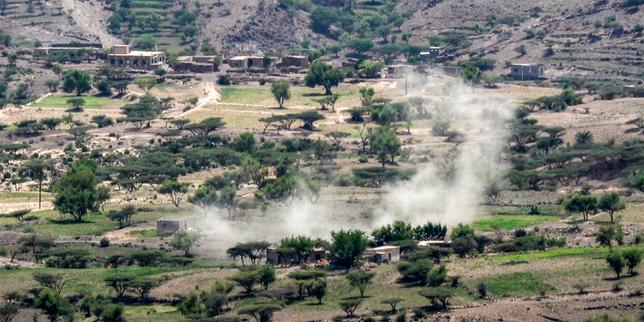
Military offensives launched against heavily fortified urban centers fail when they rely on political signaling rather than logistical endurance and supply chain integrity. The announcement by Yemeni government forces, backed by the coalition led by Saudi Arabia, regarding a renewed push toward the capital of Sanaa under Houthi control, represents a strategic pivot. To understand the viability of this operation, one must deconstruct the theater of operations through three structural lenses: supply line vulnerability, urban defensive depth, and the economic cost function of asymmetric attrition.
The Logistical Bottleneck of the Central Highlands
Any military advance from the eastern and southern approaches toward Sanaa requires traversing extreme topological barriers. The ascent from the coastal plains and desert plateaus into the central highland massif creates severe choke points along primary arterial highways.
Operationally, an advancing force faces a severe gradient in supply line security.
- Distance from forward operating bases to the contact line stretches logistical tails.
- Mountainous terrain limits vehicular movement to narrow mountain passes, which are easily interdicted by small, mobile insurgent cells.
- Fuel consumption rates spike exponentially when armored columns operate at high altitudes and on steep inclines.
When state-aligned forces attempt to project power into territory held by entrenched non-state actors, the defender operates on interior lines. The Houthis maintain localized supply caches distributed throughout the rugged topography of the central mountains, reducing their exposure to long-range interdiction. Conversely, the coalition-backed forces must secure hundreds of kilometers of supply lines against asymmetric disruption, sabotage, and ambush. Without absolute air supremacy and localized ground security along every kilometer of the rear guard, any major offensive risks overextension.
Urban Defensive Depth and Asymmetric Attrition
Sanaa is not merely a political capital; it is a mature, fortified defensive urban ecosystem. Insurgent forces have spent years embedding command-and-control nodes within dense civilian infrastructure, establishing underground communication networks, and pre-positioning defensive obstacles across all major entry vectors.
Urban combat alters the standard calculus of force ratios. Traditional military doctrine suggests a minimum 3:1 attacking-to-defending force ratio for successful urban operations, which increases significantly when the defender has prepared fortifications. In the case of Sanaa, the defending network utilizes several structural advantages:
- Decentralized Command: Operational leadership is not reliant on single, fixed administrative buildings that can be neutralized via precision strikes. Authority is compartmentalized among cellular units.
- Vertical Integration: High ground surrounding the capital provides
Strategic Analysis of the Yemeni Government Offensive on Sanaa and Houthi Control Dynamics
news
The operational announcement by Yemeni government forces, backed by Saudi coalition support, to launch a military offensive aimed at reclaiming the capital city of Sanaa from Houthi control represents a critical inflection point in the protracted civil conflict. Understanding the mechanics of this escalation requires examining the operational variables, structural constraints, and cost functions governing both the state-aligned coalition and the Ansar Allah movement.
The Operational Anatomy of the Sanaa Offensive
Military campaigns targeting heavily urbanized, entrenched administrative centers face severe geometric and logistical friction. Sanaa is not merely a geographic objective; it functions as the central node of Houthi political legitimacy, economic extraction, and military command.
The state-aligned forces operate under a distinct operational architecture characterized by external coalition dependency and internal fragmentation. Ground advances depend heavily on air superiority and financial backing provided by external partners, primarily Saudi Arabia. However, coalition air power alone cannot alter urban defense networks built over a decade of asymmetric warfare.
[Coalition Air Support] ---> [Ground Force Advance] ---> [Urban Defense Attrition]
                                                                  |
                                                          (Logistical Friction)
The Houthi defensive posture relies on interior lines of communication, deep subterranean fortifications within the mountainous periphery of the capital basin, and mobilized personnel pools secured through ideological and tribal coercion. The cost function for the Houthi movement heavily favors defense over mechanized offense; holding urban terrain requires a fraction of the logistical expenditure needed to sustain a multi-front conventional advance.
Economic and Administrative Leverage Points
Control over Sanaa dictates the fiscal viability of any governing body in Yemen. The central bank infrastructure, telecommunications nodes, and major tax collection apparatuses remain concentrated within the capital.
- Fiscal Extraction: The de facto authorities in Sanaa maintain revenue streams through customs duties imposed at major transit corridors, corporate taxation, and state asset management.
- Supply Chain Vulnerability: Countering these revenue models requires strategic interdiction of import channels via Red Sea ports and land routes, a variable heavily influenced by broader regional naval security dynamics.
- Administrative Fragmentation: Dual governance structures—one centered in Aden and recognized internationally, the other in Sanaa—create parallel economic systems that complicate long-term stabilization, regardless of military outcomes.
Regional Alignment and Asymmetric Escalation Vectors
The conflict cannot be isolated to domestic actors. The Houthi alliance with external regional networks provides asymmetric deterrent capabilities that alter traditional military calculations.
When government forces signal an advance on the capital, the defending faction typically responds not only through localized counter-attacks but through regional power projection. This includes the deployment of long-range loitering munitions and ballistic systems designed to raise the economic and political costs for coalition members backing the offensive. Consequently, military planners in Riyadh and Aden must weigh the tactical utility of capturing ground in Sanaa against the strategic vulnerability of critical infrastructure to retaliatory strikes.
Strategic Outlook and Force Deployment Realities
A successful transition of control in Sanaa demands a synchronized multi-domain campaign that integrates cyber warfare, financial strangulation, and targeted tribal defection alongside conventional infantry maneuvers. Purely kinetic approaches historically yield protracted stalemates when applied to entrenched insurgent-governed urban environments.
The trajectory of the announced offensive will be determined less by initial breakthrough velocity and more by the endurance of supply chains, the cohesion of disparate anti-Houthi militias on the southern and eastern axes, and the willingness of regional patrons to underwrite an extended urban campaign. Sustainable political resolution remains contingent upon dismantling the economic monopolies sustained by the de facto authorities rather than transient territorial gains along the perimeter.


