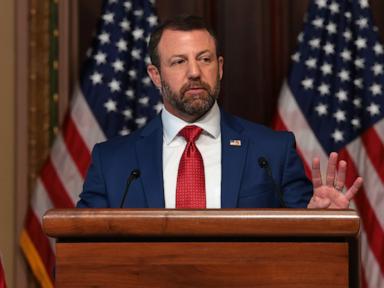
Political coalitions rarely fracture over their ultimate objectives; they fracture over the calibration of execution mechanisms. When Department of Homeland Security Secretary Markwayne Mullin addressed the National Governors Association regarding the intersection of workforce demands and statutory immigration controls, the resulting friction within the conservative base exposed a recurring structural tension. This tension exists between ideological purity in political rhetoric and operational pragmatism in executive governance. Deconstructing this event requires mapping the competing incentives, institutional constraints, and economic variables that define modern border management.
The Mechanics of the Conservative Coalition Fracture
The backlash against executive immigration statements originates from a divergence in how factions define state success. Hardline factions evaluate policy through an absolute binary: total exclusion versus systemic failure. Executive administrators, conversely, operate within a complex administrative apparatus constrained by federal statute, labor market metrics, and logistical bottlenecks.
When an official acknowledges that specific economic sectors experience genuine labor shortages that domestic pools cannot immediately absorb, ideological purists interpret this acknowledgment as a retreat from zero-tolerance enforcement. Yet, institutional strategy requires separating enforcement mechanics from labor supply equations. The friction occurs because the political base treats immigration as a singular moral crusade, while the Department of Homeland Security treats it as a multivariate operational matrix encompassing border interdiction, visa administration, and interior enforcement.
The Cost Function of Visa Reform and Labor Constraints
Analyzing the debate over employment-based visas reveals a fundamental economic trade-off. Modern industrial capacity relies on predictable labor inputs across multiple skill tiers. When policymakers look at employment visa programs, they encounter two conflicting models:
- The Short-Term Band-Aid Model: Extending temporary work authorizations or expanding numerical caps without structural adjustment. This approach creates administrative backlogs and fails to integrate labor supply with long-term macroeconomic demand.
- The Permanent Integration Model: Aligning industrial sectors, labor unions, and federal oversight to build structured pipelines. This model reduces underground hiring economies but requires political compromises that hardliners reject.
Secretary Mullin noted that relying purely on temporary visa extensions acts as a temporary patch rather than a structural fix. However, introducing industry groups and labor unions into the legislative or regulatory adjustment process triggers immediate distrust from anti-immigration coalitions who view institutional labor as fundamentally misaligned with national sovereignty goals.
Enforcement Realities Versus Rhetorical Expectations
The operational scope of the Department of Homeland Security involves managing over 260,000 employees across twenty-two distinct components, ranging from Customs and Border Protection to Immigration and Customs Enforcement. Managing this machinery involves continuous resource allocation decisions that rarely align with absolute political expectations.
- Prioritization Constraints: Federal agencies possess finite detention bed space and personnel hours. Consequently, leadership must prioritize targets, focusing operational capacity on individuals with criminal records or active security threats before managing broad interior enforcement.
- Jurisdictional Friction: Non-cooperative municipal policies, commonly designated as sanctuary jurisdictions, create operational lag. When local law enforcement declines to honor administrative detainers, federal agents must deploy supplementary resources, increasing operational costs and slowing removal timelines.
- Judicial Backlogs: Adjudicating asylum claims involves statutory due process protections that cannot be bypassed by executive fiat alone. The volume of pending claims creates an administrative bottleneck where individuals remain in the interior while awaiting judicial review.
Critics often mistake these systemic operational constraints for a lack of political will. When administrative adjustments occur—such as temporary shifts in vehicle stop protocols or localized enforcement pacing—observers outside the executive branch interpret tactical readjustments as strategic capitulation.
The Information Asymmetry in Immigration Discourse
Public debates regarding immigration policy suffer from a persistent information asymmetry between macro-level administrative data and micro-level political messaging. While political discourse often frames immigration exclusively as a binary choice between open borders and mass deportation, actual governance requires managing millions of legal entries, naturalization ceremonies numbering in the hundreds of thousands annually, and complex visa category tracking.
Acknowledging that the legal immigration apparatus processes nearly a million naturalizations a year does not negate the administrative burden of unauthorized entries. Instead, it highlights the dual-track nature of the federal agency, which is statutorily mandated both to facilitate legal pathways and to deter unlawful presence. When leadership attempts to articulate this dual mandate, simplified media amplification strips away the nuances of institutional responsibility, converting structural trade-offs into personal political liabilities.
Strategic Execution and Operational Forecast
The friction experienced by the Department of Homeland Security under current administrative goals points toward a permanent structural reality: executive agencies executing restrictionist agendas will continuously face internal coalition pressure whenever they touch economic variables tied to labor.
To stabilize enforcement without alienating institutional base support, leadership must decouple interior enforcement metrics from broader economic policy debates. The strategic play for the executive branch is to maintain unyielding operational transparency on border interdiction and deportations while formally delegating economic labor allocation metrics to legislative bodies, thereby insulating executive enforcement from the volatile crosscurrents of industrial labor demands.
The DHS and DOT Announcement on Highway Safety Enforcement
This video provides a direct look at how the administration frames its operational priorities and inter-agency coordination regarding enforcement actions.