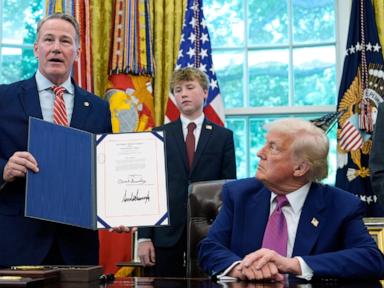
Electoral outcomes in high-turnout rustbelt states are governed by macroeconomic shock propagation, structural incumbent recognition assets, and the efficiency of nationalized surrogate mobilization. The 2026 Ohio U.S. Senate special election between Democratic victor Sherrod Brown and Republican incumbent Jon Husted provides a clear case study in how exogenous economic vectors can override standard partisan alignment baselines. Analyzing the mechanics of Husted's high-profile rally circuit alongside Brown's localized labor strategy reveals the quantitative limits of executive endorsements when primary economic indicators deteriorate.
The Macroeconomic Shock Matrix
Electoral behavior in industrialized swing states relies heavily on cost-of-living performance metrics. Prior to the peak of the campaign cycle, multiple external variables shifted consumer price structures sharply upward. The implementation of broad tariffs, trade disruptions with northern trade partners, and geopolitical conflict in the Middle East created a simultaneous shock to domestic manufacturing input costs and retail energy prices. For a different perspective, see: this related article.
When fuel prices soar and industrial supply chains face artificial friction, the local voting populace experiences direct utility loss. For an incumbent party or a candidate tied directly to the administrative apparatus via high-profile surrogate rallies, this environment introduces an asymmetric penalty. Voters experiencing margin compression look past partisan identity to register economic discontent. Husted, running as the aligned choice backed by presidential muscle, could not decouple his campaign from these macro-level headwinds.
The Incumbency and Recognition Asymmetry
Campaign resource allocation relies on baseline brand equity. Candidates lacking deep, multi-decade statewide profiles must expend capital resources purely on introduction and biographical definition. Related coverage on the subject has been shared by BBC News.
Brown entered the race with near-universal name recognition derived from decades of continuous service in federal and state office. This equity generated a structural budget advantage. While Husted was forced to fund and air intensive positive biographical advertising campaigns to solidify his public definition, Brown deployed his capital directly toward counter-cyclical messaging and localized economic defense.
[Husted Campaign Strategy]
Capital Outlay ---> Biographical Introduction ---> Defensive Positioning

[Brown Campaign Strategy]
Capital Outlay ---> Direct Economic Messaging ---> Labor/Working-Class Mobilization
This structural difference in resource expenditure efficiency created a baseline deficit that surrogate appearances could only partially offset. Rallies featuring national figures generate high-density media coverage and mobilize core partisan zealots, but they function primarily as tactical turn-out events rather than strategic persuasion mechanisms for undecided suburban or independent cohorts.
Geographic Pivot Points and Suburban Fragmentation
Ohio’s electoral map splits along distinct metropolitan and rural economic corridors. The mechanics of the 2026 contest turned on the fracturing of traditional suburban voting blocs and the behavioral shifts of unaffiliated moderates.
Historically, Republican mobilization strategies rely on high margins in collar counties around Cincinnati and Columbus, counterbalanced by rural turnout. However, the external economic shocks altered the calculus for independent voters in these exact suburbs. Polling indicators leading up to the final weeks showed a statistical dead heat, driven by high volatility among unaffiliated blocks who historically tilt toward economic pragmatism over ideological signaling.
When trade wars introduce uncertainty into local manufacturing, export-dependent logistics, and agricultural supply chains, suburban centers experience political drift. Brown capitalized on this drift by framing his platform around anti-tariff worker protection and supply chain stabilization. Husted's counter-strategy relied on tying local economic grievances to broader national conservative themes, but abstract ideological narratives struggle to compete with concrete household utility costs.
Strategic Forecast and Forward Execution
Future cycles in high-variance industrial states will hinge on the velocity of macroeconomic transmission. When external policy shocks directly impact fuel and input pricing within 12 to 24 months of an election cycle, state-level candidates aligned with the governing federal apparatus face an uphill structural battle.
To insulate against similar vulnerabilities, campaigns in manufacturing-heavy corridors must decouple their local identity from national economic friction points early in the cycle. Relying on surrogate star power to reverse macro-level cost pressures represents a high-cost, low-yield allocation of political capital. Future contenders must build localized economic firewalls before external shocks materialize, or face the exact margin erosion that defined the outcome of Ohio's 2026 senate contest.


