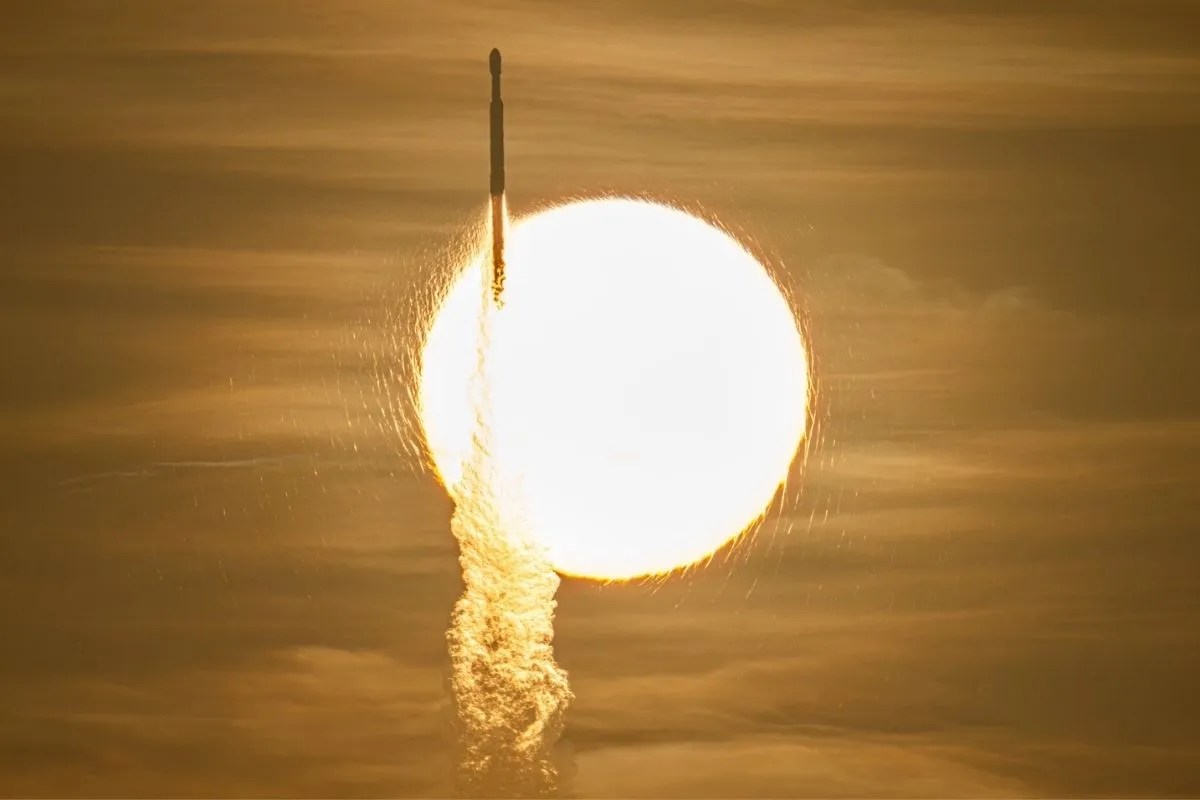
Astrophysical observation faces a structural bottleneck between angular resolution and survey speed. Traditional flagships optimize for deep-field photon collection over narrow coordinate boundaries, leaving wide-field kinematic mapping severely under-resourced. The Nancy Grace Roman Space Telescope resolves this mechanical trade-off through a primary optic matching the spatial diameter of the Hubble Space Telescope paired with a Wide Field Instrument yielding a spatial domain capture rate roughly one hundred times greater per exposure. Deployed via a SpaceX Falcon Heavy configuration from Launch Complex 39A at the Kennedy Space Center, the observatory has initiated its three-month trajectory toward the second Sun-Earth Lagrange point, establishing an operational baseline designed to quantify accelerated cosmic expansion and invisible mass distribution through statistical mechanics rather than isolated point-source imaging.
The architecture of the mission relies on three primary variables: field-of-magnitude expansion, near-infrared spectral filtering, and telemetry volume generation. While previous generations of orbital observatories prioritized narrow-angle photon counts to resolve high-redshift anomalies, Roman utilizes a 300-megapixel infrared camera array designed to map hundreds of millions of individual galaxies over its operational lifecycle. This shift from targeted microscopy to macro-surveillance alters the economic function of astrophysical data acquisition. Instead of spending weeks slewing between isolated targets, the hardware executes sweeping sky scans that capture transient cosmic events, gravitational microlensing anomalies, and large-scale structural filaments concurrently. You might also find this related coverage useful: Mapping Vulnerability Digital Sovereignty and the Architecture of Third Party Geopolitics.
The operational trajectory targets the second Lagrange point, situated approximately 1.5 million kilometers from Earth. This orbital placement minimizes thermal fluctuations and gravitational drag while providing an unobstructed vector toward deep space. The transfer phase requires approximately ninety days of mechanical commissioning, during which the ground control team at the Goddard Space Flight Center must execute sequential calibration routines. These protocols involve thermal stabilization of the focal plane assembly, deployment of the primary sunshade, and handoffs from near-Earth tracking networks to the Deep Space Network nodes stationed across Australia, Spain, and California.
Dark energy quantification serves as the primary operational directive for the observatory. Traditional methodologies measure luminosity distance via standard candles such as Type Ia supernovae, which introduces calibration variance across varying redshifts. Roman bypasses this limitation by deploying dual independent tracking mechanisms: baryonic acoustic oscillations and weak gravitational lensing. Baryonic acoustic oscillations utilize the periodic clustering of galaxies as a standard ruler frozen in the early universe, allowing researchers to measure expansion histories without relying exclusively on variable stellar candles. Simultaneously, weak gravitational lensing maps the minute distortion of background galaxy shapes induced by intervening mass concentrations. This provides an empirical vector for charting invisible mass distribution across cosmic time, bypassing the direct emission constraints that blind optical instruments to non-luminous phenomena. As highlighted in recent reports by Wired, the results are widespread.
The data architecture required to process the observatory output represents a fundamental shift in astrophysical computing systems. The Wide Field Instrument generates roughly 1.4 terabytes of raw telemetry daily, eclipsing the throughput of any prior NASA astrophysics payload. Managing this volume requires an automated processing pipeline that integrates automated classification algorithms and distributed computing clusters. Ground infrastructure cannot rely on manual curation by research teams; instead, telemetry is ingested, calibrated, and indexed via automated routines designed to flag transient anomalies for immediate secondary observation by complementary platforms like the James Webb Space Telescope.
Planetary system discovery functions as an secondary operational vector that leverages the same wide-field mechanics. By monitoring dense star fields toward the galactic bulge for micro-lensing signatures—instances where a foreground star bends the light of a background source to reveal an orbiting planet—the mission scales exoplanet detection into statistical distributions. Rather than detecting massive planets via radial velocity shifts in nearby star systems, the observatory can identify rocky worlds, free-floating planets, and distant gas giants located thousands of light-years away, mapping the demographic distribution of planetary systems across the galactic plane.
Operational risk during the initial deployment phase concentrates on thermal dissipation and mechanical alignment precision. The focal plane array utilizes hexapod actuators capable of real-time microscopic adjustments based on ground-station telemetry feedback, mitigating the long-term structural degradation caused by solar radiation pressure and thermal expansion cycles. Failure to maintain optical tolerance across the 2.4-meter primary mirror assembly would degrade the wide-field multiplex advantage, transforming high-throughput surveys into blurred spatial aggregations.
Future observational cycles depend entirely on the successful completion of the current three-month transit and checkout window. Ground control must verify telemetry integrity, align the secondary mirror optics, and initiate baseline data streams prior to the release of initial calibration imagery scheduled for early next year. Mission controllers must maintain precise station-keeping burns at the Lagrange threshold to ensure structural longevity across the baseline five-year operational mandate, maximizing the temporal yield of wide-field infrared surveys before propellant reserves dictate orbital decay protocols.