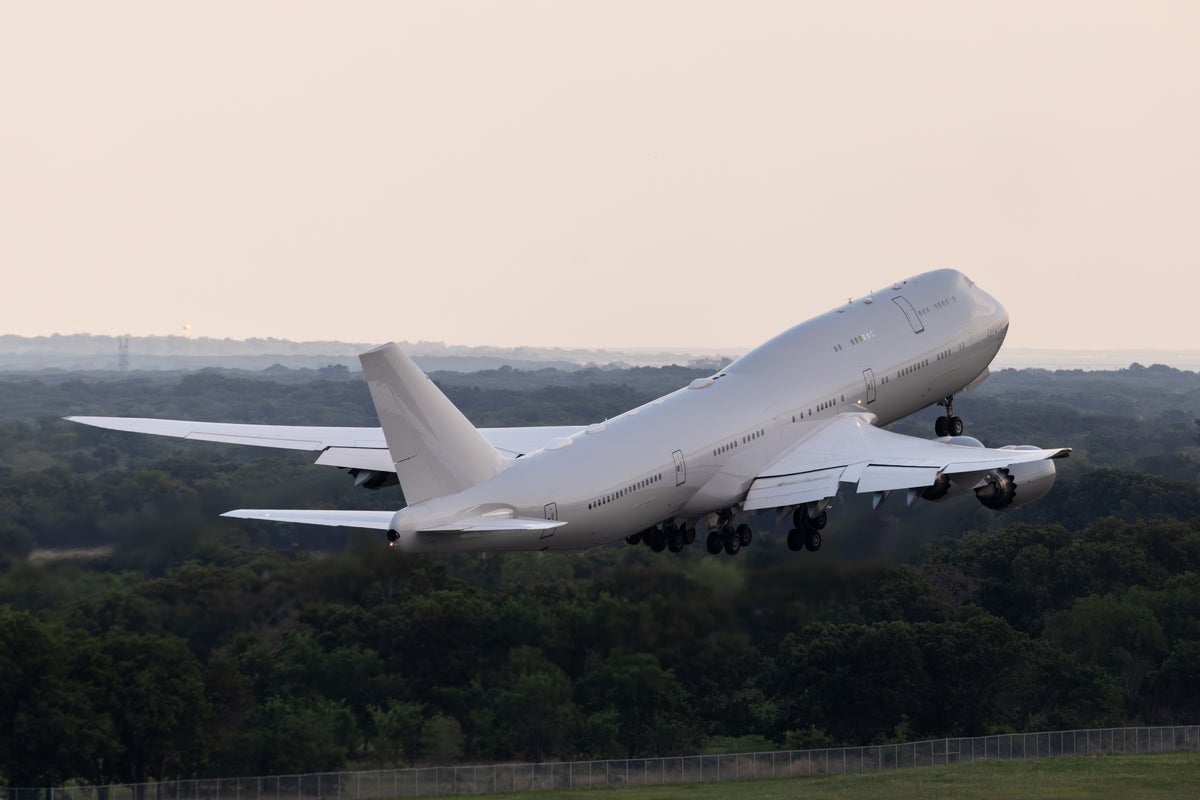
The arrival of the modified Boeing 747-8i aircraft this summer represents more than a logistical upgrade; it is the culmination of a decade-long procurement cycle defined by fixed-price risk, diplomatic asset transfers, and the physical convergence of executive power with advanced defense systems. While public discourse focuses on the $400 million overhaul figure or the aesthetic shifts in the livery, the true strategic value lies in the platform’s survivability under Electromagnetic Pulse (EMP) conditions and its role as a secure mobile node in the National Command Authority (NCA) hierarchy.
The Acquisition Logic of the "Gifted" Platform
The narrative that the Qatari government "gifted" these aircraft requires a precise economic deconstruction. In 2018, the Qatar Amiri Flight transferred two Boeing 747-8i airframes to the United States. In the context of sovereign defense relations, such transfers are rarely philanthropic. They function as a form of non-cash geopolitical collateral, reinforcing the strategic partnership between the U.S. and Qatar, specifically regarding the Al Udeid Air Base.
From a procurement standpoint, acquiring these "low-hour" airframes allowed the U.S. Air Force to bypass the standard manufacturing queue, though it introduced significant engineering friction. Converting a luxury commercial interior into a hardened military asset is often more complex than building from a "green" airframe. The Air Force had to strip the Qatari VIP configuration down to the structural ribs to integrate the Mission Communication System (MCS) and the internal power generation required to run a flying Pentagon.
The Three Pillars of the VC-25B Overhaul
The $400 million expenditure frequently cited is a subset of a much larger $3.9 billion to $5.3 billion program (depending on accounting for R&D vs. per-unit cost). The overhaul focuses on three critical domains that distinguish the presidential aircraft from any commercial or standard military transport.
1. Survivability and Hardening
Standard aircraft electronics are vulnerable to the high-altitude electromagnetic pulse generated by a nuclear detonation. The VC-25B overhaul replaces miles of standard wiring with shielded, radiation-hardened cables. The skin of the aircraft is reinforced to act as a Faraday cage, ensuring that the flight control systems and mission computers remain operational during a "day of" scenario.
2. Autonomous Ground Logistics
The presidential aircraft must operate independently of local airport infrastructure, which may be compromised or nonexistent during a crisis. This necessitates the installation of internal retractable airstairs and specialized baggage loading systems. These additions increase the aircraft's take-off weight and alter its center of gravity, requiring a complete recalibration of the flight control software—a primary driver of the project's timeline extensions.
3. The Mission Communication System (MCS)
The VC-25B acts as the "Silver Dollar" node in the U.S. military’s global communications net. The overhaul integrates:
- Multi-band satellite communications (SATCOM) for secure voice and data.
- Advanced crypto-logic hardware for EHF (Extremely High Frequency) transmissions.
- Direct links to the Pentagon’s National Military Command Center.
The Cost Function of Fixed-Price Contracting
The financial friction associated with this arrival stems from the 2018 fixed-price contract between Boeing and the U.S. Government. Under a fixed-price agreement, the contractor assumes all risks for cost overruns. Boeing has reportedly lost over $2 billion on the VC-25B program due to several cascading bottlenecks:
- Labor Scarcity in High-Clearance Sectors: Each technician working on the aircraft requires high-level security clearances. The pool of available labor is finite, and any turnover creates months of delays during the vetting process.
- Supply Chain Rigidity: Aerospace parts for the 747-8i are specialized; military-grade versions of those parts are rarer. When a design change is mandated by the Air Force, the "ripple effect" in procurement costs is absorbed entirely by the manufacturer.
- Design Maturity Errors: Integrating a complex medical suite (including a functional operating room) and defensive countermeasures into an existing airframe led to unforeseen wiring interference issues.
Operational Limitations and Geographic Reach
The transition from the aging VC-25A (based on the 747-200) to the VC-25B (747-8i) introduces significant performance upgrades. The 747-8i has a larger wingspan ($68.4$ meters vs $59.6$ meters) and utilizes GEnx-2B67 engines, which offer a 16% improvement in fuel efficiency.
This efficiency translates directly into "unrefueled range." While the VC-25A is capable of aerial refueling—a feature retained in the VC-25B—the increased efficiency of the new airframes allows for a wider variety of mission profiles without the need for a tanker rendezvous. This reduces the mission's "footprint" and lessens the burden on Air Mobility Command.
The physical size of the new aircraft creates a different constraint: airport compatibility. The 747-8i is a Group VI aircraft. Many smaller international airports that could accommodate the older VC-25A cannot support the wingspan or the weight of the VC-25B. This necessitates a strategic shift in presidential travel planning, forcing a greater reliance on motorcades from larger regional hubs or the use of smaller "C-32" (Boeing 757) aircraft for secondary locations.
The Livery and Political Symbolism
While often dismissed as a cosmetic detail, the aircraft's exterior paint scheme is a matter of strategic branding. The transition from the classic Raymond Loewy "Baby Blue" to the proposed darker, patriotic palette—or the reversion to the traditional look—impacts the aircraft's infrared signature. Darker colors absorb more heat, which can affect the cooling requirements of the onboard electronics suites.
Furthermore, the "Air Force One" callsign only applies when the President is on board. The aircraft themselves are the property of the 89th Airlift Wing at Joint Base Andrews. Their arrival this summer signals the beginning of an "Operational Test and Evaluation" (OT&E) phase, where the aircraft will be flown under simulated combat and crisis conditions before they are officially certified for presidential transport.
Decoupling Fact from Narrative in the Summer Arrival
The summer arrival is not a "turn-key" delivery. It marks the delivery of the physical asset to the Air Force for final acceptance testing. The $400 million mentioned in various reports is often a mischaracterization of the annual budget allocation for the modification phase, rather than the total cost of the aircraft.
Strategic planners must account for the following variables during the integration phase:
- Pilot Training Transition: Moving from an analog-heavy cockpit in the 747-200 to the "glass" cockpit of the 747-8 requires a complete overhaul of pilot training protocols.
- Maintenance Infrastructure: The 747-8i is no longer in commercial production. Ensuring a 30-year lifecycle for these two aircraft requires the Air Force to secure a massive inventory of long-lead spare parts now, before the global supply chain for this airframe type further contracts.
- Defensive Suite Calibration: The aircraft’s laser-based infrared countermeasures must be tested against a variety of simulated threats to ensure the sensor-to-jammer latency is within survivable limits.
The true value of this transition is the reset of the "structural clock." The current VC-25A fleet is over 30 years old, with maintenance costs per flight hour increasing exponentially. The VC-25B arrival provides a modern, more efficient, and more survivable platform that secures the continuity of government for the next four decades.
The move to the VC-25B is a necessary hardening of the executive branch's most mobile asset. The focus must remain on the platform's ability to maintain a secure "Line of Sight" to global nuclear forces during a blackout, rather than the political optics of its procurement.
The immediate tactical priority is the synchronization of the OT&E phase with the upcoming election cycle. The Air Force must ensure that the transition between the old and new platforms occurs without a "readiness gap." This requires maintaining the VC-25A fleet in peak condition while simultaneously training crews on the VC-25B. The bottleneck is not the aircraft itself, but the human capital required to operate two entirely different generations of the same platform simultaneously.