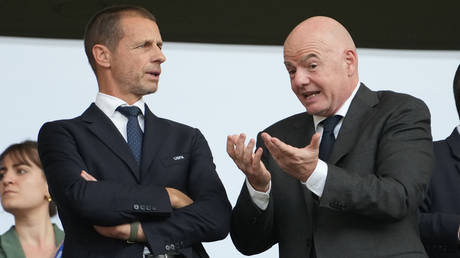
Modern European football operates on a dual-track economic architecture that separates revenue accumulation from competitive access. The structural tension between elite clubs and continental governing bodies is not an ideological dispute over fairness, but a mechanical conflict over market control, capital distribution, and risk mitigation. When elite stakeholders attempt to capture the upside of transnational competition while shifting downside risk onto domestic ecosystems, governance bodies respond by fortifying their regulatory moats. Understanding this dynamic requires moving past rhetorical framing and examining the balance sheets, incentive structures, and operational bottlenecks that dictate how capital flows through the sport.
The Revenue Concentration Engine
At the center of European club competition economics lies a compounding feedback loop: domestic league performance yields access to continental tournaments, which generate outsized broadcasting and commercial payouts, which in turn fund the talent acquisition required to maintain domestic and continental dominance.
The Three Tiers of Capital Inflow
- Broadcast Rights Distribution: Continental broadcasting contracts dwarf domestic rights in marginal value per match, creating a high-yield tier of revenue available exclusively to a closed circle of participants.
- Commercial Valuation Multipliers: Participation in elite transnational fixtures acts as a signaling mechanism for global brands, inflating sponsorship values for participating clubs far beyond their regional market size.
- Player Asset Amortization: Access to elite revenue streams allows clubs to absorb high player acquisition costs under regulatory frameworks, maintaining a liquidity advantage that smaller competitors cannot replicate through organic commercial growth.
This architecture creates a steep revenue gradient. Clubs operating outside the primary continental ecosystem face a capital deficit that compounds annually. Because fixed costs—such as stadium operations, academy infrastructure, and baseline payroll—remain high regardless of tournament qualification, missing out on continental revenue forces clubs into defensive financial postures. They must either sell core assets or increase financial leverage, both of which degrade long-term competitive viability.
The Regulatory Defense Mechanism
Governing bodies derive their authority from regulatory capture over the competition calendar and licensing frameworks. By controlling the official sanctioning of matches, these organizations act as central planners in a market where demand for transnational fixtures far exceeds supply.
Regulatory Instruments of Control
- Calendar Harmonization: Controlling international match windows prevents alternative tournament formats from securing viable broadcast slots without incurring regulatory sanctions for participating players and clubs.
- Licensing Compliance: Financial sustainability regulations tie participation rights directly to balance sheet metrics, which inherently favor legacy institutions with established revenue baselines over emerging capital-backed entities.
- Sanction Enforcement: The threat of exclusion from domestic leagues provides governing bodies with the leverage necessary to enforce compliance across disparate member associations.
The friction between elite clubs and governing bodies intensifies when the distribution mechanisms of these revenues are contested. Elite stakeholders argue that their brand equity drives the vast majority of broadcast value, and therefore they should capture a proportionally larger share of the surplus. Governing bodies counter that their role is redistributive, using elite-generated surpluses to fund grassroots development, solidarity payments, and lower-tier competitions that sustain the broader football pyramid.
The Cost Function of Elite Squad Management
To understand why clubs push relentlessly for revenue expansion, one must analyze the cost structure of elite sporting operations. Unlike traditional corporate entities where labor costs scale predictably with revenue, football club expenditures exhibit extreme stickiness on the downward side.
Player contracts are multi-year fixed liabilities. If a club fails to qualify for elite continental competition, revenues drop by thirty to fifty percent overnight, while player wages and amortization schedules remain locked. This structural mismatch produces systemic vulnerability. To mitigate this risk, elite operators pursue structural guarantees—permanent qualification slots or closed-league models—that eliminate variance and insulate capital investments from the volatility of single-elimination sporting outcomes.
Conversely, governing bodies face political pressure from domestic leagues that rely on sporting uncertainty to maintain fan engagement. If the elite tier becomes insulated, domestic matches lose competitive narrative value, depressing domestic broadcast values downstream. The governing body's optimization problem is therefore balancing the appeasement of ultra-high-revenue clubs against the preservation of the wider ecosystem's commercial health.
Market Failure and Antitrust Dynamics
The ongoing legal and commercial battles over competition access stem from fundamental questions of market dominance. When a single entity acts as both the regulator of a sport and the commercial organizer of its most lucrative competition, a structural conflict of interest emerges.
Independent tournament organizers face high barriers to entry due to regulatory controls over stadium access, referee allocation, and player eligibility. When alternative formats are proposed, the incumbent regulator can adjust licensing rules to penalize participants. This dynamic suppresses entrepreneurial entry into the match-promotion market, keeping supply artificially constrained and prices high for end consumers.
However, deregulation carries its own systemic risks. An entirely open market driven purely by capital concentration would likely accelerate wealth polarization among clubs, reducing competitive balance within domestic leagues to the point where spectator interest declines. The challenge is designing a governance model that introduces market discipline without destroying the interconnected pyramid structure that generates the sport's talent pipeline.
Strategic Realignment
The resolution of this structural conflict will not be found in moral appeals to sporting tradition or regulatory protectionism. Capital flows where friction is lowest. If incumbent governing bodies fail to offer revenue-sharing models that satisfy elite stakeholder return-on-investment thresholds, alternative commercial structures will continue to emerge, backed by private equity and sovereign wealth funds seeking yield in sports infrastructure.
Future viability requires shifting from a zero-sum distributive fight to a market-expansion strategy that monetizes global digital audiences more efficiently while preserving enough domestic uncertainty to maintain engagement across all tiers of the pyramid. The governing body that successfully decouples elite revenue generation from domestic league calendar congestion while maintaining solidarity mechanisms will capture the next decade of football economics.