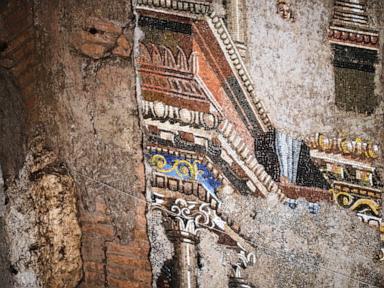
The opening of a subterranean archaeological asset after a thirty-year dormancy represents a complex exercise in resource allocation, structural stabilization, and public access management. When the monumental fresco and mosaic complex beneath Rome's historical fabric transitions from a closed conservation zone to a publicly accessible site, the operational mechanics reveal the friction between preservation physics and municipal tourism demand. Most media coverage reduces this event to a sensational milestone. A rigorous breakdown requires examining the actual variables governing site longevity: microclimate control, visitor-induced thermal load, atmospheric humidity fluctuation, and the opportunity cost of restricted spatial capacity.
The Conservation Cost Function
Every subsurface archaeological site operates within a fragile thermodynamic equilibrium. For three decades, the fresco and mosaic strata beneath the Roman site existed in a sealed environment where humidity, temperature, and microbial growth remained relatively constant. Introducing human foot traffic fundamentally alters this equation.
Each visitor acts as a mobile heat source and a humidity vector. The human body radiates thermal energy and releases moisture through respiration and perspiration. When thousands of visitors enter an enclosed subterranean chamber daily, the ambient temperature rises, and the dew point shifts. This dynamic threatens the physical integrity of ancient wall paintings. Pigments bound to wet plaster, known as buon fresco, are acutely sensitive to salt crystallization cycles. As warm, moisture-laden air interacts with cold ancient masonry, condensation forms on the painted surfaces. Water dissolves soluble salts within the brick and mortar. When the moisture evaporates, these salts recrystallize beneath or on top of the pigment layer, exerting internal pressure that shatters the paint matrix from within.
Managing this degradation vector requires strict engineering controls. The site operators cannot rely on natural ventilation. They must deploy mechanical climate control systems designed to maintain strict thermal bands and relative humidity thresholds. This introduces a permanent operational expenditure. The cost of admission or restricted ticketing models must account for continuous HVAC amortization, real-time sensor monitoring, and periodic chemical consolidation of the plaster layers.
Spatial Economics and Throughput Optimization
The physical dimensions of the newly opened Roman site dictate an unforgiving throughput limit. Unlike open-air monuments like the Colosseum or the Roman Forum, subterranean spaces feature fixed perimeters and restricted egress routes.
Asset monetization and heritage protection exist in direct opposition here. Maximizing daily ticket sales generates immediate revenue for municipal coffers and local hospitality ecosystems. However, exceeding a specific threshold of concurrent visitors spikes the internal carbon dioxide concentration. Elevated carbon dioxide levels accelerate the chemical degradation of calcareous mortars and create an acidic micro-environment when combined with ambient moisture.
To resolve this optimization problem, site administrators implement strict time-slot reservation systems. This approach enforces artificial scarcity, transforming the visit from an open-access public good into a rationed luxury asset. The economic trade-off is clear. Lower volume preserves the structural integrity of the mosaic tesserae and fresco pigments, extending the asset lifespan indefinitely. The opportunity cost is uncaptured visitor revenue and suppressed ancillary spending in surrounding commercial districts.
The Engineering of Subterranean Visibility
Displaying ancient art in dark, damp underground chambers demands sophisticated optical engineering. Traditional incandescent or high-heat lighting solutions are functionally obsolete in modern conservation practice. High-intensity lighting emits infrared radiation that bakes fragile pigments and ultraviolet radiation that breaks down organic binders.
The restoration teams deploy narrow-band light-emitting diode arrays calibrated to specific color rendering indexes. These systems minimize thermal emission while maximizing the visual distinction between individual mosaic tesserae. The placement of optical instruments must avoid casting harsh shadows across low-relief plaster work while preventing direct glare on polished marble accents.
Furthermore, visitor pathways must be engineered as floating, non-invasive structures. Bolting walkways directly into ancient foundations introduces vibration stress and accelerates structural fatigue. Modern installations utilize cantilevered steel frames anchored into modern concrete sub-floors, ensuring that human footfall energy dissipates into the ground without transferring kinetic shock waves to centuries-old walls.
Regulatory and Logistical Bottlenecks
Opening a site dormant for thirty years involves navigating a dense bureaucratic matrix. Municipal heritage authorities, national archaeological superintendencies, and civil protection agencies must align on emergency egress protocols, fire safety compliance, and structural load limits.
The primary bottleneck in urban archaeology is not discovery or restoration; it is liability management. Subterranean spaces in historic city centers often lack modern utility infrastructure. Installing emergency ventilation, fire suppression systems, and handicap-accessible lifts without damaging ancient archaeological layers requires surgical precision. Engineers must route conduits through modern basements or utility tunnels adjacent to the site, often incurring massive capital expenditures and extended timelines before the first ticket can be sold.
Capitalizing on Heritage Infrastructure
The financial viability of opening subterranean Roman assets depends on integrating the site into a broader urban mobility and tourism management framework. Treating the fresco and mosaic complex as an isolated attraction creates localized congestion bottlenecks and fails to capture the economic multiplier effect of cultural tourism.
Municipal stakeholders must deploy dynamic pricing models that shift demand away from peak travel seasons, utilizing digital ticketing platforms to smooth out visitor curves. Concurrently, conservation protocols must be codified into binding operational charters where public funding is directly tied to sensor-verified environmental metrics rather than arbitrary political timelines. The long-term preservation of these Roman masterpieces requires treating the site not as a static museum exhibit, but as a dynamic biological and mechanical system that demands continuous algorithmic oversight and disciplined capital reinvestment.