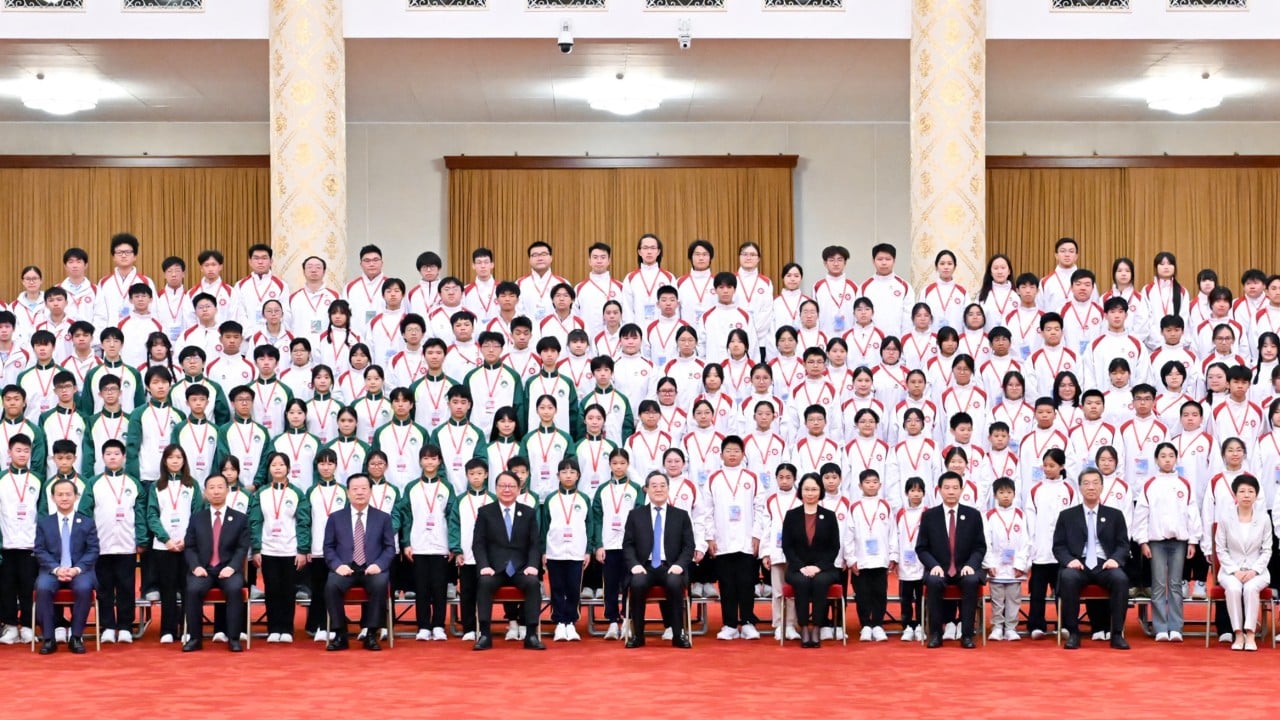
State-sponsored educational mobility initiatives operate as calculated instruments of political alignment, designed to alter cognitive frameworks and ideological positioning through controlled environmental exposure. When educational delegations from Hong Kong and Macau travel to Beijing, the operation functions less as a conventional student tour and more as a high-throughput vector for civic synchronization. The mechanics of these initiatives rely on a structured sequence of spatial immersion, institutional signaling, and elite institutional access intended to internalize macroeconomic and political narratives within target demographics. Deconstructing this mechanism requires moving past superficial descriptions of itinerary items to analyze the actual variables driving behavioral and perceptual adjustment.
Educational travel of this scale is governed by a tripartite structural framework: spatial dominance, normative validation, and structural co-optation. Spatial dominance is achieved by placing participants within high-significance national infrastructure nodes, such as major technological hubs, administrative complexes, and historical memorials. This layout forces a cognitive adjustment, replacing abstract notions of national scale with tangible, overwhelming empirical data regarding state capacity. Normative validation occurs through direct interaction with institutional leaders, academic peers, and elite administrators who embody the desired ideological standard. Structural co-optation is the final phase, where participants are integrated into formalized alumni networks and ongoing engagement loops that preserve the behavioral patterns established during the physical journey. For a different perspective, consider: this related article.
The operational economics of these student exchanges reveal clear trade-offs between short-term logistical expenditure and long-term ideological retention. The cost function of such programs is calculated per participant against the projected yield in sustained political compliance and reduced friction within autonomous regional administrations. When youth demographics from special administrative regions are exposed to centralized administrative planning units, the state absorbs the friction of cross-jurisdictional transit to eliminate the friction of ideological divergence. The efficiency of this exchange depends on the density of the itinerary; low-density cultural tours yield negligible shifts in geopolitical perception, whereas high-density institutional and technological immersions trigger measurable updates in participant alignment metrics.
Analyzing the transmission channels uncovers the primary failure modes of conventional public diplomacy campaigns. Traditional communication models rely on passive media consumption, which allows the receiver to maintain high levels of critical skepticism. In contrast, physical immersion within centralized state apparatuses forces active navigation of built environments that communicate authority and scale. A student walking through a national aerospace laboratory or a major logistics hub does not merely consume propaganda; they interact with the physical output of industrial policy. This environment neutralizes standard counter-arguments by substituting theoretical critique with empirical scale. Similar analysis regarding this has been published by BBC News.
The feedback loops established during these visits are carefully calibrated to prevent cognitive dissonance. When participants encounter contrasting realities between their home jurisdictions and the administrative center, the itinerary is structured to provide immediate, authoritative context from vetted guides and administrators. This preemptive reframing converts potential points of friction into reinforcement mechanisms. The operational architecture ensures that every variable—from accommodation placement to debriefing sessions—serves to consolidate a unified narrative of national trajectory.
Evaluating the efficacy of this civic engineering requires examining the longitudinal trajectory of the participants rather than immediate post-trip sentiment surveys, which are notoriously vulnerable to social desirability bias. Longitudinal tracking indicates that the persistence of ideological alignment decays unless reinforced by secondary professional or economic integration networks. Consequently, these educational trips are rarely isolated events; they function as the top of a funnel designed to identify, categorize, and channel cooperative talent into cross-border institutional pathways.
The optimization of cross-border ideological pushes will increasingly rely on data-driven personalization of itineraries, tailoring institutional touchpoints to the specific academic and professional specializations of incoming cohorts. As physical and digital integration deepens between autonomous regions and the administrative center, the distinction between educational tourism and strategic cadre development will continue to dissolve, rendering such initiatives standard components of regional governance and stability maintenance.