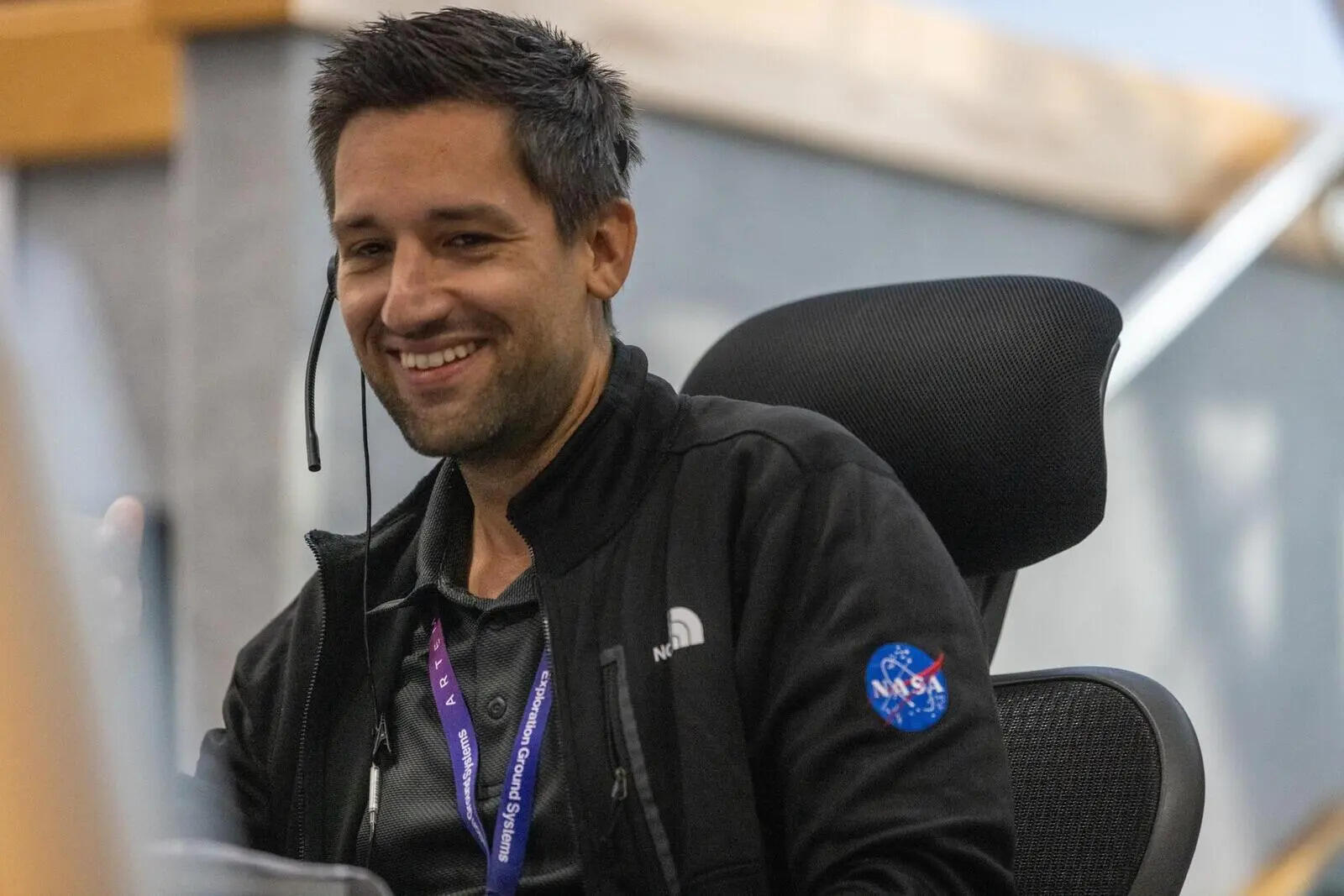
The success of the Artemis program depends not on political rhetoric, but on the mitigation of structural and thermal stressors during the critical phases of trans-lunar injection and atmospheric reentry. While public attention gravitates toward astronauts, the integrity of the mission is anchored by the engineering rigor applied to the Orion Multi-Purpose Crew Vehicle (MPCV) and the Space Launch System (SLS). Dan Florez, a lead structural engineer at NASA, represents the technical foundation upon which human spaceflight is built. His work focuses on the intersection of materials science and kinetic energy management, ensuring that the Orion spacecraft survives the transition from vacuum to high-velocity atmospheric friction.
The Mechanics of Kinetic Energy Dissipation
The Artemis II and III missions require the Orion capsule to enter the Earth's atmosphere at speeds approaching 25,000 miles per hour. This velocity generates temperatures exceeding 5,000 degrees Fahrenheit on the heat shield. The engineering challenge is categorized into three specific vectors: You might also find this connected article useful: How NextGen AI Leaders are Actually Saving Newsrooms.
- Thermal Protection System (TPS) Integrity: The ablative heat shield, composed of Avcoat, must erode at a predictable rate to carry heat away from the capsule. Structural engineers must calculate the exact thickness required to protect the underlying titanium structure without adding prohibitive mass to the spacecraft's launch weight.
- Structural Load Management: During reentry, the capsule experiences decelerations of up to 8g. The internal skeleton of the spacecraft must distribute these forces evenly to prevent localized failure points that could lead to cabin depressurization.
- Vibration and Acoustic Fatigue: The SLS launch sequence generates extreme acoustic energy. Engineers like Florez utilize finite element analysis (FEA) to simulate how these vibrations propagate through the spacecraft’s joints and sensors.
The Cost Function of Mass versus Safety
In aerospace engineering, mass is the primary constraint. Every kilogram of structural reinforcement added to the Orion capsule requires a non-linear increase in propellant for the SLS. This creates a "Mass-to-Orbit" bottleneck. Structural engineers operate within a narrow margin where they must maximize the factor of safety while minimizing the weight of the airframe.
The Artemis structural design utilizes a "Birdcage" architecture—a series of longitudinal stringers and circumferential frames. This design prioritizes load-path efficiency. By optimizing the geometry of these components, engineers reduce the reliance on heavy, solid-plate structures. The move toward friction-stir welding in the assembly of the Orion pressure vessel further reduces mass by eliminating the need for thousands of traditional rivets, which are prone to fatigue and add significant weight. As discussed in recent articles by ZDNet, the results are notable.
System Interdependency and Failure Modes
A failure in structural engineering is rarely a standalone event; it is the result of cascading system dependencies. Florez’s role involves managing the interface between the pressure vessel and the external thermal protection.
- The Coefficient of Thermal Expansion (CTE) Mismatch: The metal structure of the capsule expands and contracts differently than the ceramic-based heat shield. If the bonding layer between these materials fails, the heat shield can delaminate, exposing the primary structure to plasma.
- The Orion-to-Service-Module Connection: The structural bolts and separation mechanisms must withstand the high-frequency vibrations of the boosters while remaining capable of instantaneous, clean disconnection once the spacecraft reaches orbit.
These variables are tracked through a "Structural Health Monitoring" (SHM) system. This involves embedding sensors within the spacecraft to provide real-time data on strain and temperature. This data is not just for post-flight analysis; it informs the iterative design of subsequent Artemis iterations (IV through VII), allowing engineers to trim safety margins that prove over-engineered or reinforce sections showing unexpected stress.
Human Factors in Structural Design
The engineering of the Artemis capsule differs from the Apollo era due to the "Long-Duration Habitability" requirement. Artemis is designed to sustain crews for weeks, rather than days. This shifts the structural focus toward internal volume optimization and radiation shielding.
The placement of life support systems, water storage, and avionics is a structural puzzle. Water, being dense, is strategically placed to serve as a secondary radiation shield for the crew during solar flare events. The structural engineer must account for the shifting center of gravity as consumables are depleted throughout the mission. A shift in the center of mass affects the capsule’s "trim angle" during reentry; if the angle is off by even a fraction of a degree, the capsule may skip off the atmosphere or burn up due to excessive drag.
Testing and Validation Frameworks
Before any component is integrated into the Artemis stack, it undergoes a "Test-to-Failure" protocol. This empirical approach validates the mathematical models used during the design phase.
- Acoustic Testing: The spacecraft is placed in high-decibel chambers to simulate the roar of the RS-25 engines.
- Static Load Testing: Hydraulic rams apply millions of pounds of force to the airframe to confirm it can handle the 3.3 million pounds of thrust generated by the SLS.
- Drop Testing: The Orion capsule is dropped into water tanks at varying angles to simulate the impact of splashdown in the Pacific Ocean.
The work of engineers like Dan Florez bridges the gap between theoretical physics and hardware reality. The "Hidden Hero" narrative often simplifies the complexity of these tasks, but the reality is a rigorous, data-driven process where success is defined by the absence of structural deformation under extreme conditions.
Strategic Optimization for Deep Space
The transition from Low Earth Orbit (LEO) to cislunar space introduces the variable of "Thermal Cycling." In orbit around the Moon, the spacecraft oscillates between the extreme heat of direct sunlight and the extreme cold of the lunar shadow. This cycle causes materials to expand and contract repeatedly, leading to "Micro-Cracking."
Strategic structural optimization for the next decade of lunar exploration requires moving beyond traditional aluminum-lithium alloys toward advanced composites. Carbon-fiber-reinforced polymers (CFRP) offer a higher strength-to-weight ratio but present challenges in thermal conductivity. The engineering roadmap for Artemis must solve the "Conductivity Gap"—finding ways to dissipate internal heat through a composite shell that naturally acts as an insulator.
The long-term viability of the Artemis program depends on the ability to manufacture these structures in a repeatable, cost-effective manner. The shift from "bespoke" engineering to "modular" production is the next bottleneck. By standardizing the structural nodes of the Orion capsule, NASA can decrease the lead time between missions, moving from a multi-year launch cadence to an annual cycle. This requires a fundamental shift in how structural engineers interface with supply chain logistics, ensuring that material purity and machining tolerances are maintained across a wider network of contractors.
The engineering mandate for the Artemis era is clear: eliminate the "Single Point of Failure" through structural redundancy while aggressively pursuing mass reduction through materials science. The successful return of humans to the lunar surface will be the direct output of these calculated trade-offs.
Engineers must prioritize the development of "Self-Healing" materials for the pressure vessel, specifically polymers that can seal micro-meteoroid punctures automatically. As the mission duration increases with the deployment of the Lunar Gateway, the probability of a kinetic impact rises significantly. Integrating these materials into the primary load-bearing structures is the necessary evolution for deep-space survival.