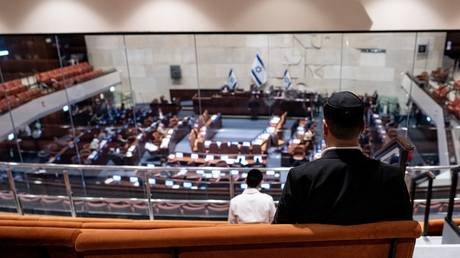
The friction within the Israeli Knesset regarding the reported U.S.-led ceasefire initiative with Iran-backed entities is not a product of political temperament, but a fundamental disagreement over the Definition of Neutralization. While the U.S. executive branch views a ceasefire as a mechanism for regional stabilization and maritime security restoration, the Israeli security establishment views it as a "kinetic pause" that facilitates the regeneration of adversary capabilities. This gap in strategic time-horizons creates a structural conflict between the two allies that cannot be resolved through diplomatic phrasing.
The Tri-Node Conflict Model: Deterrence, Degeneration, and Diplomacy
To understand the fury of Israeli MPs, the current conflict must be mapped through three distinct strategic nodes. The primary failure of conventional reporting is the assumption that a ceasefire is a binary state (war or peace). In the context of Middle Eastern proxy warfare, a ceasefire is a variable in a larger cost-function.
- The Deterrence Decay Rate: Israeli military doctrine relies on the "mowing the grass" principle—a perpetual cycle of degrading adversary infrastructure to reset the clock on their offensive capabilities. A ceasefire, in the view of hardline MPs, halts the degradation process while the "decay" of the adversary's previous losses slows down.
- The Logistic Resupply Window: For Iran, a cessation of hostilities is a logistical necessity. It allows for the unhindered movement of Precision-Guided Munitions (PGMs) across the "Land Bridge" (Tehran to Beirut) without the risk of interception via Israeli kinetic action.
- The Political Leverage Ratio: The U.S. administration calculates the value of a ceasefire based on global oil price stability and the protection of Red Sea shipping lanes. These are global macroeconomic concerns. Conversely, Israel’s calculation is focused on the Zero-Distance Threat: the physical presence of Radwan forces on its northern border.
Categorizing the Israeli Opposition: Hardliners vs. Pragmatists
The internal Israeli backlash is categorized into three specific ideological frameworks, each with a different set of objections to the Trump-mediated proposal.
The Sovereignty Autonomy Group
This faction, led by figures within the religious-nationalist blocs, views any U.S.-brokered deal as a breach of Israeli strategic autonomy. Their logic follows the Independence Axiom: A state cannot outsource its core existential security to a foreign power, regardless of the strength of the alliance. Their primary fear is that a U.S. guarantee creates a "veto" over Israeli preemptive strikes. If Israel signs onto a U.S. deal, every future strike against a shipment of missiles becomes a diplomatic incident with Washington.
The Military Realist Faction
This group focuses on the Kill-Chain Efficiency. They argue that the IDF currently possesses intelligence and positioning that allows for a high rate of attrition against proxy leadership. Entering a ceasefire creates an "Intelligence Dark Period." Once the kinetic pressure is removed, human and electronic intelligence assets become harder to maintain as the adversary moves back into civilian-embedded subterranean structures.
The Regional Alignment Skeptics
These analysts look at the broader Abraham Accords framework. They argue that if Israel appears to be caving to Iranian pressure via Washington, it weakens the "Strong Horse" perception required to maintain normalization with Sunni Arab states. In this framework, Israeli strength is the currency of regional peace; a ceasefire brokered by an outside power is seen as a devaluation of that currency.
The Mechanics of Proxy Regeneration
A ceasefire does not freeze the status quo; it shifts the conflict from a kinetic phase to a procurement phase. The Israeli security apparatus calculates the "Regeneration Velocity" of Iranian proxies using several key metrics:
- PGM Saturation: The rate at which unguided rockets are replaced with GPS-stabilized kits.
- Fortification Depth: The expansion of the "Metro" tunnel systems in Southern Lebanon and Gaza during periods of aerial surveillance reduction.
- Personnel Cycle: The ability to rotate battle-hardened advisors from the Iranian Revolutionary Guard Corps (IRGC) back into the theater without risk of targeted assassination.
The MPs’ fury is rooted in the observation that the proposed ceasefire lacks a Verification and Enforcement Protocol (VEP). Without a VEP that allows for intrusive inspections or immediate kinetic responses to smuggling, a ceasefire is functionally a "re-arm period" for the proxy.
The Cost of the "Kinetic Pause"
The economic impact of the conflict on Israel is a significant driver for the U.S. push, but Israeli hawks argue the long-term cost function is being calculated incorrectly.
The Total Cost of Conflict (TCC) includes:
$$TCC = D_{immediate} + (R_{cost} \times T_{delay})$$
Where $D_{immediate}$ is the current cost of war, $R_{cost}$ is the cost of fighting a rehabilitated adversary later, and $T_{delay}$ is the time gained by the adversary.
Israeli MPs argue that while $D_{immediate}$ is high, the exponential growth of $R_{cost}$ due to Iranian technological advancement (specifically loitering munitions and AI-integrated drone swarms) makes a ceasefire a net-negative investment for Israeli national security. This is the Delayed Escalation Paradox: By avoiding a small war today, the parties guarantee a catastrophic war tomorrow.
The Structural Divergence in US-Israeli Goals
The friction points to a fundamental shift in the American approach to the Middle East, regardless of the administration. The U.S. is moving toward a Containment and Pivot strategy. The goal is to lower the temperature in the Levant to focus resources on the Indo-Pacific.
Israel, however, operates on a Total Eradication of Proximate Threats doctrine. These two goals are mathematically incompatible.
- The U.S. Goal: Equilibrium. A state where no side is winning, but the violence is managed at a level that does not disrupt global markets.
- The Israeli Goal: Asymmetry. A state where the adversary is rendered incapable of projecting power across the border.
The "fury" reported in the Knesset is the sound of these two divergent strategies grinding against each other.
The Absence of "Snap-Back" Mechanisms
A critical failure identified by the Israeli strategic community in the proposed deal is the lack of an automated "Snap-Back" mechanism. In previous agreements, such as the JCPOA or various Gaza ceasefires, violations required a lengthy diplomatic review process before consequences were enacted.
The Israeli demand is for Algorithmic Response: A pre-agreed set of violations (e.g., the movement of a specific tonnage of explosives across a border) that triggers an immediate, pre-authorized IDF kinetic response without the need for further consultation with the White House. The current proposal’s reliance on "consultation" is viewed by Israeli MPs as a trap that grants the adversary a permanent "violation window."
The Strategic Shift Toward a "Unilateral Enforcement" Model
Given the domestic pressure within Israel and the geopolitical requirements of the U.S. administration, the likely outcome is not a formal adherence to the ceasefire, but a shift toward a Unilateral Enforcement Model.
Israel will likely allow the U.S. to announce a cessation of hostilities to satisfy diplomatic requirements while maintaining a "Gray Zone" kinetic policy. This involves:
- Deniable Sabotage: Shifting from airstrikes to cyber-physical attacks on Iranian supply chains.
- Threshold Testing: Executing precise strikes on high-value targets while calculating the exact limit of what will trigger a full-scale retaliation.
- Intelligence-Led Interdiction: Focusing exclusively on the "bottlenecks" of the Land Bridge, specifically at the border crossings between Iraq and Syria, where the legal ambiguity of the territory allows for higher degrees of kinetic freedom.
The fury of the MPs serves a dual purpose: it signals to the Israeli public that the government remains committed to total security, and it provides the Israeli executive branch with the necessary "domestic constraint" leverage when negotiating with Washington. By presenting a divided and angry parliament, the Israeli leadership can demand higher concessions or more "freedom of action" clauses within the ceasefire framework.
The ultimate strategy for Israel is to transform the ceasefire from a "Stop" command into a "Filter" command—allowing normal civilian and economic activity to resume while reserving the right to surgically extract any military hardware that crosses the established "red lines." This requires a level of tactical precision and political will that the current U.S. proposal, in its current unrefined state, does not yet support.
The path forward for the Israeli defense establishment is the integration of high-frequency surveillance and autonomous strike capabilities to enforce these red lines without the need for large-scale troop mobilizations that trigger diplomatic crises. This "Technological Enforcement" is the only viable bridge between the U.S. desire for quiet and the Israeli requirement for security.