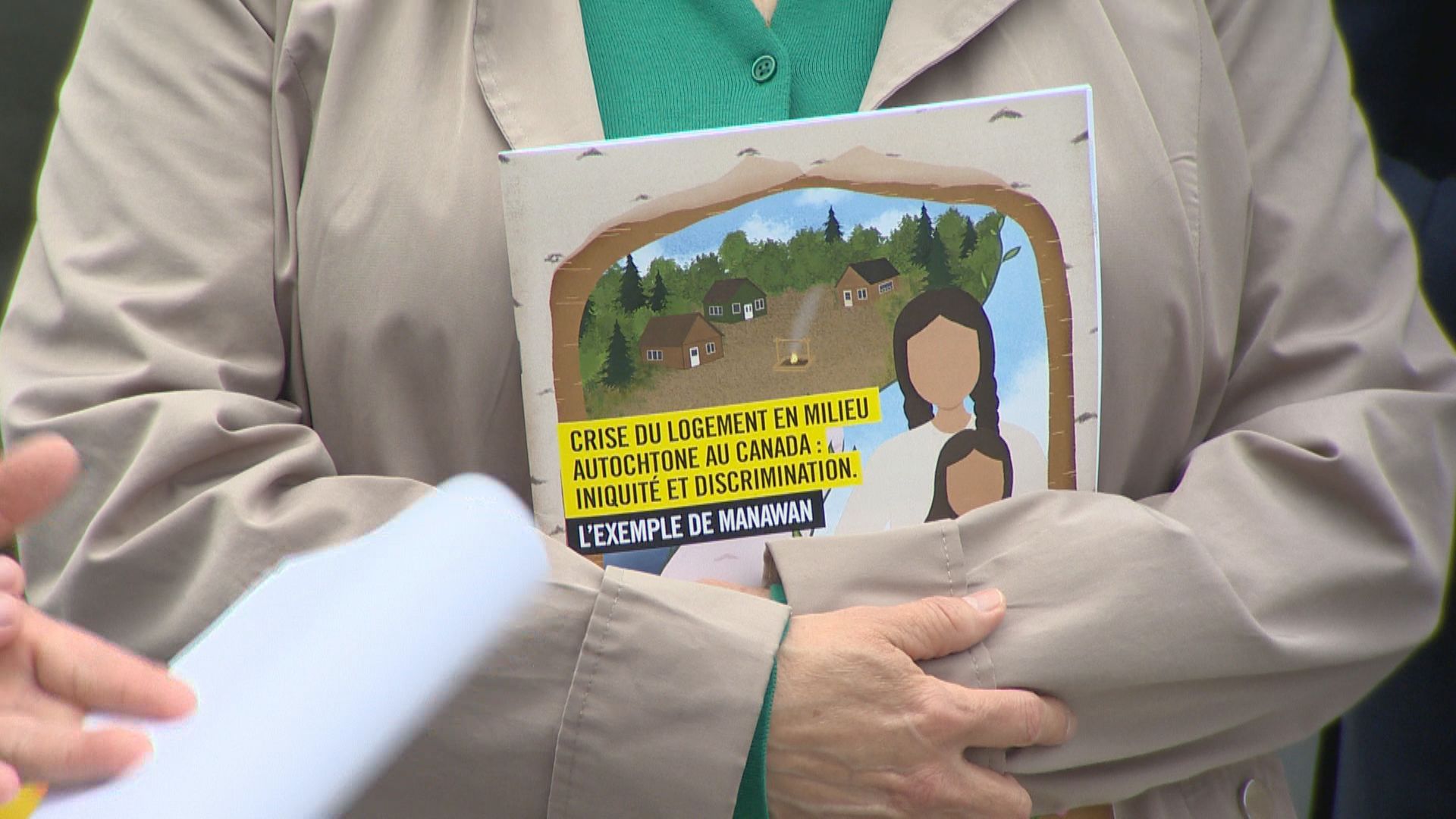
The housing crisis in Manawan is not a localized shortage of square footage but a systemic collapse at the intersection of demographic acceleration, jurisdictional friction, and infrastructure decay. While public discourse often frames the issue through the lens of human rights violations—as highlighted by Amnesty International—the underlying reality is an operational bottleneck where the rate of household formation has decoupled from the rate of capital deployment. The Atikamekw community of Manawan faces a deficit so profound that it has transitioned from a social challenge to a physical impossibility: there is literally no physical space to house a population growing at rates far exceeding the provincial average.
The Triad of Systemic Failure
To understand why Manawan remains in a state of emergency despite repeated interventions, the problem must be disaggregated into three distinct pillars of failure.
- The Infrastructure Ceiling: Manawan is a landlocked community where the physical capacity to expand is limited by the absence of serviced land. Housing requires more than lumber and labor; it requires water mains, sewage treatment, and electrical grids. The current utility infrastructure is operating at or beyond peak capacity, meaning every new unit built adds a marginal load that the existing system cannot sustain.
- The Demographic Divergence: The birth rate within the Atikamekw Nation creates a "youth bulge." In most Canadian municipalities, housing turnover occurs as older generations downsize or move to assisted living. In Manawan, the population is predominantly young and expanding. There is no "exit" side to the housing equation, only a "demand" side that compounds annually.
- The Capital Velocity Gap: Federal funding cycles are inconsistent with northern construction windows. The administrative lag between a funding announcement and the actual disbursement of capital often misses the short seasonal window required for major earthworks and foundation pouring in northern Quebec.
Analyzing the Overcrowding Coefficient
Overcrowding in Manawan is frequently cited but rarely quantified in terms of its social and economic cost functions. When a single-family dwelling designed for five inhabitants houses fifteen, the depreciation of the asset accelerates exponentially.
The Accelerated Depreciation Cycle
In a standard residential model, a home’s lifecycle is roughly 40 to 60 years before a major overhaul is required. In Manawan, the intensity of use—driven by high occupancy—shortens this lifecycle to less than 20 years. High moisture levels from cooking, bathing, and respiration in an over-occupied space lead to structural mold and respiratory health crises. This creates a feedback loop: the community loses existing housing stock to rot and condemned status almost as quickly as it can secure funding for new units. The net gain in habitable rooms is often near zero.
This "housing treadmill" is a direct result of ignoring the physical limits of building materials under extreme load. Until the maintenance and renovation budgets are decoupled from new construction grants, the community will continue to see its total housing inventory stagnate or shrink in real terms.
The Jurisdiction-Funding Paradox
The core logic of the crisis rests on the "fiduciary gap" created by the Indian Act. Unlike a standard Quebec municipality, Manawan cannot leverage its land base to secure private mortgage capital or municipal bonds. The land is held in trust, which removes the most powerful tool for housing development: the ability to borrow against equity.
- Reliance on Parliamentary Appropriations: Because the community cannot access private capital markets, it is 100% dependent on Indigenous Services Canada (ISC) and the Canada Mortgage and Housing Corporation (CMHC).
- The Inefficiency of Single-Source Funding: This creates a monopsony where the federal government is the only "buyer" of housing solutions, leading to standardized designs that often fail to account for the specific geographic and cultural needs of the Atikamekw.
The result is a bottleneck. Even if the federal government triples the budget, the lack of a diverse capital stack—combining public, private, and non-profit funds—means that the procurement process remains slow, bureaucratic, and prone to political shifts.
Geographic Isolation as a Multiplier of Cost
Manawan is located approximately 120 kilometers north of Saint-Michel-des-Saints, accessible via a secondary gravel road. This isolation acts as a massive cost multiplier on every kilogram of material transported.
- Logistics Premiums: The "Manawan Premium" on construction is estimated to be between 30% and 50% higher than in urban centers like Montreal. This is driven by fuel costs, wear and tear on transport vehicles, and the need to house external labor during the construction phase.
- Labor Scarcity: There is a chronic shortage of specialized trades (electricians, plumbers, HVAC technicians) within the region. Importing this labor requires paying per-diems and travel costs, which further dilutes the purchasing power of every dollar allocated for housing.
- Seasonality Constraints: The frost line in northern Quebec dictates a narrow window for pouring concrete. If a funding delay occurs in May, the entire project is often pushed to the following year, during which time inflation has eroded the original budget's effectiveness.
The Health and Social Externalities of Density
The "alarm" sounded by organizations like Amnesty International is often focused on the human rights aspect, but from a strategic standpoint, the crisis represents a massive "hidden" expense in the healthcare and social services sectors.
There is a direct correlation between housing density and the transmission of infectious diseases. In Manawan, this has manifested in outbreaks of tuberculosis and other respiratory ailments that have long been eradicated in the rest of Quebec. Furthermore, the lack of private space is a primary driver of psychological stress, which correlates with higher rates of domestic friction and educational underachievement.
If a student has no quiet space to study because they share a bedroom with four siblings, the "educational ROI" of the local school system is suppressed. The housing crisis is, therefore, a lead weight on the entire socio-economic development of the Atikamekw Nation.
Structural Requirements for Resolution
To move beyond the cycle of "sounding alarms" and into a phase of resolution, the strategic framework must shift from "building houses" to "building systems."
Developing a Regional Materials Hub
The cost of logistics could be mitigated by establishing a pre-fabrication facility closer to the community or within the region. By shifting from on-site stick-building to modular, climate-controlled factory construction, the community could extend the building season to 12 months. This would also serve as a dual-purpose economic engine, providing local employment in manufacturing rather than just seasonal construction.
Infrastructure-First Mandates
No further housing units should be planned without a concomitant expansion of the water treatment and power grid. The current practice of "squeezing" new units onto existing lines is a recipe for utility failure. A large-scale, multi-year infrastructure grant is the prerequisite for any meaningful increase in housing stock.
Land Tenure Innovation
While the Indian Act remains a constraint, the community can explore long-term leasehold arrangements that allow for quasi-ownership models. This could potentially unlock small amounts of private financing or at least give residents a greater stake in the long-term maintenance of their properties, slowing the depreciation cycle mentioned earlier.
The crisis in Manawan is the logical outcome of a system that treats housing as a series of one-off grants rather than a permanent, growing infrastructure requirement. The deficit is currently so large that "incrementalism"—the addition of 5 or 10 houses per year—is mathematically insufficient to even maintain the current (and failing) status quo.
The immediate requirement is a "Marshall Plan" style injection of capital specifically targeted at serviced land development. Without the creation of new, serviced lots, the talk of "human rights" remains a rhetorical exercise. The community requires a minimum of 200 units immediately just to reach a baseline of safety; achieving this necessitates a total decoupling of construction from the standard, sluggish federal procurement process. The only path forward is a self-governance model where the Atikamekw of Manawan control the capital, the design, and the labor force, bypassing the administrative friction that has characterized the last three decades of failure.