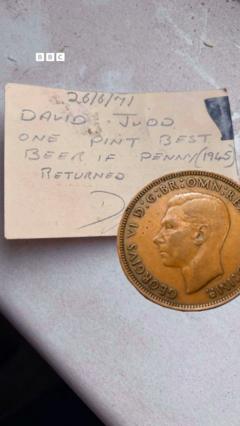
Long-duration informal contracts typically fail due to counterparty attrition, inflation decay, and institutional amnesia. When an electrical contractor in Oxfordshire concealed a 1945 penny inside a residential wall in 1971 alongside a written pledge of a complimentary pint upon its return, the transaction established a fifty-five-year options contract. The recent redemption of this physical token by a homeowner executing structural renovations exposes the underlying mechanics of low-probability, high-sentiment social agreements. Deconstructing this event reveals three distinct operational variables that govern how temporal arbitrage functions in micro-scale human interactions.
The Temporal Decay Function of Informal Liabilities
Unrecorded physical promises operate outside standard legal frameworks, relying entirely on the originator's memory persistence and geographic stability. In this specific case, the asset carrier was a low-denomination currency unit paired with a physical business card, functioning as a bearer bond of negligible initial face value but high sentimental optionality.
- Counterparty Risk Mitigation: The original issuer, David Judd, remained traceable decades later due to familial continuity and regional permanence, bypassing the high failure rate typical of multi-decade personal tracking.
- Inflation Distortion: A beverage priced at approximately fifteen pence in 1971 underwent significant nominal expansion over fifty-five years. The eventual payout required the modern proxy value rather than the historical cash equivalent, highlighting the divergence between nominal face value and real replacement cost in long-tail obligations.
- Information Asymmetry: The issuer distributed hidden liabilities across multiple undisclosed residential properties without maintaining a central ledger, treating the distribution as a stochastic exercise rather than a predictable liability stream.
The Physical Trigger as a Renovation Catalyst
Standard residential updates rarely yield historical artifacts unless the intervention involves invasive demolition of structural envelopes. The discovery mechanism relied on a binary physical state change: the transition of a structural partition from intact to fractured.
[Demolition Event] ---> [Kinetic Release of Penny] ---> [Decodification of Business Card] ---> [Network Trace via Digital Graph]
When the partition failed under mechanical force, the embedded artifact transitioned from dormant material to active data. The inclusion of specific identifying data—an electrical trade card—short-circuited the standard anonymity barrier inherent in hidden time capsules. Rather than presenting an unbranded curiosity, the finder held an indexed vector pointing directly to the originator's professional lineage.
Network Topology and Modern Traceability Vectors
The transition from localized physical discovery to cross-generational contact relied on distributed digital social graphs. Traditional geographic localism would have restricted this discovery to word-of-mouth channels, severely bottlenecking the probability of closure.
The utilization of a public social media index by the homeowner bypassed traditional municipal archives. By broadcasting the identifier extracted from the 1971 business card into a digital routing network, the search cost dropped from linear investigative labor to near-zero network query latency. This dynamic demonstrates that physical nostalgia assets now operate with digital liquidity, drastically shortening the time-to-redemption once the physical barrier is breached.
Execution Blueprint for Long-Horizon Contingent Assets
To operationalize similar localized feedback loops without relying on random demolition events, asset originators must balance index precision against structural permanence.
- Embed redundancy by pairing ephemeral media with inorganic substrates that survive moisture and physical compression.
- Index the contingent offer to a standardized consumer index rather than a fixed nominal unit to protect the real value against currency devaluation.
- Utilize decentralized registry markers that survive single-point-of-failure migrations in family or corporate lineages.
A Bicester woman claimed a pint promised in 1971 after finding a coin in her wall
This video provides visual context on the numismatic characteristics and historical background of 1970s British currency and error coin identification.
http://googleusercontent.com/youtube_content/1