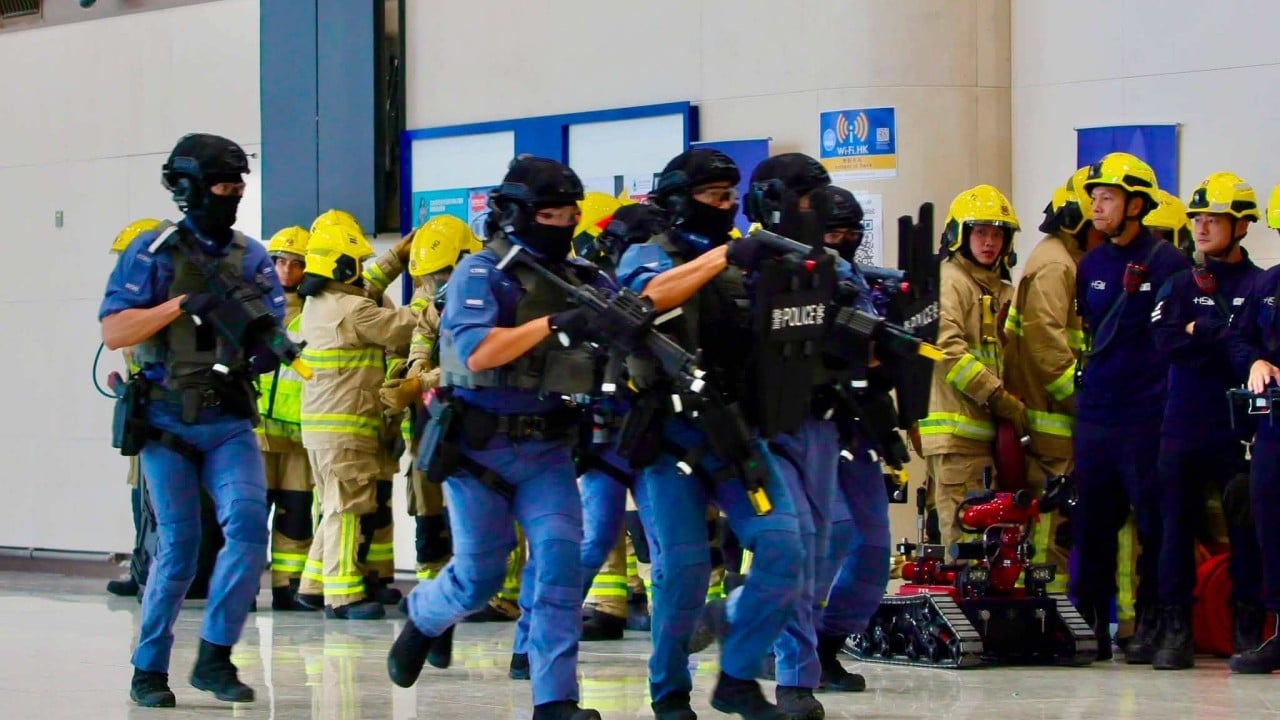
Geopolitical stability at high-density land boundaries depends on operational friction reduction and rapid cross-agency coordination. When Hong Kong authorities executed their inaugural counterterrorism simulation at the redeveloped Huanggang Port facility, the objective extended far beyond a routine safety demonstration. Such exercises function as stress tests for institutional interoperability, evaluating how distinct security apparatuses manage high-velocity threat vectors in constrained, high-traffic environments.
Border checkpoints operate under a fundamental systemic tension: the mandate to maximize passenger and cargo throughput conflicts directly with the enforcement of exhaustive security controls. Modern port design attempts to resolve this tension through spatial architecture and digital automation. However, architectural optimization fails when faced with intentional disruption. Counterterrorism drills isolate this vulnerability, forcing agencies to measure their response latency under simulated duress.
The Operational Mechanics of Port Security Architecture
The redeveloped Huanggang crossing represents a critical node in the Greater Bay Area mobility network. Land border ports handle immense volumes of daily cross-boundary traffic, creating dense focal points where minor security friction compounds into severe logistical bottlenecks. To understand the significance of a security drill at this specific location, one must deconstruct the port into three distinct operational layers:
- The Clearance Layer: Automated biometric verification systems, vehicular inspection scanners, and immigration queuing queues designed for high-frequency processing.
- The Command Layer: Multi-agency communication protocols connecting local police forces, immigration departments, customs authorities, and national security units.
- The Containment Layer: Physical access controls, perimeter fortifications, and rapid-deployment tactical zones intended to isolate anomalies without halting total operational flow.
When a simulated threat event occurs—such as a coordinated assault, a chemical hazard detection, or a hostage scenario within the terminal—the primary operational challenge is dynamic sectorization. Standard operating procedures dictate a total shutdown of affected zones. Yet, an uncalibrated shutdown creates cascading gridlock across adjacent highway networks and rail links, generating secondary vulnerabilities.
Threat Vector Analysis in High-Density Terminals
Security planners categorize land boundary threats by their spatial velocity and lethality profile. Unlike maritime or aviation checkpoints, land crossings feature porous perimeters and continuous human traffic, making traditional perimeter defense models insufficient.
- Asymmetric Infiltration: The introduction of covert operatives disguised as routine commuters carrying non-metallic or improvised hazardous materials. Detection relies on behavioral analytics and randomized secondary screening protocols rather than static X-ray imaging.
- Infrastructure Sabotage: Direct attacks on critical node components, including power sub-stations, data fiber lines governing immigration databases, or traffic control gantries. The failure mode here is total data blindness, forcing operators to revert to manual, paper-based verification processes that reduce throughput by upwards of ninety percent.
- Mass Panic Cascades: The psychological dimension of an attack often outweighs its physical destructiveness. In a multi-level terminal like Huanggang, uncontrolled crowd movement presents a severe casualty risk independent of the initial threat vector.
Live-action drills test the friction points between these vectors and the response capabilities of first-responder units. Specifically, they evaluate the time delta between threat identification, command authority handover, and tactical neutralization.
Institutional Interoperability and Command Friction
The most persistent failure mode in cross-jurisdictional security operations is command fragmentation. Hong Kong and mainland integration points require distinct legal jurisdictions and operational mandates to coordinate seamlessly during an active crisis.
When a simulated incident scales from a localized disturbance to a multi-agency counterterrorism event, decision-making authority must shift from administrative customs officers to tactical intervention units. This transition introduces friction across three dimensions:
- Communication Protocols: Radio frequency incompatibilities and differing cryptographic standards between municipal police and specialized tactical units.
- Jurisdictional Handover: Legal ambiguities regarding who maintains operational command during the initial golden minutes of an engagement.
- Information Silos: Delays in disseminating real-time intelligence from CCTV surveillance networks to frontline operators entering a hostile terminal zone.
The Huanggang exercise serves as a diagnostic tool for these friction points. By introducing randomized variables into the simulation—such as simultaneous communication node failures or multiple decoy threats—planners measure the resilience of the command hierarchy under stress.
Infrastructure Resilience and Throughput Recovery Economics
Evaluating the success of a counterterrorism drill requires examining economic and logistical recovery metrics. Security is not a zero-sum state; every minute of operational suspension at a primary trade and commuter artery incurs quantifiable economic costs across regional supply chains.
Port operators utilize a metric known as the Recovery Time Objective. This measures the duration required to transition from an active threat mitigation posture back to baseline passenger and freight clearance operations without compromising forensic integrity at the scene.
During high-profile redevelopment projects like the new Huanggang facility, architectural planning must incorporate modular isolation capabilities. Instead of shuttering an entire multi-story terminal during a security breach, modern infrastructure design implements physical zoning dampers—remotely deployable steel barricades, independent ventilation systems, and isolated emergency egress corridors. These features allow security forces to contain a hostile element in a single quadrant while maintaining continuous passenger flow through parallel processing channels.
Strategic Deployment of Intelligence-Led Deterrence
Physical drills are visible manifestations of a deeper deterrence strategy. Their primary value lies not in the physical choreography of tactical squads, but in the signaling effect delivered to potential threat actors.
A well-publicized, highly coordinated inter-agency drill communicates operational readiness and reduces the expected utility of an attack. It demonstrates that the target infrastructure possesses adaptive defense mechanisms capable of scaling response forces faster than an adversary can execute a coordinated disruption.
Future resilience at major land boundaries will rely on predictive integration. By coupling physical infrastructure simulations with artificial intelligence-driven anomaly detection models, security agencies can transition from reactive tactical containment to preemptive threat neutralization before hostile elements ever reach the physical perimeter.
Upgrade the automated surveillance feeds at all primary vehicle inspection bays to include real-time behavioral tracking algorithms, and mandate bi-monthly cross-jurisdictional communication handoff audits to eliminate command latency before the next structural capacity expansion phase.