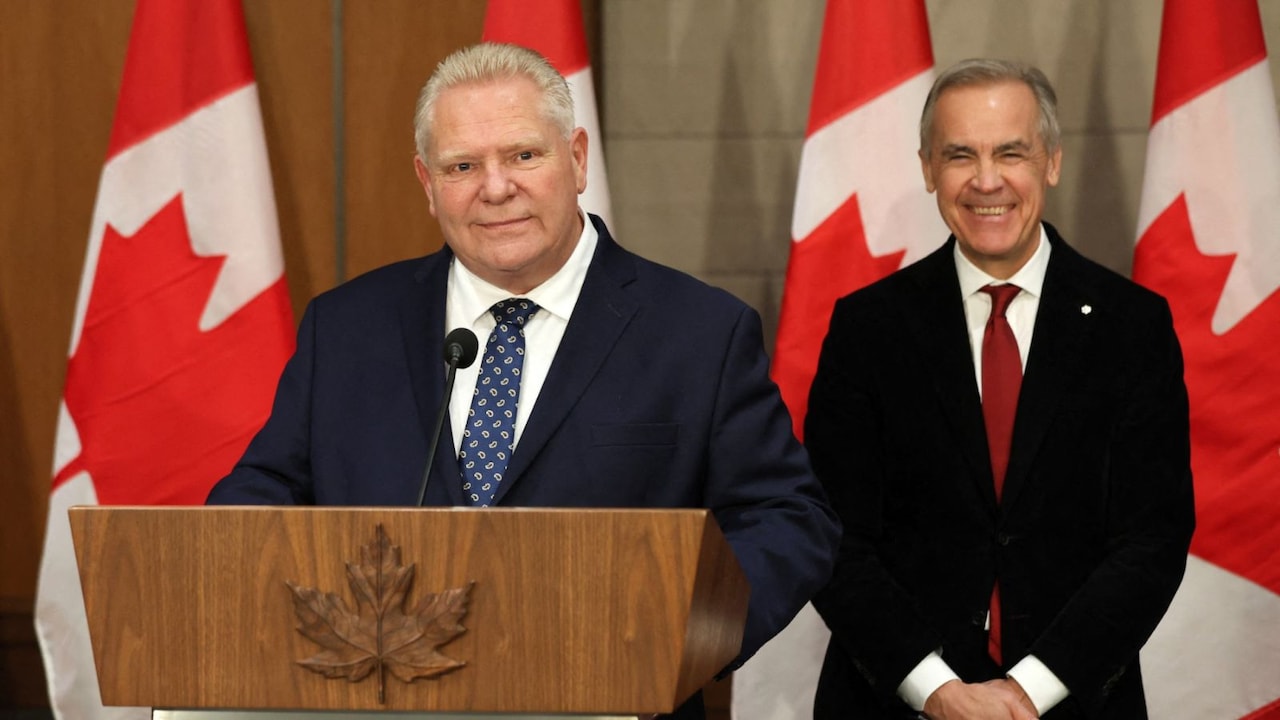
Trade negotiations between Washington and Ottawa collapsed after bilateral frameworks failed to resolve structural disagreements over market access and defensive duties. Following the breakdown, the White House enacted severe import duties, prompting immediate federal retaliation and sharp escalation from regional sub-national executives. At the center of this friction lies Ontario Premier Doug Ford, whose threat to withhold high-grade industrial inputs, critical minerals, and cross-border electricity has transformed a traditional tariff dispute into a total test of regional economic interdependence.
The Cost Function of Integrated Manufacturing
Modern industrial production across the Great Lakes region does not operate on simple import-export models. Instead, it relies on hyper-integrated transnational supply chains where components cross international borders multiple times before final assembly. The automotive sector serves as the primary diagnostic case for this structural reality. Steel coils, raw aluminum, and specialized wiring harnesses move fluidly between Michigan, Ohio, and Ontario assembly plants.
When a fifty percent tariff is applied to these intermediate goods, the cost function shifts instantly. Importers cannot simply absorb the delta or pivot to domestic suppliers within a quarter. Domestic production capacity for specialized high-grade nickel, refined uranium, and specific automotive sub-components lacks the immediate redundancy required to replace cross-border inflows.
- Input Price Inflation: Raw material costs escalate immediately upon customs clearance, compressing margins for original equipment manufacturers.
- Logistics Friction: Border processing times multiply as compliance verification adapts to new protective barriers.
- Capacity Bottlenecks: Alternative domestic extraction and refinement facilities face multi-year regulatory and capital expenditure timelines before reaching commercial scale.
This creates an acute transmission mechanism. Rather than protecting domestic industries, broad tariffs on intermediate inputs penalize downstream manufacturers who depend on the exact cross-border efficiency being penalized.
Asymmetric Weaponization of Infrastructure and Resources
Regional leadership in Ontario has shifted the strategic calculus from defensive trade arguments to active resource denial. By threatening to restrict foundational inputs—specifically electricity transmission, refined uranium, and critical minerals essential for aerospace and defense manufacturing—the provincial government exposes structural vulnerabilities in the American industrial base.
The underlying mechanics of this leverage rely on inelastic demand. Industrial facilities in the U.S. Northeast and Midwest depend on baseload electricity and raw mineral supplies that cannot be substituted overnight.
- Critical Mineral Dominance: The Pentagon relies on stable foreign or allied supply chains for minerals used in guidance systems, jet engines, and electronics. Restricting access to high-grade nickel and processed rare elements directly impairs defense procurement schedules.
- Energy Transmission: Cross-border grid interties deliver gigawatts of power to millions of residential and commercial structures. Cutting or pricing out these power flows introduces immediate localized energy scarcity.
- Hydrocarbon and Potash Controls: Interprovincial coordination with western jurisdictions introduces the potential to restrict crude oil and agricultural inputs, compounding the macroeconomic pressure.
This dynamic upends the traditional assumption that sub-national actors hold no sway over foreign policy. When regional economies are deeply interwoven, the executives governing extraction and generation nodes hold veto power over national trade strategies.
The Political Economy of Retaliation and Deterrence
The breakdown of diplomacy reflects fundamentally misaligned bargaining objectives. Federal negotiators faced demands to restrict Canada's sovereign right to execute trade agreements with third-party nations—a condition Ottawa rejected as an infringement on national autonomy. In response, the deployment of retaliatory duties and aggressive rhetoric signals a pivot away from cooperative resolution toward prolonged economic attrition.
Deterrence in trade wars requires credibility of pain. When Ontario leadership articulates a willingness to endure economic contraction rather than submit to unilateral coercion, it alters the opponent's risk calculation. Standard game theory models suggest that a player willing to accept higher immediate utility losses to impose reciprocal damage changes the equilibrium outcome.
However, this strategy introduces severe systemic risk. Prolonged friction accelerates capital flight, disrupts labor markets across the automotive corridor, and forces corporate planners to restructure long-term capital allocation away from North American integration entirely. Supply chain redundancy is expensive, but persistent policy volatility makes that expense look like a necessary insurance policy to corporate boards.
Strategic Execution for Transnational Enterprises
Supply chain operators and industrial strategists must transition from crisis response to permanent structural realignment. Operating within an environment of recurring tariff shocks requires a deterministic playbook to insulate balance sheets from sudden regulatory shifts.
- Map Multi-Tier Supply Vulnerabilities: Audit every bill of materials to identify single-source components originating across the northern border, quantifying the precise financial exposure of a prospective fifty percent duty.
- Accelerate Inventory Buffer Optimization: Transition from just-in-time logistics models to localized strategic stockpiling for critical non-substitutable inputs like specialized alloys and refined chemical agents.
- Diversify Jurisdictional Compliance: Establish dual-compliance pathways for logistics documentation to minimize customs delays as border enforcement protocols evolve.
- Engage Bilateral Advocacy Coalitions: Align with cross-border industry associations to lobby explicitly against intermediate input taxes, emphasizing the empirical damage inflicted on domestic manufacturing employment.


