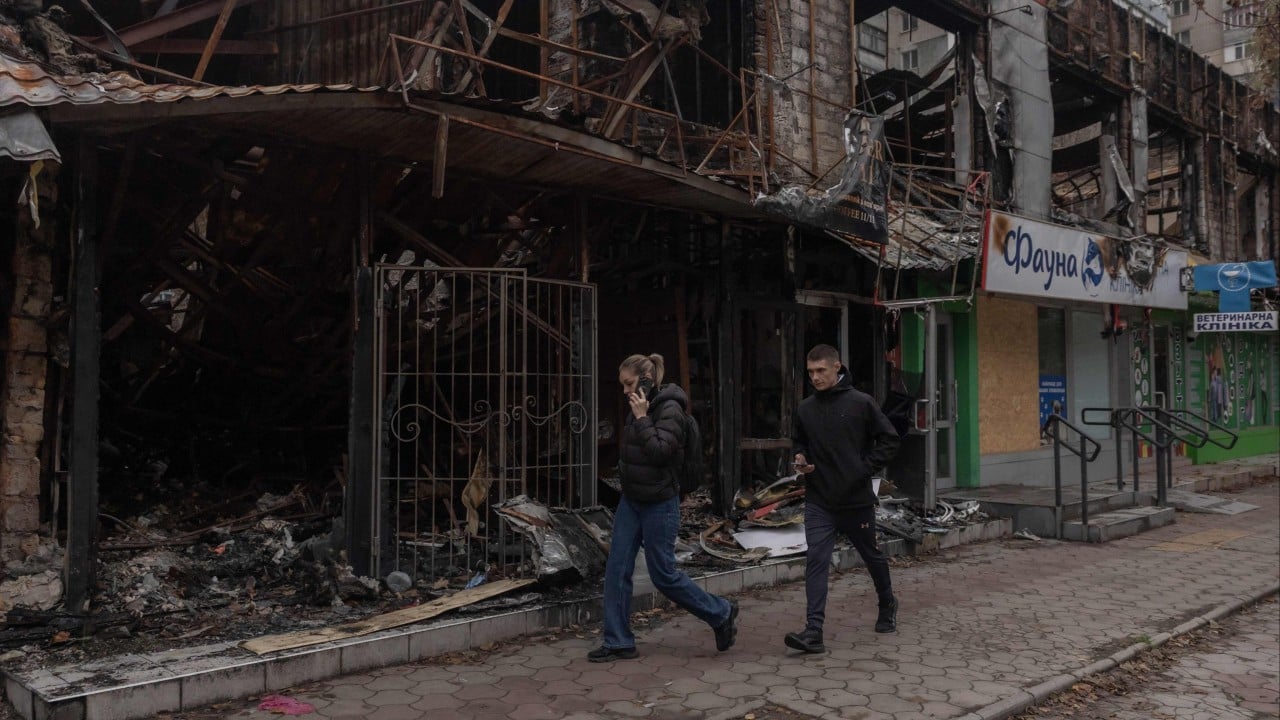
Localized ceasefires in high-intensity attrition wars rarely fail due to diplomatic miscommunication; they collapse when the operational utility of holding fire falls below the tactical cost of restraint. The termination of the longest recorded truce in the Kherson region demonstrates how localized de-escalation mechanisms function as temporary logistical pauses rather than precursors to durable conflict resolution. By stripping away diplomatic rhetoric and examining the terrain, force posture, and artillery economics along the Dnipro River, the collapse of the Kherson pause reveals a predictable cycle of tactical exploitation and asymmetric retaliation.
The Structural Constraints of the Dnipro River Front
To understand why a prolonged truce could emerge in Kherson—and why its expiration was mathematically inevitable—one must first analyze the physical geography of the sector. Unlike the rolling steppe of the Zaporizhzhia front or the dense urban sprawl of the Donbas, the Kherson operational theater is bisected by the lower Dnipro River. This waterway acts as a massive natural anti-tank ditch, fundamentally altering the offensive-defensive balance.
- The Amphibious Bottleneck: Conducting a large-scale mechanized river crossing under modern intelligence, surveillance, and reconnaissance (ISR) coverage is virtually impossible without achieving local air and artillery supremacy. Neither belligerent possesses the bridging capacity or suppressed enemy air defenses required to sustain an armored bridgehead across a waterway spanning several hundred meters to over a kilometer in width.
- The Artillery Duel Dynamic: Because ground maneuver is restricted to small-unit light infantry raids on riverine islands and contested marshes, the Kherson front operates primarily as a counter-battery and drone-interdiction zone. Combat power is measured not in kilometers of territory gained, but in shells expended, radar systems destroyed, and logistics nodes disrupted.
- Environmental Degradation: The destruction of the Kakhovka Dam in June 2023 permanently altered the hydrology of the lower Dnipro. The draining of the reservoir exposed vast expanses of unstable silt and braided channels, creating a secondary buffer zone that complicates heavy vehicle movement while offering limited cover for dispersed infantry squads.
Under these physical constraints, both commands face diminishing returns on continuous, high-volume ammunition expenditure. When neither side can execute a decisive operational breakthrough, the marginal utility of daily shelling drops, creating the exact conditions necessary for a localized, tacit, or explicitly negotiated pause.
The Three Pillars of Localized Truce Formation
When military commanders agree to halt kinetic operations in a specific sector while high-intensity combat continues elsewhere, the decision rests on three functional pillars. Standard news reporting often frames these pauses around humanitarian objectives—such as civilian evacuations, infrastructure repair, or casualty recovery—but from an operational standpoint, humanitarian access is merely the permissible byproduct of mutual military convenience.
1. Force Reconstitution and Rotation
Sustained exposure to drone surveillance and indirect fire degrades unit cohesion at a predictable rate. Units stationed along the Dnipro face chronic psychological and physical attrition even without major ground assaults. A localized truce allows field commanders to rotate exhausted frontline detachments out of forward observation posts, bring in fresh personnel, and conduct essential maintenance on towed artillery, electronic warfare (EW) suites, and transport vehicles without incurring transit casualties.
2. Logistical Stockpiling and Reallocation
Ammunition is a finite resource governed by industrial production ceilings and transport vulnerabilities. In an attrition war, general staffs constantly reallocate shells, First-Person View (FPV) drones, and air defense interceptors to whichever sector represents the main effort. Pausing kinetic activity in Kherson permits both sides to either build up local reserve stockpiles for future operations or divert critical munitions to higher-priority axes in the east without surrendering tactical positions in the south.
3. Critical Infrastructure Stabilization
The Kherson region contains vital water, power, and agricultural infrastructure that affects territories held by both forces. Total destruction of pumping stations, electrical substations, or river embankments creates humanitarian and logistical crises that burden the occupying or defending force with massive administrative costs. Temporary ceasefires frequently serve to allow engineering crews to repair dual-use infrastructure whose total collapse would render the sector uninhabitable for military garrisons.
The Cost Function of Restraint: Why the Truce Collapsed
A localized truce remains stable only while the perceived benefits of the pause exceed the security risks of allowing the adversary to operate unmolested. The breakdown of the Kherson truce illustrates how this equilibrium deteriorates over time through three distinct mechanisms.
The Intelligence Asymmetry Problem
During active combat, artillery and drone strikes force the enemy to remain dispersed, camouflaged, and mobile. When firing stops, engineering and logistics units emerge to fortify positions, dig deeper bunkers, lay new minefields, and establish hardened command posts. Every hour a truce holds, the adversary's defensive network becomes more resilient. Eventually, reconnaissance assets detect a threshold level of enemy fortification—such as the arrival of new long-range radar systems or the construction of reinforced ammunition depots—that poses an unacceptable future threat. At that point, the tactical imperative to strike high-value, stationary targets overrides the strategic value of maintaining the truce.
The Deterrence Decay Curve
In the absence of an impartial, armed third-party monitoring mission with enforcement authority, localized truces rely entirely on mutual deterrence. Compliance is policed through the threat of disproportionate retaliation. However, low-level infractions—such as unauthorized reconnaissance drone flights, EW jamming, or sniper fire—inevitably occur due to decentralized command structures or local miscalculations. If these minor violations go unpunished to preserve the broader peace, deterrence decays. The offending side interprets restraint as weakness or resource depletion and escalates its probing actions until a major kinetic response is triggered, collapsing the truce entirely.
Theater-Wide Operational Spillover
No sector of a modern war exists in isolation. Operational developments hundreds of kilometers away directly dictate the viability of local agreements. If one belligerent launches a major offensive in another theater, the defending side may deliberately shatter a quiet front like Kherson to fix enemy reserves in place. By resuming artillery barrages and amphibious probing raids along the Dnipro, a commander forces the adversary to keep troops, air defenses, and logistics tethered to the south, preventing them from reinforcing the primary battleground.
Distinguishing Verified Mechanics from Analytical Hypotheses
Evaluating the end of the Kherson pause requires strict separation between observable battlefield realities and unverified strategic intent, particularly given the opacity of military communications and the absence of the original source text's specific tactical details.
Known Operational Realities:
- Kinetic Resumption: The cessation of hostilities has ended, marked by the return of indirect fire, drone strikes, and localized skirmishes across the river line.
- Persistent Geography: The fundamental obstacle of the Dnipro River remains unchanged; the end of the truce does not equate to an immediate, large-scale armored crossing.
- Civilian Vulnerability: Population centers along both banks—particularly Kherson city on the right bank and settlements like Oleshky and Nova Kakhovka on the left—immediately revert to high-risk zones exposed to unguided and precision munitions.
Educated Hypotheses Regarding the Trigger:
- Engineering Overreach: The most probable immediate catalyst was one side attempting to use the pause to alter the tactical status quo—specifically by deploying heavy bridging equipment, reinforcing island outposts, or installing advanced EW towers capable of blinding the opponent's ISR network.
- Diversionary Pinning: A secondary hypothesis is that the resumption of fire was ordered at the operational or strategic command level to pin enemy artillery and drone units in the south ahead of planned maneuvers elsewhere along the front line.
- Command Fragmentation: Field-level units operating semi-autonomously—such as specialized drone detachments—may have initiated strikes on high-value targets of opportunity without waiting for higher-echelon approval, triggering an automatic retaliatory spiral.
Second-Order Consequences of the Resumption
The collapse of the longest truce in the Kherson sector generates immediate ripple effects across military, humanitarian, and diplomatic domains.
First, the erosion of trust in localized de-escalation mechanisms sets a rigid precedent. Future attempts to negotiate temporary pauses for prisoner exchanges, casualty recovery, or infrastructure repair in the southern theater will face significantly higher skepticism from field commanders. The baseline assumption shifts from mutual convenience to bad-faith exploitation.
Second, attrition rates will spike disproportionately in the immediate aftermath of the breakdown. Because both sides likely used the truce to gather detailed targeting data on newly revealed logistics routes and troop concentrations, the initial phase of renewed hostilities typically features exceptionally high precision and lethality. Forces that grew complacent during the quiet period suffer rapid casualties before reverting to strict dispersion protocols.
Third, humanitarian access constricts instantly. Aid organizations and municipal repair crews operating near the river line rely on predictable periods of quiet to deliver supplies and maintain basic utilities. The return of indiscriminate shelling forces the suspension of these operations, accelerating civilian depopulation and increasing the administrative burden on regional authorities.
Limitations of Localized Ceasefire Frameworks
Analysts and policymakers frequently misinterpret localized truces as building blocks for comprehensive peace settlements. This represents a fundamental category error. A local truce is a tactical tool designed to manage operational friction; it does not address the underlying political objectives driving the war.
Attempting to scale a sector-specific pause into a theater-wide ceasefire fails because the conditions that permit stability in Kherson do not exist on dry-land fronts. Where armored maneuver is physically possible, neither side can afford to grant the adversary an operational pause without risking a catastrophic defensive collapse once fighting resumes. Relying on localized truces as a diplomatic strategy mistakes a temporary logistical necessity for genuine political will.
Strategic Forecast and Operational Imperatives
With the Kherson truce terminated, the sector will revert to a state of managed, high-tech attrition characterized by persistent drone interdiction, counter-battery duels, and small-unit amphibious raids rather than decisive territorial shifts. Neither force possesses the massed combat power required to force a strategic crossing of the Dnipro without suffering unsustainable losses.
For military planners and regional security analysts, the operational imperative is clear: treat all future localized pauses along static fronts strictly as intelligence-gathering and force-reconstitution windows. Defensive posture must never relax during a truce; instead, engineering and dispersion protocols should intensify under the assumption that the adversary is mapping every movement for the inevitable resumption of fire. Diplomatically, external observers must decouple local humanitarian pauses from broader peace negotiations, recognizing that until the strategic balance of power shifts across the entire theater, any silence along the Dnipro is merely the sound of both sides reloading.


