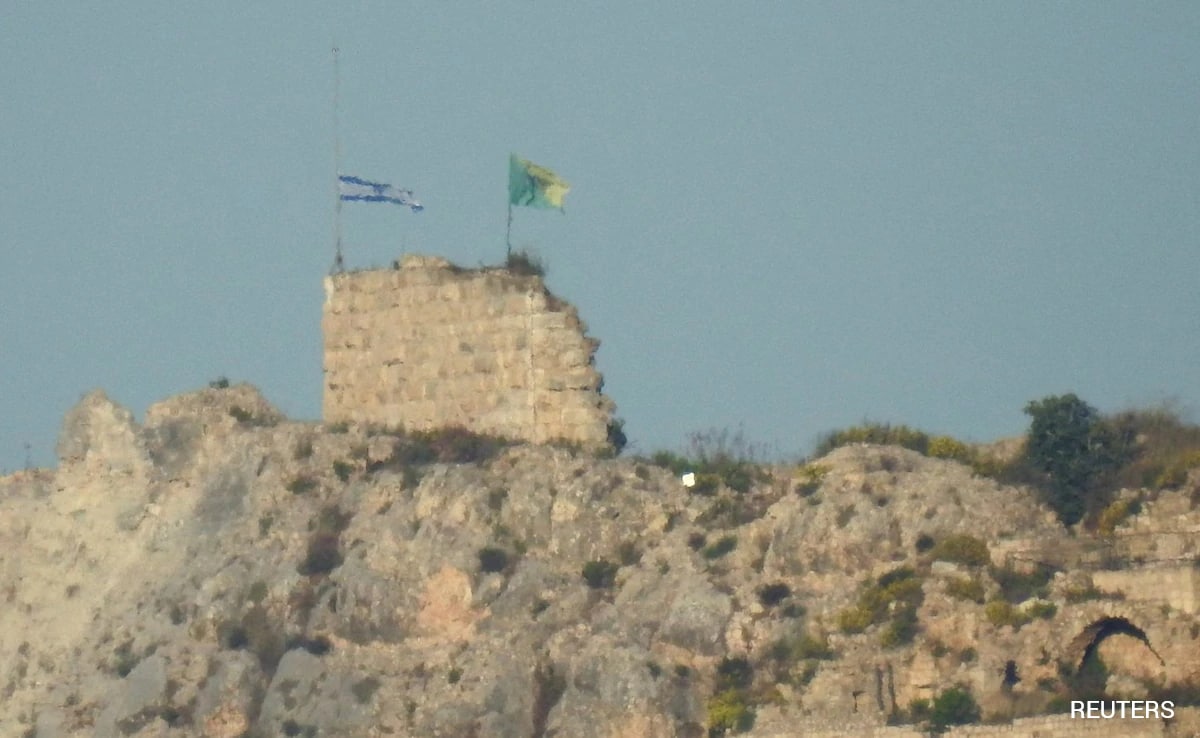
The media is obsessed with geography. When news broke that Israeli forces advanced to a historic castle in Lebanon—marking the deepest ground incursion in over a quarter of a century—the headlines practically wrote themselves. Analysts scrambled to dust off old maps, treating a stone fortress like a grand prize in a game of Risk.
They are asking the wrong question. They want to know what this foothold means for the map. They should be asking what it costs on the balance sheet of modern military attrition.
Military romanticism loves a fortress. The lazy consensus among mainstream defense analysts is that capturing a high-ground, historically significant structure represents a decisive tactical shift. It looks impressive on a live-tracking graphic. It sounds weighty in a press briefing. But in the theater of contemporary asymmetric warfare, planting a flag on a hill is often an expensive distraction disguised as a victory.
The High-Ground Fallacy in the Age of Precision
For centuries, military doctrine dictated a simple truth: hold the high ground, control the battlefield. That reality died the moment precision-guided munitions, loitering hardware, and decentralized drone networks became standard issue.
I have spent years analyzing regional security architectures and watching defense ministries pour billions into holding symbolic geography, only to watch those positions become static targets. When you occupy a highly visible, historically fixed point, you are not projecting power. You are advertising your exact coordinates.
Consider the mechanics of modern reconnaissance. A medieval castle was built to withstand siege engines and arrows. It was designed for a time when sightlines were limited to the human eye. Today, thermal imaging, synthetic aperture radar, and low-earth-orbit surveillance render stone walls obsolete. By consolidating forces at a single prominent landmark, an advancing military shifts from a fluid, unpredictable maneuver unit into a fixed line item on an opponent's targeting manifest.
The assumption that deep penetration equals control is the first premise that needs dismantling. In unconventional theaters, lines on a map are an illusion.
The Logistics Tax of Symbolic Victories
Every kilometer deeper an armored column pushes into hostile territory, its operational vulnerability does not increase linearly—it multiplies exponentially.
Let us look at the brutal arithmetic of supply lines. A forward operating position requires a continuous stream of fuel, ammunition, clean water, and medical evacuation capabilities. When that position is a historic site nestled in rugged, elevated terrain, the logistics tax becomes exorbitant.
- Conforming Corridors: Mountainous supply routes are predictable. Predictability is fatal when facing decentralized squads equipped with modern anti-tank guided weapons (ATGWs).
- Force Asymmetry: It takes five times the complement of personnel to secure a supply corridor than it does to hold the actual objective at the end of it.
- Resource Diversion: Elite maneuvering units end up repurposed as glorified highway security guards, draining momentum from the broader strategic objective.
Western militaries learned this lesson the hard way in the rugged valleys of Afghanistan. You can hold a peak for months, lose dozens of vehicles keeping it supplied, and realize the adversary simply walked around you to operate in the valleys behind your lines. The enemy does not fight for the castle; they fight for the gaps between your points of control.
Dismantling the People Also Ask Premise
Whenever an event like this occurs, public curiosity focuses on historical precedents and distance milestones. The internet wants to know: Is this the deepest incursion since 2000? Or Does holding this castle protect the border?
Answering these questions honestly requires discarding the political theater. Yes, mathematically, it may be the deepest advance in twenty-six years. But measuring modern military efficacy by kilometers advanced is like measuring the quality of software by the number of lines of code written. It is a metric used by people who do not understand how the system works.
Does holding a historic castle protect a border? No. A stone fortress cannot intercept a short-range rocket. It cannot detect a cross-border tunnel network dug through limestone kilometers away. It does not stop an uncrewed aerial vehicle flying twenty meters above the tree line.
The premise that physical occupation of a historic landmark yields security is fundamentally flawed. Security in modern conflict is achieved through intelligence dominance, rapid interception capabilities, and political resolution—not by pretending to be crusaders holding a redoubt.
The Unintended Consequence of Deep Penetration
There is a distinct downside to challenging the conventional wisdom of territorial gains, and it lies in the psychological domain of warfare. While an objective may be a logistical nightmare, the domestic political capital generated by "capturing a castle" is intoxicating. Governments run on optics.
But optics are a wasting asset.
When you push deep into an adversary's backyard to capture a symbol, you hand them a powerful narrative tool. You provide a unifying focal point for decentralized resistance cells. In asymmetric warfare, the occupant of the castle becomes the target in a shooting gallery. The adversary does not need to recapture the fortress; they merely need to make staying there too expensive to sustain.
If you want to achieve actual strategic stability, you do not march toward the most obvious landmark on the horizon. You disrupt the enemy's network, degrade their command infrastructure, and maintain maximum mobility. You stay fluid.
Stop looking at the map through a 19th-century lens. The capture of a historic castle is not a paradigm shift or a masterstroke. It is a high-stakes logistical gamble wrapped in a public relations campaign. The side that wins the current conflict will not be the one holding the oldest stones; it will be the one that understands geography is no longer the ultimate prize.