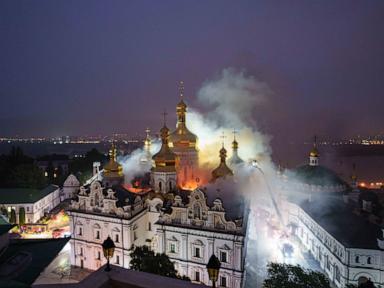
Western media loves a spectacle of destruction. When a Russian missile strike tears through a high-profile target or damages a historic religious site in Ukraine, the headlines write themselves. They scream about a new escalation, a demonstration of overwhelming force, or a catastrophic shift in the war's momentum.
It is a narrative built entirely on a flawed premise.
If you are looking at smoke rising from a civilian center and seeing a display of tactical dominance, you are misreading the modern theater of war. Air superiority is not measured in broken glass or tragic body counts. It is measured in the systematic degradation of an adversary's operational capacity.
By that metric, these high-profile, multi-million-dollar barrages are not a sign of strength. They are an admission of structural bankruptcy.
The Arithmetic of Depletion
Let us strip away the emotional framing and look at the brutal math of defense economics. A single Kalibr cruise missile costs roughly $1.2 million to manufacture. An Kh-101 can push past $13 million depending on the variant and guidance package.
When a military entity fires dozens of these high-value assets into non-military logistics nodes or symbolic architecture, it is spending capital it cannot easily replace. Russia's domestic production lines, heavily choked by supply chain bottlenecks and microchip scarcity, cannot match this burn rate.
Military analysts from organizations like the Royal United Services Institute (RUSI) have repeatedly pointed out that strategic bombing campaigns against civilian infrastructure rarely, if ever, force a capitulation. Instead, they produce two distinct counter-effects:
- Logistical redirection: They force the defending nation to optimize its air defense grid, pulling short-range systems like Gepards or NASAMS into tighter, more lethal domestic umbrellas.
- Political cohesion: They harden civilian resolve and eliminate the political viability of compromise, while accelerating the delivery of sophisticated Western hardware like Patriot batteries.
Firing a $10 million weapon to damage a target with zero kinetic value to the frontline is a logistical failure masked as a psychological victory. It is the military equivalent of burning your own furniture to keep the house warm.
The Flawed Premise of Terror Bombing
The mainstream press routinely treats these barrages as a cohesive strategy designed to break Ukraine's will. This view ignores a century of military data.
During World War II, the Allied bombing of German cities did not collapse German industrial output; production actually peaked in 1944 amidst the heaviest raids. The Blitz did not break British morale; it consolidated it.
To suggest that Russia is executing a brilliant, terrifying master plan by striking urban centers is to give their command structure far too much credit.
The reality is far messier. These strikes are often the result of intelligence obsolescence. In many cases, Russian forces are firing missiles based on target coordinates that are weeks or months old, aiming for supply depots or troop concentrations that moved long ago. When the missile hits, it strikes whatever happens to be standing there now—often a residential block or a cultural landmark.
To call this a targeted campaign of calculated terror implies a level of precision and real-time tracking that the Russian military simply does not possess in this theater. It is not precision terror. It is expensive blindness.
Why the Defensive Grid is Winning the Long Game
The real story of these barrages is the quiet success of attrition defense.
Every time a multi-axis missile strike is launched, it acts as a stress test for Ukraine's integrated air defense system. Early in the conflict, intercept rates were dangerously low. Today, even during massive, coordinated saturation attacks involving low-flying drones and ballistic assets simultaneously, intercept success rates routinely cross the 75% threshold.
Consider the operational reality for a commander on the ground:
- Detection: Long-range radar and Western airborne early warning platforms pick up the launch signatures almost instantly.
- Layering: Mobile defense teams handle low-cost loitering munitions, saving expensive interceptor missiles for high-speed cruise profiles.
- Depletion: The attacker expends their limited stockpile of precision-guided munitions, while the defender's interceptor inventory is backed by the industrial capacity of a multi-nation coalition.
The current strategy of throwing massive volume against a constantly adapting defensive grid is unsustainable for Russia. They are trading finite, high-tech hardware for short-term media dominance.
The Industrial Reality
I have spent years analyzing manufacturing pipelines and procurement cycles in highly restricted defense environments. I know what a healthy industrial base looks like. This isn't it.
Russia has been forced to cannibalize commercial technology—pulling semiconductors out of consumer appliances—just to keep their missile assembly plants moving. They are relying on third-party states for low-tier ammunition and basic strike drones.
When you see a major barrage, you are not looking at a sustainable operational tempo. You are looking at a military that has accumulated inventory over months of quiet hoarding, only to dump it all in a single, politically motivated spasm to satisfy hawks in Moscow who demand visible action.
The downside to analyzing the war this way is obvious: it offers no immediate comfort to the populations living under the threat of these strikes. A poorly aimed missile kills just as effectively as a perfectly targeted one. The human cost remains devastatingly real. But conflating human tragedy with strategic efficacy is the exact mistake the Kremlin wants Western media to make.
Stop asking how Ukraine can survive these periodic barrages. Start asking how much longer Russia can afford to buy headlines with its remaining strategic reserve.
The next time a massive strike flashes across your screen, ignore the smoke. Count the missiles, look at the factory output realities, and recognize the desperation of a military that has run out of ways to win on the actual battlefield.