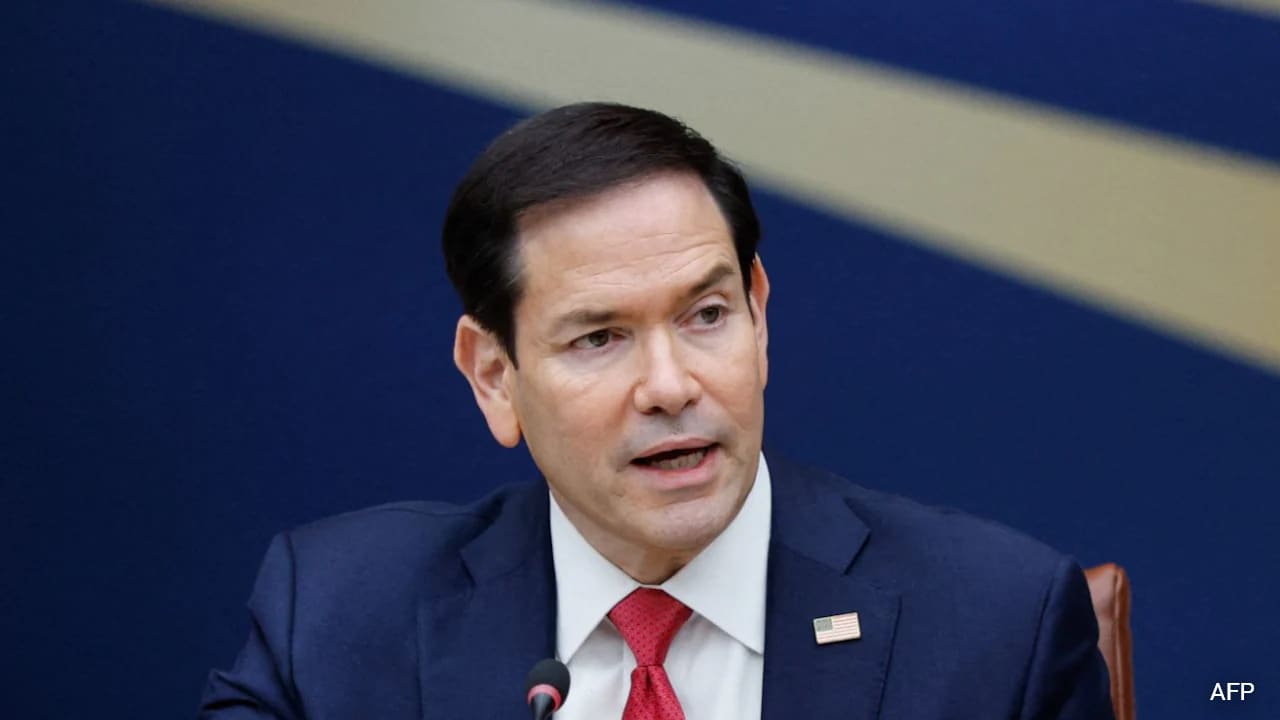
Public messaging from the executive branch regarding Tehran operates on a deliberate dual-track system that confuses surface-level observers while serving a precise deterrent function. When Secretary of State Marco Rubio explicitly rejects the premise of a diplomatic breakthrough with Iran at the exact moment President Donald Trump characterizes military strikes as highly unlikely, the administration is not exhibiting internal disorganization. Instead, Washington is executing a classic coercive bargaining posture designed to freeze an adversary's decision-making loop. By simultaneously closing the door on premature concessions and lowering the immediate temperature on kinetic escalation, the United States forces Tehran into a strategic holding pattern where neither military provocation nor diplomatic stalling yields immediate leverage.
Standard geopolitical reporting treats these two statements as a contradiction—a hawkish chief diplomat clashing with a risk-averse commander-in-chief. That framing fails because it evaluates political rhetoric as literal policy commitments rather than signaling mechanisms within an ongoing game-theoretic negotiation. To understand the actual trajectory of US-Iran relations, analysts must separate public posturing from operational constraints, map the cost functions of both administrations, and examine how asymmetric signaling alters the calculus of regional deterrence.
The Architecture of Dual-Track Signaling
In international relations theory, coercive diplomacy relies on the calibrated manipulation of risk. Thomas Schelling defined this dynamic as the threat that leaves something to chance. When an administration presents a unified front of pure aggression, it backs the adversary into a corner where preemptive escalation becomes the only rational survival strategy. Conversely, a unified front of pure conciliation signals weakness, inviting the adversary to extract maximum concessions while continuing malign activities.
The juxtaposition of Rubio’s diplomatic rejection and Trump’s kinetic dismissal solves this signaling dilemma through institutional division of labor.
- The Diplomatic Ceiling (State Department): By publicly dismissing reports or rumors of a breakthrough, Rubio establishes a high baseline for any future agreement. This posture neutralizes Tehran’s primary diplomatic tactic: dragging out negotiations to secure incremental sanctions relief without dismantling its core nuclear or regional proxy infrastructure. Setting a hard ceiling communicates to domestic audiences, regional allies, and Iranian negotiators that the price of entry for formal talks remains total structural compliance, not cosmetic freezes.
- The Kinetic Floor (White House): By stating that military strikes are highly unlikely, Trump removes the immediate existential panic that drives Tehran toward irrational escalation. A regime convinced it will be bombed within seventy-two hours has zero incentive to restrain its regional proxies or halt uranium enrichment. Lowering the perceived probability of an imminent strike buys time for economic pressure to compound without triggering a catastrophic regional war that would spike global energy prices and entangle US ground assets.
This separation of messaging creates a narrow corridor for Iranian leadership. Tehran cannot claim victory through an imminent diplomatic deal, nor can it rally domestic and regional support around an imminent American invasion.
Deconstructing the Diplomatic Rejection
Marco Rubio’s refusal to validate narratives of a diplomatic breakthrough addresses a specific vulnerability in Western negotiating history with the Islamic Republic. Over the past two decades, diplomatic engagements with Tehran have repeatedly fallen into a predictable trap: the illusion of momentum.
When senior US officials acknowledge progress before verifiable concessions occur, three immediate consequences degrade American leverage:
- Sanctions Erosion: Global financial markets and third-party buyers—particularly independent refiners in Asia—interpret diplomatic optimism as a precursor to relaxed enforcement. Oil purchases from Iran increase immediately, injecting billions of dollars in hard currency into Tehran’s treasury before a single centrifuge is unplugged.
- Allied Hedging: Regional partners in the Gulf and Israel adjust their security postures when they suspect Washington is pursuing a bilateral accommodation. If allies believe the United States is softening its stance, they either hedge by cutting separate, suboptimal deals with Tehran or act unilaterally to sabotage the emerging diplomatic track.
- Domestic Political Fracture: Signaling openness to a deal with Tehran without concrete, upfront concessions triggers immediate legislative resistance in Washington, constraining the executive branch's room to maneuver.
Rubio’s hard rejection functions as a market-correcting mechanism. By killing breakthrough speculation in its infancy, the State Department maintains maximum enforcement pressure on Iranian oil exports and banking networks. The operational logic is straightforward: if Tehran wants the economic lifeline that comes with diplomatic legitimacy, it must first pay the upfront cost of dismantling its enrichment capacity and severing logistical pipelines to regional militias.
The Verification Bottleneck
A secondary driver behind the rejection of a breakthrough is the technical reality of Iran’s nuclear program. Unlike earlier phases of the standoff, where reversing nuclear progress required rolling back nascent research, Iran’s current breakout timeline is measured in days or weeks rather than months.
In this environment, an interim agreement—such as a "freeze-for-freeze" arrangement where Iran caps enrichment at sixty percent in exchange for limited asset unfreezing—is strategically worthless to Washington. A freeze leaves the knowledge base, advanced centrifuge cascades, and fortified underground facilities intact. Rubio’s posture reflects an institutional recognition that any agreement failing to achieve irreversible dismantlement merely subsidizes a threshold nuclear state.
The Cost Function of Kinetic Restraint
While the State Department locks down the diplomatic flank, the White House’s characterization of military strikes as highly unlikely reflects a cold calculation of military, economic, and political cost functions. A direct kinetic campaign against Iranian nuclear and military infrastructure is not a surgical, single-night operation; it is the opening salvo of a multi-theater attrition conflict.
Evaluating the decision matrix for a military strike requires weighing four distinct variables:
1. Target Hardening and the Limits of Airpower
Iran has spent two decades burying its most critical nuclear assets beneath solid granite at facilities like Fordow and Natanz, specifically engineered to withstand conventional bunker-busting munitions. Destroying these sites from the air requires sustained, multi-wave sorties utilizing heavy bombers and specialized ordnance, alongside the complete suppression of Iranian integrated air defense systems. Even an optimal bombing campaign sets the physical infrastructure back by a few years while permanently cementing the political will in Tehran to rebuild covertly and weaponize immediately.
2. Regional Asymmetric Retaliation
Tehran’s primary deterrent is not its conventional air force or navy, which would be neutralized rapidly, but its distributed network of ballistic missiles, one-way attack drones, and regional proxy forces. A US strike on Iranian soil triggers an immediate, multi-front response targeting:
- US bases and personnel across Iraq, Syria, Jordan, and the Gulf states.
- Critical desalination plants and energy infrastructure in Saudi Arabia and the United Arab Emirates.
- Commercial maritime traffic transiting the Strait of Hormuz and the Bab el-Mandeb Strait.
3. Global Macroeconomic Shock
Roughly twenty percent of the world's petroleum liquids consumption passes through the Strait of Hormuz. Even a temporary disruption caused by naval mines, anti-ship cruise missiles, or spiked maritime insurance premiums would drive crude oil prices sharply upward. For an administration prioritizing domestic inflation control and economic growth, triggering an energy-induced global recession is an unacceptable political and strategic cost unless vital national security interests are directly attacked.
4. Force Allocation Across Global Theaters
Every carrier strike group, aerial refueling tanker, and Patriot air defense battery deployed to the Central Command area of responsibility is an asset unavailable for deterrence in the Indo-Pacific. High-intensity conflict in the Middle East consumes precision-guided munitions—such as SM-6 interceptors and Tomahawk cruise missiles—at rates that exceed current US defense industrial base replenishment capacities. Restraint preserves strategic bandwidth for peer-level competition.
The Friction Between Rhetoric and Operational Reality
The primary limitation of this dual-track strategy is its reliance on disciplined execution and predictable adversary behavior. Coercive bargaining works only when both sides understand the red lines and possess the command-and-control architecture to prevent accidental escalation.
Three specific failure modes threaten to collapse this delicate equilibrium:
- Proxy Autonomy: Tehran exercises varying degrees of operational control over its regional partners. While Hezbollah or Iraqi militias generally align with Iranian strategic directives, groups like the Houthis in Yemen possess independent domestic incentives. A rogue missile strike that causes mass American casualties would instantly invalidate the White House’s preference for kinetic restraint, forcing a retaliatory strike regardless of macroeconomic consequences.
- The Misinterpretation of Restraint: Authoritarian regimes frequently misread democratic restraint as a lack of political will. If the leadership in Tehran interprets Trump’s dismissal of strikes as a permanent guarantee of immunity rather than a conditional pause, they may accelerate covert weaponization activities, pushing past the threshold where Washington is forced to act militarily under far worse tactical conditions.
- Allied Divergence: Israel operates on a fundamentally different threat timeline than the United States. While Washington can absorb the risk of a threshold Iran managed through containment and economic pressure, Jerusalem views an Iranian nuclear weapon as an immediate existential threat. If Rubio’s diplomatic rejection confirms that no negotiated dismantlement is forthcoming, and Trump’s kinetic restraint signals that the US will not lead a strike, Israel faces heightened pressure to act independently—a move that would inevitably draw the United States into the conflict anyway.
Executing Strategic Containment
Navigating this impasse requires moving beyond reactive public statements toward a structured, multi-layered containment architecture. Because neither a comprehensive diplomatic grand bargain nor a preventative war offers an acceptable risk-to-reward ratio, US policy must optimize for long-term attrition and deterrence stability.
The execution of this strategy requires four synchronized operational steps:
- Enforce Secondary Sanctions Rigorously: Diplomatic rejection only carries weight if economic isolation is real. Treasury and State Department officials must target the financial intermediaries, ship-to-ship transfer networks, and port operators facilitating illicit Iranian crude sales, raising the transaction costs for Tehran until foreign exchange reserves are depleted.
- Harden Regional Force Posture: Rather than deploying offensive strike packages that signal imminent war, the Pentagon must prioritize integrated air and missile defense networks across Gulf partner nations. Demonstrating the ability to neutralize Iranian drone and ballistic missile salvos degrades Tehran’s primary asymmetric deterrent without firing an offensive shot.
- Maintain Ambiguity on Nuclear Red Lines: While keeping the threshold for conventional strikes high, Washington must communicate privately—through verified backchannels—that crossing specific enrichment or weaponization milestones will trigger an automatic, overwhelming military response. Public restraint must never translate into private permissiveness.
- Synchronize Intelligence and Interdiction with Allies: To prevent unilateral military surprises from regional partners, the intelligence community must establish joint real-time monitoring protocols focused on Iranian covert procurement and underground facility construction, pairing this with coordinated maritime interdiction of weapons shipments bound for regional proxies.
The current divergence in Washington’s messaging is a calculated holding pattern, not a permanent resolution. Over the coming quarters, Tehran will inevitably test the boundaries of Trump’s kinetic restraint through low-level proxy harassment or incremental nuclear advancements to see if the threshold for American military action is genuinely immobile. Washington must meet those probes not with hollow diplomatic concessions, nor with an immediate march to full-scale war, but with targeted, disproportionate financial penalties and covert interdiction that steadily raise the internal cost of the regime’s survival.


