Subsea telecommunications cables carry over 99% of transoceanic data traffic, serving as the physical backbone of the global digital economy. While often discussed in terms of technical resilience or accidental anchor drags, the deliberate targeting of this infrastructure has recently been elevated to a doctrine of strategic deterrence. Tony Robinson, CEO of Eurasian network operator RETN, posited that the capability to sever deep-sea cables could function as a deterrent akin to nuclear weapons. This comparison requires rigorous deconstruction. Nuclear deterrence relies on Mutually Assured Destruction (MAD)—a binary, high-attribution, total-war framework. Undersea cable interdiction operates in a fundamentally different strategic vector: gray-zone warfare characterized by deniability, asymmetric economic exposure, and low-threshold escalation.
To evaluate whether subsea infrastructure vulnerability can truly function as a deterrent, we must map the physical realities, economic dependencies, and strategic calculus of cable warfare.
The Structural Vulnerability of the Subsea Layer
The global subsea cable network is not an amorphous web; it is a highly concentrated physical system governed by geography, economics, and maritime bottlenecks. This physical reality creates discrete points of vulnerability that undermine simple models of network redundancy.
The Chokepoint Architecture
The global routing of data is constrained by continental shelves and geopolitical narrows. A significant percentage of intercontinental traffic funnels through a handful of geographic choke points:
- The Red Sea / Suez Canal Corridor: Connecting Europe to Asia, this narrow, shallow waterway contains dozens of critical cables, making it the single most vulnerable transit point for global data.
- The Luzon Strait: Positioned between Taiwan and the Philippines, this strait is a vital conduit for transpacific traffic and is highly susceptible to both seismic activity and naval blockades.
- The Strait of Malacca: The primary maritime gateway between the Indian and Pacific Oceans, where dense shipping traffic and shallow waters maximize the risk of both accidental and intentional cutting.
The Anatomy of a Cable System
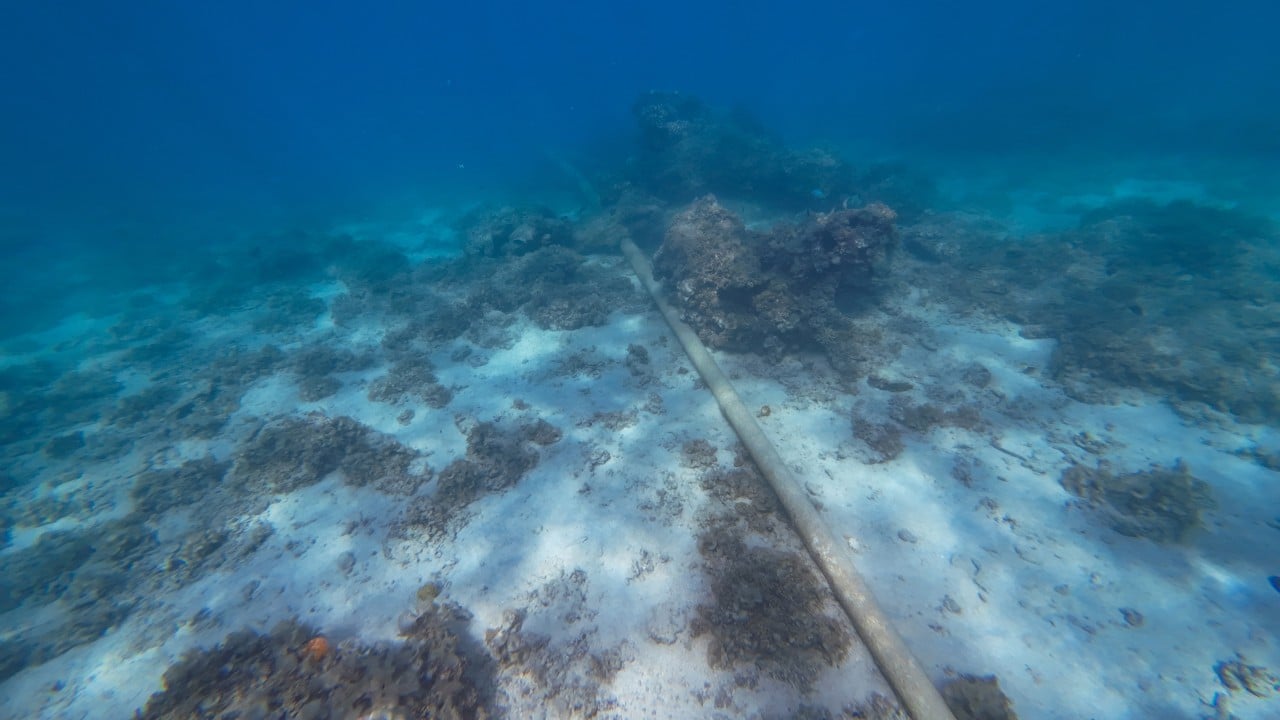
A common misconception is that subsea cables are massive, armored pipes. In reality, deep-sea cables—laid at depths of up to 8,000 meters—are roughly the diameter of a garden hose.
[Outer Polyethylene Jacket]
   └── [Mylar Tape]
        └── [Stranded Steel Wires (Armoring)]
             └── [Aluminum Water Barrier]
                  └── [Polycarbonate Tube]
                       └── [Copper Tube (Power Conductor)]
                            └── [Petroleum Jelly]
                                 └── [Optical Fibers]
In deep water, the heavy steel armoring is omitted because the primary threat is not maritime activity but pressure and current. This makes them trivial to sever with specialized deep-sea equipment, such as remote operated vehicles (ROVs), submersibles, or weighted grapnels deployed from civilian vessels acting as proxies.
The Deterrence Matrix: Nuclear vs. Subsea Interdiction
To test the hypothesis that cable cutting can mirror nuclear deterrence, we must analyze both mechanisms across four strategic pillars: cost of entry, attribution, escalation control, and target vulnerability.
| Strategic Attribute | Nuclear Deterrence | Subsea Cable Interdiction |
|---|---|---|
| Barrier to Entry | Extremely high (fissile material, advanced rocketry) | Low to moderate (commercial maritime tech, ROVs) |
| Attribution Speed | Instantaneous (satellite launch detection, seismic signatures) | Delayed or ambiguous (gray-zone operations, deniable proxies) |
| Escalation Threshold | Binary (total peace or total annihilation) | Incremental (localized disruptions to systemic chaos) |
| Economic Self-Harm | Absolute destruction of the actor | Asymmetric (depends on domestic data sovereignty) |
The Attribution Bottleneck
Nuclear deterrence works because the origin of a missile launch is immediately known. If Country A launches an ICBM at Country B, Country B’s early warning systems detect the thermal signature within seconds, triggering an immediate retaliatory strike.
Subsea interdiction operates under a veil of strategic ambiguity. A cable severed in the deep ocean may not be discovered for hours or days. Pinpointing the cause requires sending a specialized repair ship to fish the cable from the seabed. Determining whether a break was caused by an underwater landslide, an commercial fishing trawler's anchor, or a state-sponsored saboteur is technically difficult and politically fraught. This ambiguity dilutes the threat of immediate retaliation, weakening the core mechanic of traditional deterrence.
The Escalation Ladder
Nuclear weapons sit at the absolute top of the escalation ladder. Their use signals the end of conventional diplomacy and the commencement of total war. Cable cutting, conversely, is a tool of the gray zone—the space between normal state competition and open armed conflict.
An adversary can sever a single cable to signal capability, two to inflict targeted economic pain, or an entire corridor to blindingly disrupt communications during a parallel conventional operation. Because the immediate casualty count of a cable cut is zero, the victim nation faces a proportional response dilemma. Responding to a digital and economic disruption with conventional kinetic force risks being viewed as the aggressor.
The Asymmetric Cost Function
For an asset to act as a deterrent, its destruction must impose an unacceptable cost on the adversary while preserving the safety of the holder. In the context of subsea cables, this cost function is highly asymmetric and favors nations with specific economic and structural characteristics.
Data Sovereignty and Geography
The vulnerability of a state to cable warfare depends heavily on its geography and the architecture of its domestic internet.
- Island Nations and Lit Environments: The United Kingdom, Japan, and the United States are deeply reliant on transoceanic cables for international commerce, financial transactions, and military command-and-control.
- Continental Landmasses: Nations like Russia and China possess extensive terrestrial fiber networks connecting them directly to Eurasia. While they still rely on subsea cables for global reach, their critical domestic and regional communications can pivot to land-based infrastructure.
This asymmetry means that a threat to sever global subsea infrastructure does not carry the same weight for all actors. A state less dependent on Western financial systems and transoceanic data flows can use the threat of cable destruction to hold a highly digitized adversary hostage, without fearing an equivalent level of economic devastation from a counter-cut.
The Financial System Vulnerability
The true target of systemic cable interdiction is not streaming video or consumer communications; it is the global financial architecture. The Society for Worldwide Interbank Financial Telecommunication (SWIFT) and automated high-frequency trading platforms rely on the low-latency paths provided by subsea fiber.
A coordinated strike on the transatlantic or transpacific cable corridors would stall clearinghouses, freeze liquidity, and halt international supply chains. The economic damage would not be measured in the cost of repairing the physical line (millions of dollars), but in the systemic shock to global GDP (trillions of dollars).
Technical Deficiencies in Current Repair and Redundancy Frameworks
The argument against the potency of cable cutting as a weapon usually rests on network resilience. Optimists point out that the internet is designed to route around damage. If Cable A is cut, traffic automatically shifts to Cable B. While this is true for localized or accidental cuts, the framework collapses under a coordinated, multi-point interdiction strategy due to severe operational bottlenecks.
The Repair Ship Bottleneck
The global fleet of dedicated cable-laying and repair vessels is dangerously small, consisting of fewer than 60 active ships worldwide. Most of these vessels are operated by private consortia and are stationed in specific quadrants to service commercial faults.
[Cable Cut Detected]
   └── [Mobilize Repair Vessel: 3-5 Days]
        └── [Transit to Site: 2-7 Days]
             └── [Grappling & Splicing Operations: 5-10 Days]
                  └── [System Restored (Total Elapsed Time: 2-3 Weeks)]
If an adversary severs multiple critical cables simultaneously within a specific region (e.g., the North Sea or the Mediterranean), the demand for repair ships will instantly outstrip supply. Furthermore, these civilian vessels are completely unprotected. In a conflict scenario, an adversary could easily deny access to the repair zone using conventional naval assets or sea mines, stretching a temporary outage into months of continuous disruption.
Capacity Saturation and Latency Spikes
While routing protocols like BGP (Border Gateway Protocol) can dynamically redirect data when a path goes dark, the remaining cables do not possess infinite surplus capacity. Shunting the traffic of five transatlantic cables onto the remaining three results in immediate bandwidth throttling, packet loss, and severe latency spikes. For enterprise cloud architectures, synchronized financial markets, and military drone operations, this degradation is functionally equivalent to a complete outage.
Operational Reality over Nuclear Analogy
The assertion that deep-sea cable cutting is a weapon of deterrence equivalent to nuclear weapons is structurally flawed. It conflates the raw destructive potential of a kinetic weapon with the asymmetric friction of infrastructure sabotage.
Cable cutting does not deter war through the threat of total annihilation; instead, it provides a highly calibrated mechanism for coercion, blindness, and economic disruption below the threshold of open warfare. It is a weapon of leverage, not of stalemate.
To counter this asymmetry, defensive strategies must shift away from the illusion of absolute physical security for thousands of miles of underwater line. Instead, efforts must focus on:
- Hardening the repair supply chain by subsidizing domestic, state-controlled fleets of repair vessels.
- Developing rapidly deployable low-Earth orbit (LEO) satellite constellations specifically configured to temporarily absorb critical government and financial data loads when maritime routes fail.
- Establishing clear international doctrines that explicitly define coordinated attacks on critical telecommunications infrastructure as acts of aggression triggering collective kinetic defense protocols.