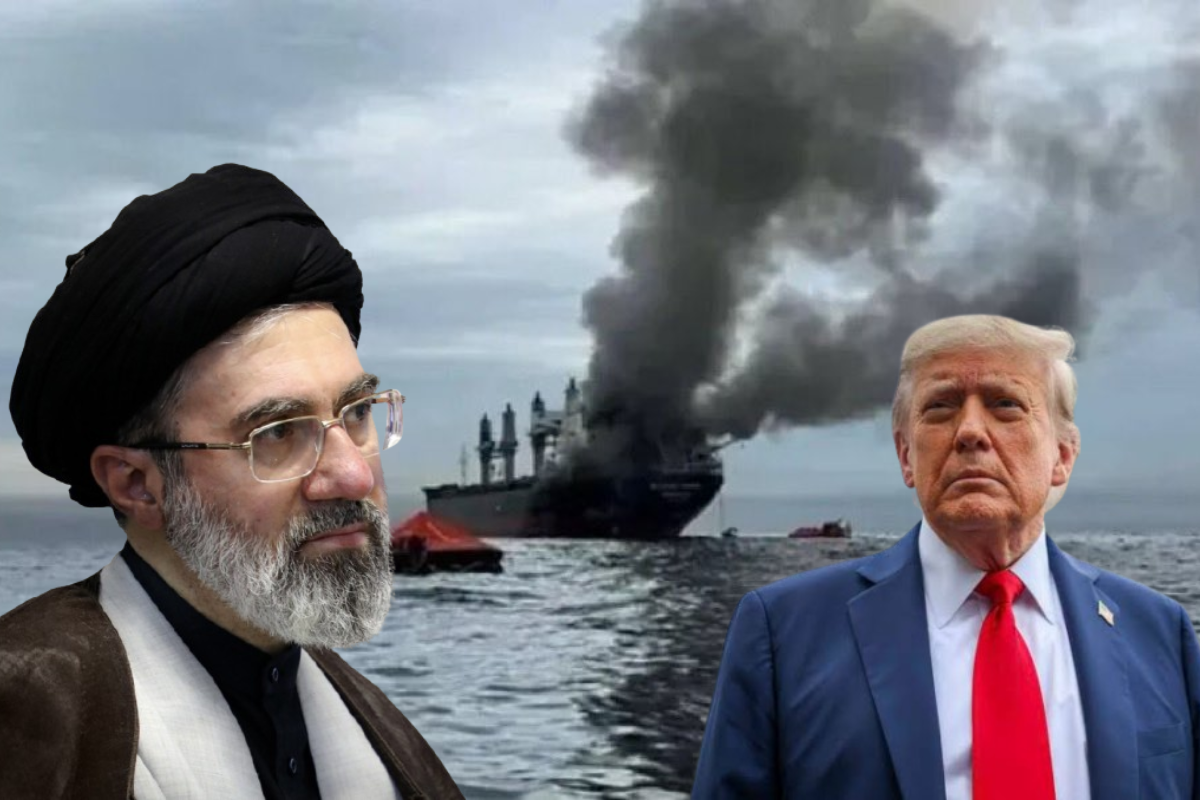
Every time Washington drops ordnance in the Middle East, the media machine spins up the same tired panic porn. Tehran rolls out the tired script. They flash their teeth, scream about closing the Strait of Hormuz, and pump out breathless warnings that the global economy is two seconds away from plunging into a permanent dark age. The headlines write themselves. Analysts on cable news sweat through their makeup explaining how a chokepoint handling a massive chunk of the planet's petroleum supply is about to turn into a naval graveyard.
It is theatre. Pure, unadulterated geopolitics for the masses.
I have watched desks panic over these empty threats for over a decade. I have seen junior traders lose their shirts shorting crude based on bellicose Persian press releases, while veteran desks quietly buy the dip knowing the exact math of the region. The lazy consensus says a closed Strait means global economic collapse. The reality is far more cynical, much more structural, and entirely ignored by people who mistake volume for capability.
Let us dismantle the mythology of the ultimate maritime chokehold.
The Physical Geography Of A Paper Tiger
To understand why Tehran cannot and will not shut down the Strait of Hormuz, you have to look past the fiery rhetoric and stare at the bathymetry and the geography.
The Strait is roughly twenty-one miles wide at its narrowest point. That sounds tight. It sounds defensible. But the inbound and outbound shipping lanes are each only two miles wide, separated by a two-mile buffer zone. This creates a designated maritime highway sitting almost entirely within the territorial waters of Oman, not Iran. Under international maritime law, specifically the concept of transit passage enshrined in the United Nations Convention on the Law of the Sea, commercial vessels have a legal right to navigate these waters continuously and expeditiously.
When Iranian officials stand at podiums and swear they control every drop of water moving through that corridor, they are relying on public ignorance. They do not own the whole channel. They share it. More importantly, their military posture in the Persian Gulf is asymmetrical, designed for harassment and domestic chest-beating, not sustained power projection against a modern naval coalition.
Imagine a scenario where the Islamic Revolutionary Guard Corps attempts to mine the entire channel or sink a fleet of supertankers to block traffic. What happens the next morning?
The United States Fifth Fleet, stationed right across the water in Bahrain, alongside regional allies who have zero appetite for economic strangulation, wakes up. Within seventy-two hours, Iranian naval assets—the aging patrol boats, the makeshift missile batteries, the coastal radar sites—would be systematically dismantled from the air and sea. Tehran knows this calculus better than anyone else. Their entire strategic doctrine relies on staying just below the threshold of total war. A full closure of the Strait crosses that threshold instantly. It is an act of economic suicide that invites immediate, kinetic devastation.
The Addiction To High Oil Prices
Here is the dirty secret nobody in the establishment wants to admit: Iran needs high oil prices to survive, but they need the oil to actually move to get paid.
Tehran operates on razor-thin margins thanks to decades of punishing international sanctions. Their primary customer is China, buying discounted crude through shadow tanker fleets that skirt Western tracking systems. If the Strait closes, Chinese refineries starve. Beijing does not tolerate disruptions to its energy lifeline out of ideological solidarity with Tehran; Chinese leadership views the Middle East through a strictly transactional lens.
If Iran cuts off the hands that feed it by stopping the flow of oil, Beijing will not applaud anti-imperialist defiance. Beijing will quietly greenlight whatever punitive measures are necessary to reopen the taps. The Chinese Communist Party values stability and energy security above all else. A rogue proxy choking off crude shipments is a liability, not an asset.
Furthermore, look at the internal balance sheet of the Iranian state. The regime uses external aggression as a pressure valve for domestic discontent. Whenever inflation spirals out of control, the currency craters, or citizens take to the streets demanding basic civil liberties, the state apparatus pivots hard toward military posturing against the West. Striking a defiant pose over Hormuz costs them nothing in domestic currency and plays well on state television. It is a distraction playbook running on an endless loop.
The Structural Irrelevance Of Chokepoints
We live in an era of hyper-fixation on physical chokepoints. People love the drama of a narrow waterway. Whether it is the Suez Canal getting blocked by a rogue container ship or Hormuz facing phantom threats from speedboats, the human brain loves a single point of failure narrative. It is clean. It makes for good television.
It also ignores how modern logistics actually work.
Energy markets are elastic, hyper-financialized, and adaptive. When physical supply routes face credible threats, the system reroutes. Pipelines like the Habshan-Fujairah oil pipeline in the United Arab Emirates bypass the Strait of Hormuz entirely, pumping millions of barrels of crude directly to the Gulf of Oman. Saudi Arabia maintains the East-West Pipeline, capable of moving millions of barrels from the Persian Gulf coast to the Red Sea.
These bypass assets are specifically designed to mitigate the exact geopolitical blackmail Iran attempts every time tensions flare. Yet, mainstream commentary routinely treats the Strait as an absolute monopoly on Middle Eastern energy export. It is not. It is merely the cheapest and most convenient route, not the only one left standing.
When you factor in the strategic petroleum reserves held by major consuming nations across the OECD, along with the surging production capacity of non-OPEC suppliers in the Western Hemisphere, a temporary disruption in the Gulf becomes a manageable pricing shock rather than an existential apocalypse.
The Cost Of Buying The Narrative
The danger is not that Iran will successfully seal off the Persian Gulf. The danger is that policymakers, corporate boards, and investors base multi-billion-dollar decisions on the lazy assumption that the Middle East is perpetually on the brink of total maritime paralysis.
I have seen corporate strategies paralyzed for quarters because a CEO watched a twenty-second clip of an Iranian speed boat harassing a cargo vessel. Capital gets misallocated. Risk premiums on shipping insurance skyrocket artificially, padding the bottom lines of maritime insurers while penalizing legitimate commerce. Entire portfolios get restructured around a worst-case scenario that has a near-zero probability of sustained execution.
Stop treating every press release from the Persian Gulf as a declaration of impending global catastrophe. Look at the balance of power. Look at the financial incentives. Look at the pipelines bypassing the water entirely.
The Strait of Hormuz belongs to geography, not to the loudest voice in Tehran. The next time the drums of war beat and the warnings roll across your screen, check the price of oil, check the shipping insurance rates, and remember who profits most from keeping you terrified of a paper tiger.