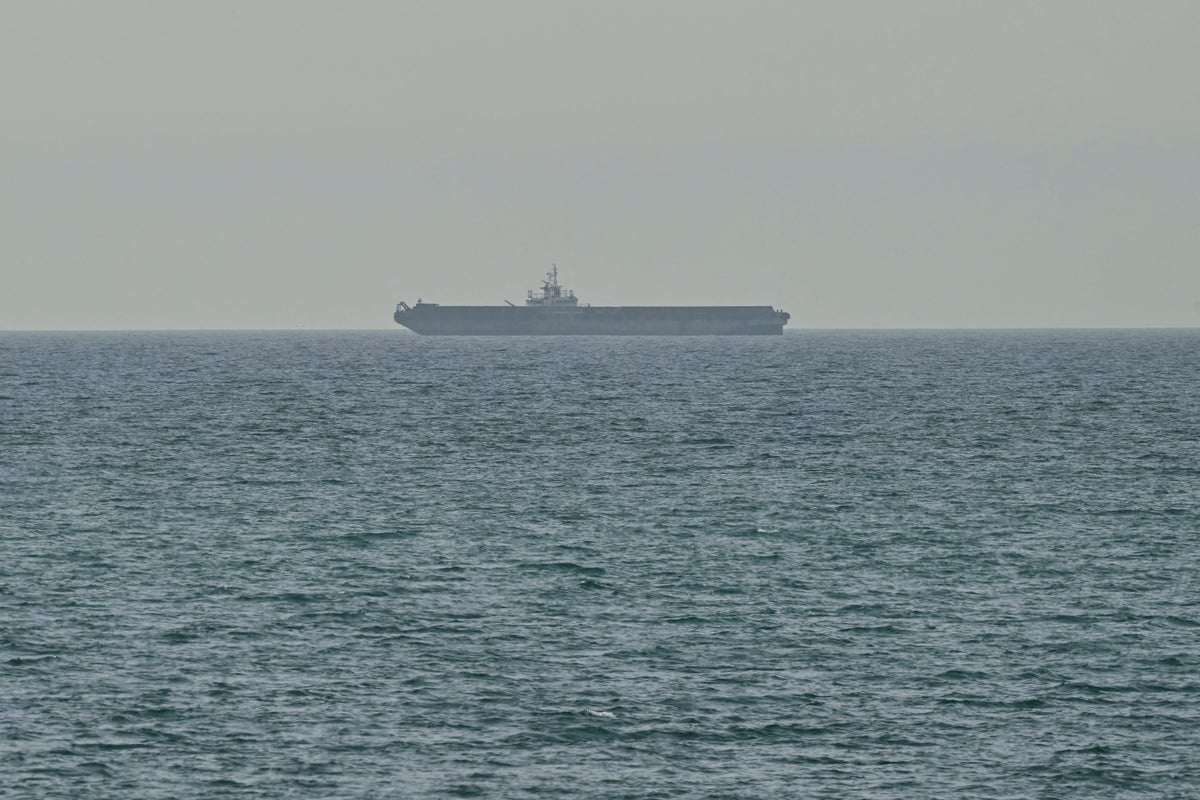
The maritime blockade of the Strait of Hormuz has long been the ultimate "red line" in global geopolitics. When the Trump administration pivoted toward a strategy of maximum pressure, the world braced for a tectonic shift in how oil flows from the Persian Gulf. Yet, months into this heightened posture, the reality on the water tells a story of expensive stalemates rather than decisive victories. While the rhetoric suggests a strangulation of illicit trade, the actual data reveals a complex game of cat-and-mouse where shadows are more prevalent than substance. The blockade is not a wall; it is a filter, and a porous one at that.
The Mechanics of a Modern Naval Sieve
To understand why a total blockade is functionally impossible, one must look at the sheer volume of traffic. The Strait is a narrow carotid artery, barely 21 miles wide at its tightest point, through which 20% of the world's total oil consumption passes daily. You cannot simply park a fleet of destroyers and hope for the best.
Modern blockades do not look like the wooden-ship cordons of the Napoleonic era. They are digital. They rely on the Automatic Identification System (AIS), satellite imagery, and ELINT (electronic intelligence). However, the "dark fleet"—a growing armada of aging tankers with opaque ownership—has mastered the art of "spoofing." These vessels disappear from digital maps in the Gulf of Oman and reappear days later, fully loaded, having swapped cargo in the middle of the night.
The U.S. Navy and its partners are forced to play a perpetual game of "Whac-A-Mole." Every time a specific Iranian vessel is flagged, it undergoes a name change, a flag-of-convenience swap, or a shell company transfer. The blockade is currently failing to stop the flow of sanctioned crude because the cost of enforcement is linear, while the ingenuity of smugglers is exponential.
The Crude Reality of Energy Markets
Oil is fungible. This is the fundamental truth that policy hawks often ignore. Once a barrel of oil hits the high seas, its origin becomes a matter of paperwork, and paperwork can be forged. The blockade has certainly increased the "risk premium" for shipping, but it has not halted the trade. Instead, it has created a lucrative shadow market.
Middlemen in Malaysia, the UAE, and Singapore have become the de facto clearinghouses for "grey" oil. By blending Iranian grades with other crudes, these entities can legally reclassify the product. The result? The oil still reaches its destination—often in East Asia—but the profits are diverted into a web of privateers and corrupt officials rather than the state treasuries the blockade was intended to protect.
The Insurance Bottleneck
If there is a true pressure point, it isn't the guns of a cruiser; it’s the ledgers of Lloyd’s of London. Most of the world’s shipping is insured by a handful of P&I (Protection and Indemnity) clubs based in the West. By threatening these insurers, the administration has successfully forced legitimate, Tier-1 shipping companies to avoid the region.
However, this has merely cleared the field for "rust buckets." Vessels that are past their prime, under-insured, and operating under flags like Comoros or Cook Islands are now the primary users of these lanes. We have traded a regulated, transparent shipping environment for a dangerous, unregulated one. A single collision or spill from one of these unmaintained tankers would cause an environmental catastrophe that no blockade could justify.
The Geopolitical Backfire
The intent of the blockade was to force a behavioral change in Tehran. Instead, it has deepened the military cooperation between Iran, Russia, and China. When you block the front door, you force the resident to build a tunnel to the neighbor’s house.
Russia, already an expert at bypassing Western sanctions, has provided the blueprint for the "ghost fleet" operations. China, the primary consumer, provides the political cover and the final port of call. This "Axis of Evasion" has turned the Strait of Hormuz into a testing ground for counter-sanction technologies. They are developing non-dollar payment systems and sovereign insurance schemes that bypass the Western financial grid entirely.
The blockade is inadvertently accelerating the very de-dollarization that the U.S. Treasury has spent decades trying to prevent. By using the Strait as a blunt instrument of financial warfare, the administration has signaled to every mid-tier power that the Western-led maritime order is conditional.
The Logistics of Escalation
What happens if the "tough talk" turns into actual kinetic intervention? The logistics of a hard blockade—where ships are physically boarded and seized—are a nightmare. The Strait is within easy reach of Iran’s coastal missile batteries and its vast fleet of "suicide" fast-attack craft.
A full-scale enforcement action would require the U.S. to establish air superiority over the entire Persian Gulf, a move that would be viewed as an act of war. The Pentagon knows this. This is why, despite the aggressive language from the State Department, the Navy’s Rules of Engagement (ROE) remain relatively conservative. They are there to monitor and deter, not to spark a global energy crisis by sinking tankers.
The Problem of Proportionality
If the U.S. seizes an Iranian tanker, Iran typically responds by seizing a British or South Korean tanker. This tit-for-tat cycle serves no strategic purpose. It merely drives up the cost of global shipping and forces allies to distance themselves from American policy. The blockade, in its current form, lacks a clear "off-ramp." Without a diplomatic component, it is a slow-motion collision with no winner.
The Economic Toll on Allies
While the U.S. is now a net exporter of energy, its allies in Europe and Asia are not. The blockade puts a disproportionate burden on Tokyo, Seoul, and New Delhi. These nations are being asked to sacrifice their economic stability for a regional policy they did not design and do not fully support.
We are seeing a quiet rebellion in the form of "special purpose vehicles" designed to facilitate trade outside the reach of the U.S. banking system. Even the closest European allies have explored ways to bypass the blockade's financial restrictions. When the goal is "maximum pressure," but you only have the cooperation of half the world, the pressure simply leaks out through the other side.
The Intelligence Gap
The most jarring aspect of the current blockade is the lack of verifiable success metrics. How much oil is actually being stopped? The administration points to a drop in official exports, but private intelligence firms like TankerTrackers.com often show a different picture.
The gap between "official" exports and "actual" flows is widening. This suggests that the blockade is more successful as a domestic political tool than as a foreign policy weapon. It projects strength to a home audience while the actual target continues to operate through the cracks. We are witnessing the theater of power, rather than the exercise of it.
The Unintended Beneficiaries
Ironically, the biggest winner of the Hormuz blockade might be the very commodity it seeks to control. By introducing constant volatility into the region, the blockade keeps oil prices higher than they would be in a stable market. This "war premium" provides a cushion for the producers it is meant to hurt.
Furthermore, the increased cost of shipping through the Strait has made alternative pipelines—such as those crossing Saudi Arabia to the Red Sea—more attractive. This shifts the regional balance of power in ways that have nothing to do with Iranian behavior and everything to do with long-term infrastructure dominance.
Shadow Boxing in the Gulf
The blockade of the Strait of Hormuz is a classic example of a 20th-century solution being applied to a 21st-century problem. In a world of decentralized finance, satellite-blind spots, and "flag-shopping," a naval cordon is an expensive anachronism. It is a show of force that lacks the precision to actually sever the ties it targets.
The tough talk will likely continue, and the Navy will continue to patrol those narrow waters. But as long as there is a buyer in the East and a willing smuggler in the West, the oil will keep moving. The blockade isn't stopping the clock; it’s just making the gears grind louder.
True maritime security requires a return to the rule of law and a collective agreement on the freedom of navigation. Attempting to weaponize the world’s most important waterway may yield a few headlines, but it will not yield a more stable world. The focus must shift from physical barriers to the financial and digital transparency that actually governs modern trade. Until then, the Strait remains a theater where the stakes are high, the rules are murky, and the outcome is anything but certain. Stop looking at the ships on the horizon and start looking at the ledgers in the shadows.