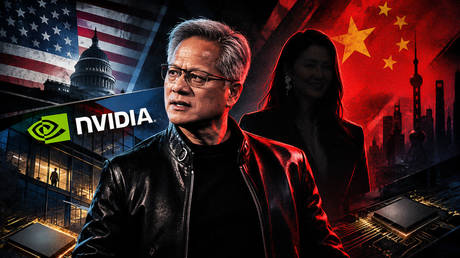
Silicon Valley loves a leather-jacketed messiah. Every tech cycle demands a single visionary to credit for a multi-trillion-dollar market cap, and right now, the financial press is busy canonizing Jensen Huang.
They point to his 1993 founding of Nvidia. They praise his 2006 bet on CUDA. They swoon over his grueling management style, his 60 direct reports, and his supposed psychic ability to see the generative AI boom coming decades before anyone else.
That narrative is lazy, historically inaccurate, and dangerously misleading for anyone trying to build or invest in modern technology.
Crediting Jensen Huang’s foresight for Nvidia’s dominance is like crediting a surfer for creating a tsunami. Huang didn't manufacture the AI wave. He survived long enough in a brutal, near-bankrupt semiconductor market until an accidental academic breakthrough washed over his hardware and turned a struggling graphics card company into an accidental monopoly.
If you want to understand how Nvidia actually conquered the world—and why its moat is far more fragile than Wall Street admits—you have to strip away the founder mythology and look at the cold, hard mechanics of timing, desperation, and sheer luck.
The Great Man Theory Is Poisoning Tech Strategy
I’ve watched dozens of enterprise founders and VCs burn hundreds of millions of dollars trying to "do a Jensen." They eliminate middle management, flatten their org charts to 50 direct reports, and pour billions into speculative R&D hoping to catch lightning in a bottle ten years down the road.
They fail every single time. Why? Because they are copying the survivorship bias, not the actual strategy.
The mainstream media treats Nvidia’s 30-year trajectory as a masterfully executed chess game. In reality, Nvidia spent its first two decades stumbling from one near-death experience to the next.
In 1995, Nvidia’s first chip, the NV1, was a commercial disaster. It used quadratic texture mapping instead of the polygon rendering that Microsoft’s DirectX standard adopted. Nvidia was weeks away from running out of cash. Huang had to lay off half the company and beg Sega—whose console contract they were failing to fulfill—to let them keep the remaining upfront cash just to stay alive.
Ten years later, in the mid-2000s, Nvidia got hit with the infamous "Bumpgate" scandal. Faulty underfill materials caused millions of laptop GPUs to fail prematurely, costing the company hundreds of millions in write-downs and tanking its stock price by nearly 80 percent.
Even the sacred cow of Nvidia’s origin story—the 2006 launch of CUDA—was not a grand masterstroke aimed at artificial intelligence.
CUDA was built to sell more video game graphics cards to scientists, oil and gas companies, and financial quants. Huang was desperately trying to find anyone outside of PC gamers to buy high-end GeForce chips because the gaming market had a hard ceiling. Deep learning wasn't even on the radar. In 2006, neural networks were considered an academic dead end—a laughingstock of computer science that had already caused two "AI winters."
Huang didn't predict the AI revolution. He built a general-purpose parallel computing tool to pad his margins, and six years later, three researchers in Toronto happened to use it to break the internet.
How Three Academics Accidentally Made Nvidia a Trillion-Dollar Company
If you want to pinpoint the exact moment Nvidia became a juggernaut, don't look at a boardroom in Santa Clara. Look at a basement lab at the University of Toronto in 2012.
Alex Krizhevsky, Ilya Sutskever, and Geoffrey Hinton were entering the ImageNet Large Scale Visual Recognition Challenge. Krizhevsky realized that training a deep convolutional neural network required massive matrix multiplication—the exact type of parallel math that GPUs used to render pixels in Call of Duty.
He bought two off-the-shelf Nvidia GTX 580 gaming cards from a retail store, wired them together, and trained AlexNet.
AlexNet crushed the competition, dropping the top-5 error rate from 26 percent to 15.3 percent. Overnight, the entire field of computer science abandoned traditional machine learning and pivoted to deep learning. And because Krizhevsky happened to write his code in CUDA, every single researcher on earth had to buy Nvidia hardware to replicate his results.
Imagine a scenario where AMD had released a usable parallel computing language in 2006 instead of letting its software stack rot. Or imagine Krizhevsky had used a cluster of PlayStation 3 consoles—which actually had powerful Cell processors that researchers were actively hacking for scientific computing at the time.
If either of those things happens, Jensen Huang is remembered today as a moderately successful CEO of a cyclical gaming hardware company, right alongside the executives who ran ATI or 3dfx.
Nvidia didn't capture the AI market through superior strategic vision. It was standing on the tracks when a runaway freight train hit, and it happened to have the only coupling mechanism that fit.
The Myth of the Flat Organization
Tech journalists love to fetishize Huang’s management structure. They marvel at the fact that he has roughly 60 direct reports, holds no one-on-one meetings, and forces every level of the company to sit in the same giant meetings so information flows "at the speed of light."
Let’s be brutally honest about what happens in real life when a CEO has 60 direct reports: nobody gets managed.
A human brain cannot effectively oversee 60 distinct business units, engineering leads, and operational heads. When you remove middle management and eliminate one-on-ones, you don't create an agile utopia. You create a Darwinian pressure cooker where senior executives spend half their week playing internal politics to get five minutes of the CEO's attention, and middle-tier engineers burn out from conflicting directives.
The only reason Nvidia’s chaotic structure hasn't imploded is because the company has been printing money at 75 percent gross margins for the last few years.
Success covers a multitude of organizational sins. When your stock price goes up 2,000 percent and every engineer on your payroll becomes a multi-millionaire, nobody complains about the lack of career coaching or the fact that the CEO hasn't reviewed their roadmap in six months.
Try running a 60-direct-report structure at a company with 15 percent margins and flat revenue. Your best talent will walk out the door within ninety days. Huang’s management style isn't a competitive advantage; it’s a luxury afforded by a temporary monopoly.
Did Jensen Huang Actually Build an Unbreakable Moat?
Ask any Wall Street analyst why Nvidia is untouchable, and they will parrot the exact same two-word answer: CUDA’s moat.
They will tell you that millions of developers know CUDA, that decades of libraries like cuDNN and TensorRT are locked into Nvidia’s silicon, and that switching to AMD, Intel, or custom ASICs is functionally impossible for enterprise buyers.
This is the most expensive misconception in modern technology.
Yes, CUDA was an impenetrable fortress between 2012 and 2022. Back then, AI researchers were writing raw C++ kernels directly against Nvidia’s hardware. Switching architectures meant rewriting thousands of lines of low-level code from scratch.
That world no longer exists.
Today, almost nobody writes raw CUDA. Developers write in PyTorch, JAX, and Triton. These are high-level abstraction layers that sit on top of the hardware.
In 2023 and 2024, OpenAI, Meta, and Google realized that paying the "Nvidia tax"—forking over $30,000 to $40,000 per H100 or Blackwell GPU with 80 percent markups—was an existential threat to their business models. So they systematically dismantled CUDA’s lock-in from the top down.
- OpenAI created Triton, an open-source programming language that allows researchers to write highly efficient GPU code without touching CUDA.
- PyTorch 2.0 introduced native compilation backends that seamlessly route workloads to AMD’s ROCm, Google’s TPUs, and AWS’s Trainium chips with minimal code changes.
- Hyperscalers built custom silicon. Google runs almost all of its frontier Gemini models on its own TPUs. Amazon is scaling Trainium and Inferentia. Meta is deploying its MTIA chips. Microsoft is rolling out Maia.
The software moat that supposedly made Nvidia invincible is evaporating in real time. CUDA isn't a permanent lock-in anymore; it’s a legacy tax that the richest companies on earth are actively engineering around.
What Everyone Gets Wrong About Nvidia’s "Full-Stack" Strategy
When you point out that hyperscalers are building their own chips, Nvidia bulls immediately pivot to their backup argument: "Nvidia isn't a chip company anymore! They're a data center infrastructure company! Look at NVLink, InfiniBand, and their networking stack!"
Let’s look at the actual mechanics of that claim.
Nvidia bought Mellanox in 2019 for $6.9 billion. That was genuinely a smart acquisition—arguably Huang’s best capital allocation decision ever. By bundling Mellanox’s high-speed InfiniBand networking with its GPUs, Nvidia ensured that if you wanted to link 100,000 chips together to train a frontier model, you had to buy the entire rack from Nvidia.
But even that advantage is hitting a physical and economic wall.
InfiniBand is proprietary, expensive, and rigid. The rest of the networking industry—led by Broadcom, Arista, Cisco, and the Ultra Ethernet Consortium—is rapidly closing the performance gap using open-standard Ethernet. Hyperscalers hate proprietary networking even more than they hate proprietary chips because it ruins their data center uniformity.
Furthermore, the economics of AI are shifting violently from training to inference.
Training a massive frontier model requires tens of thousands of GPUs screaming at each other over ultra-low-latency interconnects. That is Nvidia’s sweet spot.
Inference—actually running the trained model to answer user queries—does not require massive, tightly coupled superclusters. It requires cheap, power-efficient, distributed compute. You don't need a $40,000 Blackwell superchip with proprietary NVLink interconnects to serve a customer support chatbot or summarize an email. A stripped-down inference ASIC from Groq, Cerebras, AWS, or AMD can do it for a fraction of the cost and power consumption.
Huang is doubling down on building massive, monolithic, liquid-cooled data center racks just as the market is fracturing toward decentralized, low-cost inference.
The Real Lesson of Nvidia’s Rise (And Why You Should Ignore the Hype)
To be clear: Jensen Huang is an elite operator. You do not survive thirty years in the ruthless semiconductor industry without being extraordinarily tough, technically literate, and paranoid. Keeping a hardware company alive through multiple console cycles, crypto booms, crypto busts, and architectural shifts requires real grit.
The downside to dismissing Huang completely is that you underestimate Nvidia’s execution speed. Moving from a two-year product cadence to a one-year architecture cadence—pushing out Hopper, then Blackwell, then Rubin on an annual cycle—is an operational feat that Intel and AMD have struggled to match. Huang runs his supply chain with ruthless efficiency, locking up TSMC’s CoWoS packaging capacity and HBM memory supply years in advance to starve competitors of components.
That is supply-chain warfare, not visionary genius.
If you are a founder, an executive, or an investor, stop reading hagiographies about Jensen Huang’s leather jacket and his 10-year crystal ball. If you base your strategy on the myth of the omniscient founder, you will make catastrophic capital allocation mistakes.
Here is how you actually apply the real lessons of Nvidia’s rise:
- Build optionality, not prophecies. Huang didn't predict AI; he built a flexible parallel-computing architecture that could be hijacked by an unforeseen use case. Stop trying to guess what the market will look like in 2036. Build modular tools that solve a painful problem today while leaving the door open for adjacent markets to repurpose them tomorrow.
- Weaponize your supply chain, not your org chart. Forget copying Nvidia’s flat management structure. If you want a real competitive advantage, look at how Nvidia locked up TSMC packaging and memory capacity. Operational bottlenecks—compute, energy, distribution, regulatory approvals—are far more durable moats than internal org charts.
- Never confuse a cyclical boom with a permanent monopoly. Every hardware monopoly in tech history—IBM in mainframes, Intel in x86 CPUs, Cisco in networking—looked completely invincible right before open standards and custom silicon hollowed out their margins. When your largest customers are also the richest companies in human history, your 75 percent gross margins are not a business model. They are a target painted on your back.
Jensen Huang didn't invent the AI revolution. He was just the guy selling shovels when a bunch of academics accidentally struck gold in his backyard—and his biggest customers are already busy manufacturing their own shovels.