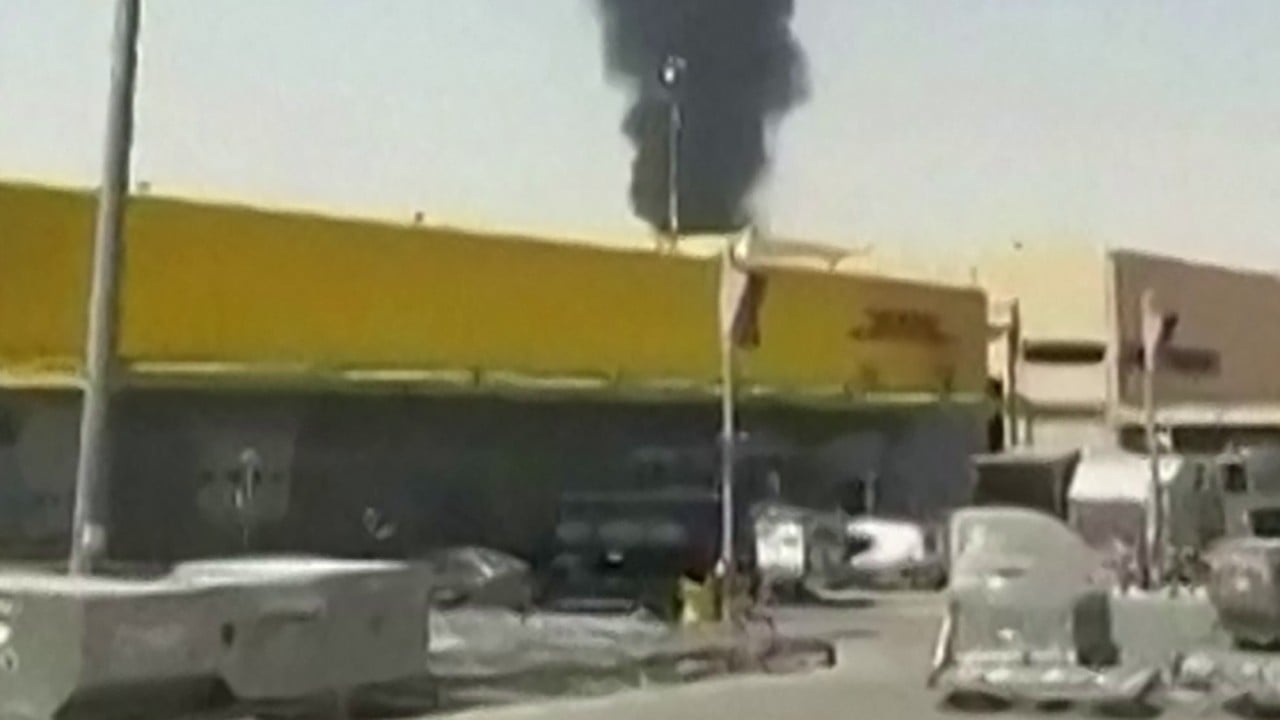
Every time a plume of smoke blooms near the perimeter of King Khalid International Airport, international newsrooms scramble to rewrite the exact same script. The narrative writes itself before the first journalist even opens a laptop. Flames over Riyadh. The Saudi capital under siege. An emboldened militia striking the heart of the kingdom.
It is lazy, terrified theater. And it is entirely divorced from reality.
I have spent years tracking defense logistics, regional security architectures, and the brutal calculus of asymmetrical warfare in the Gulf. I have watched analysts who cannot tell a Quds-2 cruise missile from a commercial lawnmower panic over every smartphone video uploaded to social media. They treat every interceptor launch as a sign of imminent collapse, missing the structural truth of what is actually happening in the skies above the Arabian Peninsula.
The standard media line paints a picture of a desperate Saudi Arabia bleeding cash and air defense assets to stop cheap, Iranian-backed flying mopeds. The reality is far more clinical, far more brutal, and completely upside down. Riyadh is not cowering under a barrage. It is running a live-fire laboratory, absorbing sporadic symbolic strikes while the Houthis burn through their shrinking strategic inventory for domestic propaganda.
Let us dismantle the mythology piece by piece.
The Interception Economics Fallacy
The favorite talking point of armchair defense critics is the cost mismatch. You have heard it a thousand times. The Houthis launch a drone built from off-the-shelf parts costing twenty thousand dollars. The Royal Saudi Air Defense Force responds with a Patriot missile battery interceptor costing millions. Therefore, the argument goes, the Houthis are winning an economic war of attrition, bleeding the Saudi treasury dry one intercept at a time.
It sounds clever. It collapses the moment you understand state budgets and industrial scale.
Saudi Arabia is a sovereign G20 economy with a multi-billion-dollar defense apparatus integrated into the most advanced radar and warning networks on earth. The cost of a Patriot interceptor is not a localized debit that threatens national solvency; it is a fixed operational cost of maintaining a modern state security umbrella. Meanwhile, the Houthi movement relies on smuggled components, clandestine assembly yards in caves, and a diminishing supply chain of precision guidance systems.
When a drone is intercepted miles away from its target, it did not achieve a strategic victory just because the interceptor cost more than the projectile. It achieved a fiscal punctuation mark. The real economic drain belongs to the faction whose supply lines run through porous borders and blockaded ports, burning through assets they cannot easily replace while their civil administration in Sana'a crumbles under the weight of governance failure.
We are told to weep for the Saudi defense budget while ignoring the absolute destitution of the territories under Houthi control. That is not analysis. That is selective blindness.
The Theater of Desperation
Why do these attacks happen when they do? Look at the ground truth in Yemen. Whenever frontlines shift against the Houthis in Marib, Shabwah, or Hodeidah, the drone launchers come out. Whenever international diplomatic pressure mounts for a durable political settlement that strips the group of its monopoly on violence, a ballistic missile heads north.
This is not offensive military strategy. It is public relations masquerading as ballistics.
The Houthi leadership understands that a ground offensive in Yemen does not trend on global news feeds. Grinding trench warfare in the desert fails to capture the attention of Western foreign policy establishments. But a strike targeting the airspace of a major global financial hub? That triggers immediate breaking news chyrons. That forces foreign ministries to issue statements. That creates the illusion of parity between a hyper-modern capital city and an insurgent militia holding a starving population hostage.
The attacks on Riyadh are essentially political press releases delivered via rocket motor. They are designed for consumption in European capitals and Washington think tanks, where analysts confuse noise with impact. Every time a missile is intercepted over the Empty Quarter or vaporized short of the Riyadh ring road, the Houthi command secures a brief media cycle to appease their hardline base and signal loyalty to their patrons in Tehran.
Military professionals do not measure success by how many headlines a projectile generates. They measure it by objective realization of strategic goals. If the goal of these strikes is to force Riyadh out of the conflict, alter Saudi economic policy, or break the resolve of the Saudi leadership, the campaign has been an unmitigated, catastrophic failure. Years of sporadic launches have produced zero structural shifts in Saudi foreign policy.
The Quiet Evolution of Saudi Security
The lazy consensus pretends that Saudi Arabia’s defense posture is static—that the kingdom is simply reacting with brute force to an unpredictable threat.
Spend time looking at how the security apparatus has adapted over the past half-decade. The integration of layered air defense, combining high-end missile batteries with electronic warfare jamming, short-range kinetic interceptors, and advanced radar cueing, has reached a level of operational maturity that few nations outside the major superpowers possess.
The reason most residents of Riyadh sleep through these incidents is not denial. It is because the defensive perimeter works with monotonous, terrifying efficiency. The air defense network has turned interception into a routine administrative task.
Furthermore, the kingdom has spent years diversifying its partnerships, investing heavily in domestic defense manufacturing through entities like SAMI, and building indigenous capabilities to reduce reliance on external suppliers. The friction of these attacks has acted as a stress test that forced structural modernization across the entire national security infrastructure.
When you attack a regional power, you either break its resolve or harden its defenses. The Houthis chose the latter. They provided the Saudi military with the political justification and urgency required to fast-track modernization programs that normally take generations.
The Real Vulnerability Nobody Talks About
If we want to discuss genuine security risks in the region, let us move past the romanticized fiction of drone strikes on capital city skylines. The real vulnerabilities have nothing to do with Houthi fireworks over Riyadh.
The modern global economy runs on supply chains, maritime choke points, cyber resilience, and energy infrastructure security. The real danger zones are the narrow straits of the Bab el-Mandeb and the Strait of Hormuz, where asymmetric actors can disrupt commercial shipping, tamper with subsea cables, or target oil export facilities with swarming tactics.
Even there, the narrative of unchecked vulnerability falls apart. Global shipping companies reroute, naval task forces patrol, and energy markets adapt with cold cynicism. The world has learned to price in geopolitical friction. A single refinery fire or tanker incident causes a temporary market spike, followed by rapid recalibration.
Yet, mainstream commentary remains fixated on the symbolic value of attacking a capital city. It is a nineteenth-century mindset applied to twenty-first-century conflicts. Capturing or striking the capital is no longer the key to winning a war or bending an economy to your will. Modern states are decentralized, digitally integrated networks. Striking the perimeter of an airport does not paralyze a government any more than a localized cyberattack collapses a continental power grid. It creates smoke, it creates noise, and by morning, the markets are open and the traffic on King Fahd Road is flowing again.
The Cost of Illusions
We do a massive disservice to regional peace by laundering Houthi military theater as strategic brilliance. When international commentators hyperventilate over every intercepted projectile, they inflate the perceived leverage of an armed group that relies on suffering and isolation to maintain internal control.
The war in Yemen will not end because a drone managed to singe a patch of desert outside Riyadh. It will end when the economic and political cost of continued insurgency finally outweighs the ideological benefits for the leadership in Sana'a. That reality has nothing to do with air defense math and everything to do with internal governance, humanitarian realities, and regional diplomacy.
Stop treating every Houthi press release fired from a mobile launcher as an existential crisis for the Saudi state. Riyadh is not falling. The economy is not breaking. The defense networks are not failing.
The smoke clears within minutes. The flights land on schedule. And the real work of building a post-oil economic powerhouse continues regardless of what falls out of the sky.


