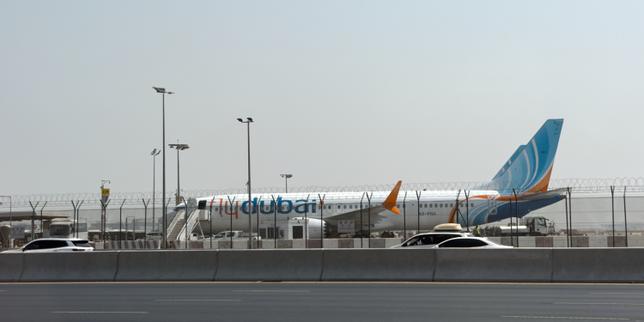
The moment a commercial aircraft strayed from its standard flight path between Dubai and Tel Aviv and touched down on Saudi tarmac, the commentariat lost its collective mind. Headlines screamed about diplomatic breakthroughs, hidden security alerts, and clandestine statecraft. Every armchair aviation pundit on the internet instantly transformed into an international relations expert, reading tea leaves in fuel burn rates and flight tracks.
It is exhausting nonsense.
The breathless coverage of this diversion exposes a fundamental disconnect between how the public perceives modern commercial aviation and how the machinery actually operates at thirty-eight thousand feet. People want a spy thriller. They want secret communications, tense cockpit showdowns, and high-stakes diplomatic chess matches. They do not want to hear about hydraulic pressure drops, passenger cardiac events, or standard alternate airfield selection matrices.
Let us clear the runway immediately. When an airliner diverts, the pilots are not consulting a foreign policy think tank. They are following a ruthless, unyielding checklist designed by safety engineers who care about one thing only: keeping physics from winning.
The Myth of the Political Cockpit
The lazy consensus in mainstream reporting treats airspace as a purely ideological battleground. If a plane from the United Arab Emirates lands in Saudi Arabia while bound for Israel, the knee-jerk narrative dictates that a profound diplomatic tremor must have caused it. Journalists love this framing because it requires zero technical competence. You do not need to understand flight management systems, international civil aviation organization annexes, or dispatch procedures when you can just invent a geopolitical conspiracy.
I have spent years watching operational control centers manage crises. The reality inside an airline dispatch office is violently unromantic.
Imagine a scenario where a pilot notices an unusual drop in engine oil temperature, or a flight attendant calls the flight deck to report an unresponsive passenger in seat thirty-four delta. At that exact second, the crew is not checking bilateral treaties. They are looking at a moving map display to find the nearest piece of concrete capable of swallowing a wide-body twin-jet safely, equipped with adequate medical or maintenance infrastructure, and accessible without violating immediate emergency declaration protocols.
Saudi airspace is not some mystical void where foreign planes vanish into diplomatic purgatory. It is a massive, highly structured grid managed by air traffic controllers who speak the exact same standardized aviation English as controllers in New York, London, or Dubai. When an emergency or an urgent operational necessity arises, international aviation law—specifically the Chicago Convention—mandates that safety supersedes sovereignty. A state must render assistance to an aircraft in distress. This is not a favor. It is a legal obligation baked into global flight safety frameworks.
Yet, commentators continue to treat routine operational diversions as coded messages between governments. It is professional laziness of the highest order.
Why Dispatchers Choose Alternate Airports
To understand why a Dubai-Tel Aviv flight ends up on the ground in the Kingdom, you have to look at the cold mathematics of flight planning. Long before pushback, dispatchers calculate ETOPS (Extended-range Twin-engine Operational Performance Standards) and critical points along a route. They map out every conceivable contingency.
When a flight encounters an unexpected variable—be it severe weather cells, sudden technical degradation, or urgent passenger health crises—the flight deck executes a pre-calculated diversion matrix. The decision is binary. You either continue to a destination with a degraded system or compromised situation, or you drop down at the nearest suitable airfield.
The media loves to pretend that landing in an unexpected country is an administrative nightmare. In practice, commercial aviation has streamlined cross-border contingencies down to a science. Ground handlers, local authorities, and airline representatives coordinate through established protocols that bypass political friction entirely. Passengers might experience confusion, and gate agents might scramble for hotel vouchers, but the structural machinery of the diversion follows a rigid, boring script written decades ago by safety regulators.
The real scandal isn't that a plane landed in Saudi Arabia. The real scandal is that the public expects every routine aviation safety protocol to be scrutinized through the distorted lens of regional conflict.
The Cost of Sensationalist Journalism
When media outlets frame standard safety interventions as geopolitical anomalies, they poison public understanding of how travel safety works. They breed paranoia among passengers who already harbor anxiety about flying over certain regions.
Every time a sensationalist article implies that a diversion is a sign of impending regional collapse or secret intelligence operations, it obscures the actual brilliance of modern aviation safety systems. Those systems work precisely because they ignore politics. They are built on redundancy, standardization, and the cold realization that human lives matter more than diplomatic optics.
If you fly across the Middle East, or anywhere else on earth, you are trusting a system designed to strip emotion out of the equation. The pilots do not care about newspaper headlines. The dispatchers do not care about social media engagement metrics. They care about getting the landing gear safely back on the ground, period.
Stop looking for shadows where there is only a flight management computer executing a routine diversion. The boring truth is that safety protocols work, and the sensational narrative you read online is just noise designed to capture your clicks while distracting you from how the world actually runs.
Next time an aviation headline tries to turn a standard operational procedure into a geopolitical thriller, remember one simple rule. The people flying the plane are too busy keeping you alive to care about politics, and you should be too.


