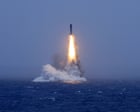
You don't fire an intercontinental-range strategic missile from a nuclear-powered submarine into the open waters of the Pacific Ocean just to do a bit of routine housekeeping. Yet, that's exactly what Beijing wants you to believe.
When the Chinese People's Liberation Army Navy sent a strategic ballistic missile screaming across the sky at 12:01 p.m., splashing down into international waters with a dummy warhead, the regional backlash was instantaneous. From Tokyo to Canberra, officials didn't just express concern; they sounded downright alarmed. Australia’s Foreign Minister Penny Wong called it "destabilizing." Japan’s Chief Cabinet Secretary Minoru Kihara pointed squarely at Beijing’s total lack of transparency.
China's response to the growing chorus of international condemnation? A collective shrug.
Foreign Ministry spokesperson Mao Ning coolly stepped up to the podium and told the world to basically calm down, stating it was a routine part of annual training and asking critics to "not overinterpret it."
But let's be honest. In the world of high-stakes nuclear deterrence, overinterpretation is the entire point. When you drop a nuclear-capable projectile into the South Pacific, you aren't just testing the hardware. You're sending a message.
The Pacific missile test is an undeniable shift in the nuclear triad
To understand why everyone is losing their minds over this, you have to look at the timeline. For decades, China kept its nuclear testing contained. It didn't broadcast its long-range capabilities to the open ocean. That changed in September 2024 when Beijing fired a land-based ICBM, likely a Dong Feng-31AG, 7,300 miles into the Pacific near French Polynesia. It was the first time they’d done that since 1980.
Now, we have this latest launch. This wasn't a land-based truck launcher hiding in the mountains of mainland China. This was a strategic nuclear submarine launching from the high seas.
If the 2024 test was China proving its land-based Rocket Force worked as advertised, this latest test is about completing the puzzle. Beijing is aggressively locking down the second leg of its nuclear triad: the ability to strike back from the ocean depths.
Submarine-launched ballistic missiles are the ultimate second-strike weapon. If a war breaks out and land-based silos are wiped out in a surprise attack, a stealthy nuclear submarine lurking somewhere in the deep ocean ensures you can still obliterate your enemy. By pulling off this launch, the Chinese military is showing the Pentagon that its sea-based deterrent is no longer just a theoretical threat on a map. It's fully operational.
Analysts are already pointing to China's Type 094 or the newer Type 095 submarines, which carry JL-2 or cutting-edge JL-3 missiles. These bad boys have ranges spanning anywhere from 5,000 to 8,000 miles. Do the math. That means a single Chinese sub sitting quietly in the Western Pacific can comfortably hold major American cities at risk.
Why the advance notices were actually a snub
Beijing claims it acted like a responsible global power by notifying regional neighbors ahead of time. Japan, Australia, and New Zealand all confirmed they got a heads-up. But if you look closer at how those notifications rolled out, the "responsible power" narrative starts to fall apart.
New Zealand Foreign Minister Winston Peters revealed that his government was notified only hours before the launch. To make matters worse, the missile tore through the South Pacific Nuclear Free Zone, established by the 1986 Treaty of Rarotonga. While the missile only carried a dummy warhead and didn't technically violate the letter of the treaty, firing a nuclear-capable delivery system through a dedicated nuclear-free zone is a massive middle finger to the Pacific Island nations.
Then there's the biggest omission of all: the United States.
Early indications suggest that while China gave the U.S. advance warning before the 2024 land-based test, they didn't extend the same courtesy this time around. Instead, China deployed satellite tracking vessels to the Pacific to monitor the telemetry themselves, letting Washington piece it together from their own radar arrays.
This selective notification isn't an accident. It's a deliberate geopolitical wedge. By warning regional U.S. allies but keeping Washington in the dark, Beijing is treating the Pacific as its own backyard, whispering to neighbors while ignoring the global superpower across the pond. It's an overt signal that this weapon isn't meant for regional squabbles with Taiwan or the Philippines. This is built exclusively to keep the U.S. military at arm's length.
The strategic terrible timing of regional defense pacts
If you want to know what actually drives military behavior, look at the calendar. China's "routine" training coincidentally landed on the exact same day that Australia and Fiji signed a new mutual defense treaty aimed directly at curbing Chinese influence in the Pacific Islands.
It also happened right while the United States was hosting its massive Rim of the Pacific (RIMPAC) military exercises near Hawaii, showcasing a united front of more than 30 nations.
China wants to disrupt that unity. By launching a strategic missile right as these defense partnerships are being inked, Beijing is reminding smaller Pacific nations of the sheer scale of raw military power they are dealing with. It’s a classic wolf-warrior diplomatic flex wrapped in a military exercise: Go ahead and sign your treaties, but remember who rules these waters.
Australian Defense Industry Minister Pat Conroy didn't hold back when asked if he bought China's excuse that the test complied with international law. "No it's not, to be honest," Conroy said, pointing out that the sudden launch was entirely inconsistent with international frameworks like the Hague Code of Conduct against Ballistic Missile Proliferation.
What happens next in the Pacific arms race
If you're waiting for Beijing to scale back its operations after this international blowback, don't hold your breath. Internal documents from regional defense forces are already warning that these deep-ocean missile tests are likely to become a permanent, persistent feature of life in the Indo-Pacific.
The Pentagon estimates that Beijing is on track to field more than 1,000 operational nuclear warheads by 2030. They are expanding their naval fleet at a breakneck pace, adding massive surface combatants and working on a fourth aircraft carrier that many suspect will be nuclear-powered.
You can't just look at this as an isolated training event. It’s part of a broader, uncompromising strategy to force the international community to accept China's expanded military footprint as the new normal. They want the world to stop reacting, stop protesting, and stop "overinterpreting" because they want you to get used to it.
For Western allies, the next steps are clear and already in motion. Expect to see an acceleration of the AUKUS security partnership between Australia, the UK, and the U.S. to get nuclear-powered attack submarines into Australian hands faster. You will also likely see the U.S. beef up its missile tracking and defense infrastructure across key hubs like Guam and the Marshall Islands.
The era of the Pacific as a quiet ocean is officially over. China has shown its hand, and no amount of diplomatic spin can hide the fact that the underwater nuclear race is burning hotter than ever.
Pacific Countries Criticize China for Submarine Missile Test
This video provides important regional context on how nations like Japan and Australia are responding to China's changing submarine capabilities in the Pacific.