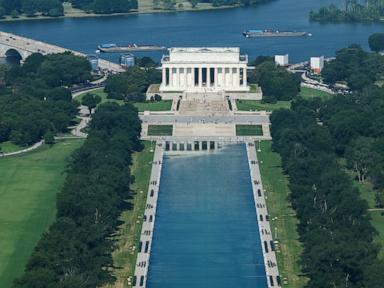
Public infrastructure debates in America follow a script so predictable it hurts. A high-profile project goes off the rails. Costs balloon. The opposition screams about corruption and incompetence. The administration in power deflects, pointing fingers at external actors or downplaying the damage.
Interior Secretary Doug Burgum’s recent defense of the Lincoln Memorial Reflecting Pool renovation is a masterclass in this political theater. Faced with a $16 million price tag, peeling paint, aggressive algae blooms, and a 350-foot gash in the liner, the official line is simple: the job was done "extremely well," the costs to fix it will be a "small number," and the real villains are vandals slicing up the pool.
This back-and-forth misses the point entirely.
The lazy consensus from critics is that this is merely a story of political vanity, no-bid contracts, and questionable aesthetics like painting a historic floor "American flag blue." The defense from the top is that the infrastructure was updated with advanced tech, and the setbacks are minor. Both sides are wrong.
The disaster at the Reflecting Pool is not an isolated incident of bad luck or simple political favoritism. It is a feature, not a bug, of how modern procurement, municipal engineering, and asset management operate. Focus less on the political blame game and look at the systemic rot it exposes.
The Myth of the Small Repair Number
When public officials promise that future fixes will cost a "small number," alarm bells should ring. I have spent years analyzing asset lifecycles and capital expenditure deployment. When a newly sealed, multi-million-gallon water feature suffers structural peeling, chemical imbalances, and liner tears weeks after completion, the true cost is never small.
The administration points to a 350-foot cumulative gash and blames individual actors. Let's engage in a quick thought experiment. Imagine a scenario where a pristine, commercial-grade industrial liner is correctly specified, mixed, cured, and bonded to a reinforced concrete substrate. Can a single individual, or even a handful of people, effortlessly tear chunks of it up by hand without systemic adhesion failure?
The answer is no. If a coating can be forcefully pulled up with bare hands, the failure occurred long before anyone stepped into the empty basin. It occurred during the surface preparation, the moisture testing, or the chemical formulation of the compound itself.
By framing the issue as simple property destruction, the narrative conveniently sidesteps the core engineering failure: intercoat adhesion loss. When a substrate fails to bond, the cost to repair is not just the cost of patching the visible holes. You have to account for:
- Complete dewatering and localized drying times.
- The removal of compromised, non-adhered sections that haven't peeled yet.
- Re-testing concrete moisture vapor emission rates (MVER).
- The compounding labor costs of mobilization for a second, off-schedule intervention.
Calling this a minor fix is a fundamental misunderstanding of commercial coating mechanics.
No-Bid Contracts and the Illusion of Speed
The outcry from congressional watchdogs focused heavily on the no-bid nature of the contracts awarded to companies like Atlantic Industrial Coatings ($14.7 million) and Green Water Solutions ($1.7 million). The political critique is obvious: favoritism. But the operational critique is far more damaging.
Governments bypass competitive bidding under the guise of urgency and specialized capability. The justification here was preparing the National Mall for America’s 250th birthday. Speed was prioritized over systemic validation.
When you eliminate competitive tension in procurement, you do not just risk paying a premium; you strip away the rigorous peer-review of technical submittals. In a standard open-bid environment for a high-profile civic structure, multiple engineering firms scrutinize the project specifications. They ask hard questions about product data sheets, cure windows under humid mid-Atlantic summer conditions, and UV stability.
When the process is accelerated and insulated from external scrutiny, blind spots multiply. The result is a predictable sequence: a rushed application, an immediate algae bloom because the specialized water-purification system cannot handle the chemical load of a degrading coating, and an empty pool during a national holiday. Speed in public works is an illusion if it requires doing the job twice.
The Real Cost of Cosmetic Infrastructure
The decision to coat the historic concrete basin in a specific shade of blue highlights a deeper, systemic issue in asset management: prioritizing cosmetic optics over functional longevity.
The Lincoln Memorial Reflecting Pool is a dynamic environmental ecosystem, not a backyard swimming pool. It interacts with local wildlife, urban runoff, intense solar radiation, and fluctuating water tables. Applying an industrial topcoat to a century-old structure introduces a new variable into a complex equilibrium.
If the concrete cannot breathe, hydrostatic pressure builds beneath the non-permeable membrane. When the pool is filled, this pressure, combined with structural movement, forces the coating to blister and delaminate.
The public is fixated on the political optics of the blue paint, but the technical failure is what matters. A cosmetic modification altered the maintenance profile of a national monument, transforming a passive concrete basin into a high-maintenance asset requiring constant chemical intervention and frequent draining.
Changing the Procurement Paradigm
To prevent these public works failures, we must change how we evaluate, bid, and execute civic engineering projects. The current model relies on reactive maintenance and politicized oversight. A modern approach requires structural changes.
+-----------------------------------------------------------------+
|                    THE CIVIC PROCUREMENT PIVOT                  |
+-----------------------------------------------------------------+
| OLD MODEL:                                                      |
| Rushed No-Bid Contracts -> Cosmetic Focus -> Reactive Repairs    |
+-----------------------------------------------------------------+
| NEW MODEL:                                                      |
| Open Peer-Reviewed Bids -> Functional Design -> Proactive Tech  |
+-----------------------------------------------------------------+
Mandate Open-Source Technical Submittals
For projects involving national landmarks or critical infrastructure, the technical specifications, product formulations, and application methodologies should be open to public and professional peer review before a single dollar is spent. Had independent coating inspectors reviewed the compatibility of the blue sealant with the existing substrate under summer conditions, the flaws would have been caught before application.
Link Payouts to Performance Milestones
Instead of front-loading capital disbursement to vendors, public contracts must utilize strict retention clauses tied to operational benchmarks. A contractor should not receive full payment upon project completion; a significant portion should be held in escrow until the asset demonstrates stability through seasonal transitions, wildlife interactions, and full capacity usage.
Prioritize Lifecycle Chemistry Over Aesthetics
Civic design must reject vanity metrics. Every material choice should be dictated by its maintenance lifecycle, carbon footprint, and resistance to localized degradation factors like algae and UV exposure. If a design choice introduces a high risk of chemical instability, it should be rejected regardless of its symbolic value.
The Price of Bad Engineering
Defending a flawed execution by claiming the upcoming repairs will be cheap is a classic sunk-cost fallacy. The $16 million already spent is gone. The true cost is the ongoing operational disruption, the loss of public trust, and the inevitable future allocations required to strip the basin down and redo the job correctly.
Fixing this problem requires looking past the political theater on television. Stop asking who scratched the liner, and start asking why the system allowed a multi-million-dollar asset to be vulnerable to bare hands in the first place. The failure isn't the vandalism; it's the engineering.