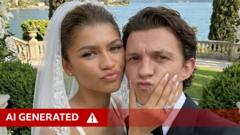
The internet is currently having a collective meltdown because Zendaya pointed out that people were "fooled" by AI-generated images of her in a wedding dress. The narrative is predictable. We are told that deepfakes are eroding the bedrock of truth, that the public is hopelessly gullible, and that we need more regulation to save us from our own eyes.
It is a lazy take. It is a boring take. It is also fundamentally wrong.
People weren't "fooled" because the technology is too good. They were "fooled" because they spent exactly 0.4 seconds looking at the image before double-tapping and scrolling to the next hit of dopamine. We are not facing an AI crisis; we are facing a terminal collapse of visual literacy. If you can't tell the difference between a high-fidelity render and a real photograph, the problem isn't the algorithm. It is your refusal to look at the details.
The Myth of the Perfect Deepfake
The competitor articles love to use words like "hyper-realistic." They want you to believe these wedding photos are indistinguishable from reality. This is a lie. Even the most advanced models currently used by "fans" to create these viral moments suffer from tell-tale biological errors.
If you actually look—and I mean actually look—at these Zendaya images, the physics of the light is wrong. Shadows don't anchor the body to the floor. The jewelry often fuses into the skin. The lace patterns on the dresses frequently defy the laws of geometry, repeating in ways that hand-stitched fabric never would.
We’ve seen this before. In the early days of Photoshop, people claimed airbrushed magazine covers were "destroying reality." Now, we look at those 2005 covers and laugh at the missing belly buttons and rubber-textured skin. We are in the "uncanny valley" phase of AI, and yet the media treats every mid-range generation like it's a breach in the space-time continuum.
The real deception isn't the pixels. It’s the context. People want to see Zendaya and Tom Holland get married so badly that their brains fill in the gaps. It’s confirmation bias wrapped in a neural network.
Why Celebrity Outrage is Often Performative
When a star like Zendaya speaks out about being "fooled," it serves a dual purpose. First, it reinforces her brand as the "authentic" girl in a digital world. Second, it creates a convenient shield against any future PR blunders.
If every image can be fake, then no image is incriminating. We are entering an era where celebrities can plausibly deny reality. Caught in a compromising position? "It's AI." This is the "Liar’s Dividend," a term coined by legal scholars Danielle Citron and Robert Chesney. The more we freak out about fake wedding photos, the more we build the infrastructure for actual villains to escape accountability.
Stop worrying about whether a dress is real. Start worrying about the fact that we are training the public to believe that visual evidence no longer exists.
The Real Cost of Being "Fooled"
- Erosion of Media Value: When everything is fake, nothing is special. A real wedding photo from a major celebrity used to be worth millions to a publication. Now, it's just another piece of "content" competing with a billion free, generated variations.
- The Death of the Pounce: We’ve lost the ability to sit with an image. The "fooled" masses aren't victims; they are lazy consumers.
- Infrastructure Inflation: We are demanding "watermarking" and "provenance tech" (like C2PA standards) for things that don't matter, which only adds layers of bureaucracy to actual photography.
Stop Trying to "Fix" AI and Start Fixing Your Eyes
The "lazy consensus" says we need labels on every AI image. This is like putting a "Caution: Hot" sticker on a cup of coffee. It might protect the company from a lawsuit, but it doesn't make the consumer any smarter.
If you want to stop being "fooled" by the next celebrity wedding hoax, stop looking for a badge or a watermark. Use your brain.
- Check the Extremities: AI still struggles with the complexity of the human hand and the way ears attach to the skull. If the fingers look like sausages or the earrings are floating, it's a bot.
- Follow the Light: Look at the catchlights in the eyes. In a real photo, they should match the environment. AI often puts a generic studio softbox reflection in the eyes even if the "photo" is supposedly taken at sunset on a beach.
- Source the Metadata: I've seen major news outlets pick up "fan" images without checking the source. If an image of a $500 million star doesn't come from a verified agency or the star’s own account, it is fake. Period.
Imagine a scenario where we actually valued truth over speed. We wouldn't need a celebrity to tell us we've been tricked. We would have seen the blurred texture of the wedding veil and moved on.
The Counter-Intuitive Truth About Celebrity Content
The irony is that Zendaya, and stars of her caliber, are already "AI-adjacent." Their professional photos are so heavily retouched, color-graded, and composited that the "real" photo hasn't existed for decades.
A professional red carpet shot goes through a pipeline of digital manipulation that makes it nearly as "fake" as a Midjourney output. The lighting is artificial. The skin is a digital reconstruction. The body proportions are often tweaked.
Why are we okay with a human editor spending ten hours making a celebrity look like a CGI character, but we lose our minds when a machine does it in ten seconds? The outrage isn't about the "fake" nature of the image—it's about the loss of control over the narrative.
Zendaya isn't worried that you think she's married. She's worried that the fan-generated version looks better, generates more engagement, and didn't require a $20,000-a-day glam squad.
The Expert's Battle Scars
I have spent years watching industries get disrupted by "unauthorized" content. I saw the music industry try to sue Napster out of existence, only to realize the "fake" or "pirated" version was what the people actually wanted because it was more accessible.
We are seeing the same thing in the celebrity image economy. The "wedding pics" are a symptom of a fan base that wants more than the controlled, sanitized PR machine is willing to give. AI is just the fulfillment of that demand.
If you are a brand or a public figure, fighting the "fake" pics is a losing battle. You are trying to hold back the ocean with a plastic bucket. The more you scream about being "fooled," the more you signal to the creators that they have power over your reality.
Common Misconceptions Dismantled
| Misconception | The Reality |
|---|---|
| "AI images are indistinguishable from reality." | Only if you are looking at them on a 5-inch screen while walking. |
| "Labels will solve the problem." | People ignore labels. They follow the dopamine. |
| "This is a new problem." | It’s just "The Cottingley Fairies" for the TikTok generation. |
| "Zendaya is the victim here." | Zendaya's brand is strengthened by the constant discourse. |
The Only Way Out is Through
We need to stop coddling the public. If you got "fooled" by a picture of Zendaya in a wedding dress that wasn't posted by Zendaya, you deserve the embarrassment.
We don't need "AI Safety" panels to discuss the ethics of fan art. We need to re-introduce the concept of skepticism. We need to stop treating every viral tweet as a news event and start treating it as what it is: noise.
The technology will continue to improve. The wedding dresses will look more real. The skin textures will become flawless. The shadows will eventually anchor the bodies to the floor.
When that happens, the answer isn't to ban the tools. The answer is to stop caring about the image and start caring about the source. Truth is a relationship, not a file format.
Get off the "outrage" treadmill. The fact that a machine can make a pretty picture of a famous person isn't a crisis. The fact that you thought it was news is the actual tragedy.
Put down the phone, go outside, and look at something that doesn't have a refresh rate. If you can still tell the difference between a tree and a screen, there's hope for you yet.
Stop asking for a "Verified" badge and start verifying things yourself.