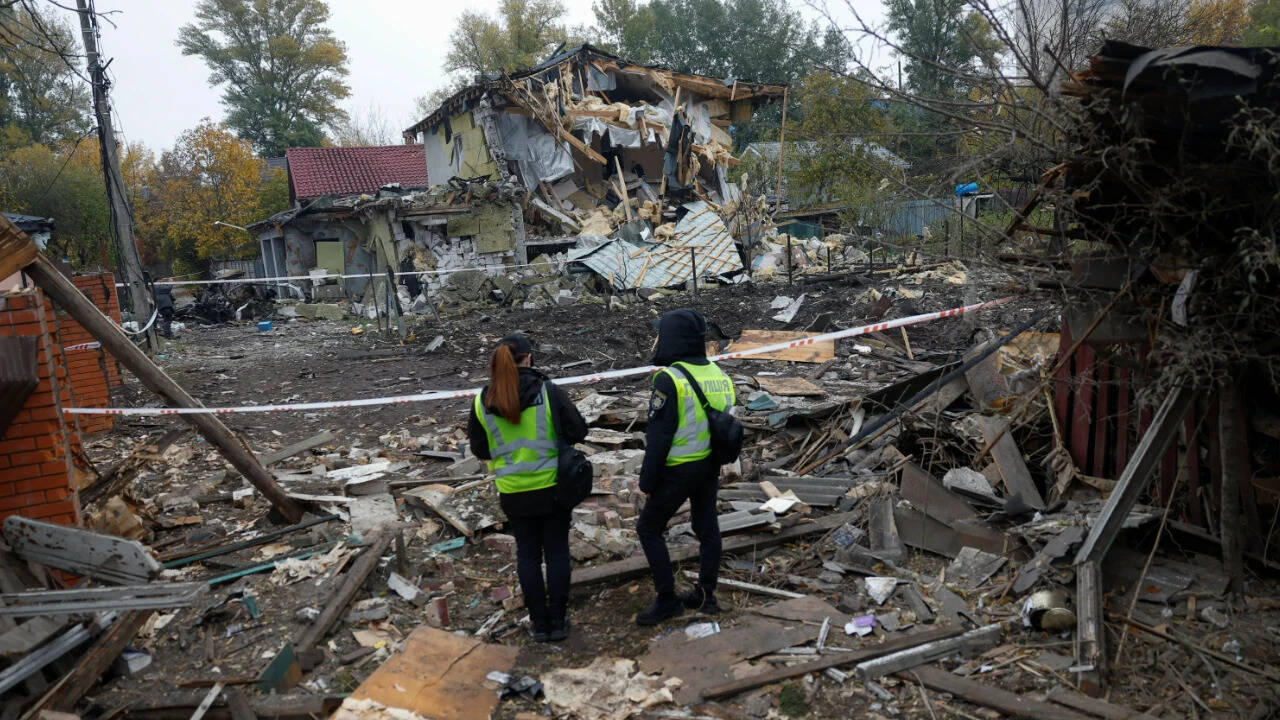
Mainstream war coverage is obsessed with body counts and broken glass.
Yesterday, a headline made the rounds about drone strikes killing three people, hitting an industrial plant in Omsk, scorching an Ozon logistics hub, and cutting power across Crimea and eastern territories. Most outlets treated it like another box-score update in a grinding conflict. Three dead. One warehouse burned. Lights out in a few districts. Move on to the next news cycle.
That framing is completely backward. If you are measuring the success of long-range unmanned aerial strikes by immediate casualty numbers or temporary blackouts, you do not understand modern industrial warfare. You are looking at the sparks while missing the fact that the entire engine block is seizing up.
The Lazy Consensus of Headline War Reporting
Standard reporting treats a strike on a refinery in Omsk and a strike on an e-commerce warehouse like random acts of chaos. They tally the human toll, note the square meters of burned roofing, and assume life returns to normal once the fire trucks leave.
I have spent years watching supply chain analysts and defense strategists make this exact mistake. They look at a map, see a localized fire, and calculate the cost of replacing concrete and steel. That math is useless. Modern industrial economies do not run on concrete and steel; they run on specialized processing bottlenecks, synchronous power grids, and razor-thin logistics margins.
When a drone hits an industrial facility in Omsk—thousands of kilometers away from the front lines—the physical blast radius is tiny. A few hundred kilograms of high explosive will not level a Soviet-era petrochemical complex. It does not need to.
Why Omsk Matters More Than the Front Line
Omsk is not just another dot on a Siberian map. It houses some of the largest oil refining and petrochemical capacity in Eurasia. To turn crude oil into high-octane fuel, aviation kerosene, or specialized lubricants, a refinery relies on massive, custom-built cracking units and distillation columns.
You cannot buy a hydrocracking tower off a shelf. Many of these components were engineered by Western firms before sanctions slammed the door shut. When shrapnel shreds a heat exchanger or ignites a catalytic reformer, the refinery does not just lose a few days of output. That specific processing line goes dark for months.
Here is the nuance the casualty-obsessed headlines miss:
- Forced Shutdowns: A refinery cannot simply "slow down" indefinitely when storage tanks fill up with unrefined crude. Without functioning secondary processing units, upstream oil wells eventually have to be capped. In Siberian permafrost, capping a well often ruins it permanently.
- Air Defense Cannibalization: Every time a slow-moving, propeller-driven drone reaches Siberia, military planners face a brutal math problem. Do you leave deep-rear refineries exposed, or do you pull multi-million-dollar surface-to-air missile batteries away from active combat zones to guard factories?
- Insurance Paralysis: Commercial insurers are not patriotic. Once deep-rear industrial zones become active target lists, underwriting dries up overnight. Companies have to self-insure, locking up billions in liquid capital that would otherwise fund operations.
The Ozon Hub Strike Is a Direct Hit on Domestic Stability
Now look at the other target mentioned in that same news cycle: an Ozon logistics hub.
To a casual reader, burning down an e-commerce warehouse sounds trivial compared to hitting an ammunition depot. Why waste long-range strike assets on cardboard boxes, consumer electronics, and winter coats?
Because in a sanction-battered economy, e-commerce giants like Ozon and Wildberries are the primary pressure valves keeping urban populations pacified. When brick-and-mortar foreign retailers pulled out, domestic online marketplaces stepped in to manage parallel imports and keep consumer goods flowing to the middle class.
Warehouse fires do not just destroy inventory. They obliterate automated sorting infrastructure and cold-chain storage that cannot be quickly rebuilt under strict export controls.
Imagine a scenario where three major regional fulfillment centers go offline within a single quarter. Delivery times jump from two days to three weeks. Sellers lose their entire working capital in a single night because warehouse fire insurance payouts get tied up in endless bureaucratic disputes. Consumer inflation spikes on everyday goods, not because of central bank interest rates, but because the physical pipes moving goods from borders to living rooms have been severed.
This is attrition aimed directly at economic bandwidth. You do not need to starve a population to create a crisis; you just need to break the logistics network that makes modern urban life predictable.
Power Cuts Are Not an Inconvenience They Are an Industrial Guillotine
Then there are the power outages across Crimea and the east. Media reports routinely describe these events as residents "sitting in the dark" or dealing with "disrupted utilities."
Residential blackouts are the least important part of a grid strike. Households can survive on camp stoves, flashlights, and sweaters. Heavy industry, rail networks, and automated water treatment plants cannot.
Electrical grids operate on a strict, unforgiving law of physics: supply and demand must match every single second. When substations and high-voltage transformers are knocked offline, grid operators have to shed load instantly to prevent cascading frequency drops that fry turbines across the entire region.
Consider what happens when the grid loses stability:
- Railroad Paralysis: Modern freight rail—the absolute backbone of military and industrial logistics—runs heavily on electric locomotives. When traction substations lose power, trains stop. Switching to diesel locomotives takes time, burns scarce fuel reserves, and slashes total freight tonnage per day.
- Cold-Start Nightmares: Industrial furnaces, aluminum smelters, and chemical plants cannot simply be turned back on with a wall switch. If a smelter loses power for more than a few hours, the molten metal solidifies inside the pots. Jackhammering solid metal out of industrial vats takes months and costs hundreds of millions of dollars.
- Transformer Scarcity: Large power transformers are bespoke, multi-ton beasts built with specialized grain-oriented electrical steel. Global wait times for new high-voltage transformers currently stretch from two to four years. Every single transformer destroyed is functionally irreplaceable within the timeline of a modern war.
Dismantling the Wrong Questions
If you search online about these strikes, you see the same tired questions dominating public discussion. Let us tear them apart.
"Do drone strikes actually change the outcome on the battlefield?"
This question assumes wars are won exclusively by infantry pushing flags across a map. History says otherwise. Germany did not collapse in 1918 because Allied troops were marching down the streets of Berlin; it collapsed because its domestic economy, rail network, and food distribution systems imploded under sustained pressure. Long-range drone campaigns are not designed to take trenches. They are designed to bankrupt the state paying for the trenches.
"Why are casualties so low if the strikes are successful?"
Because killing night-shift security guards has zero strategic value. Modern long-range drones carry relatively small warheads—often between 50 and 100 kilograms—guided by inertial navigation and optical terrain matching. They are precision scalpels aimed at high-value, fragile equipment: distillation towers, radar arrays, fuel bladders, and electrical switchgear. Low casualty counts actually prove the strikes are hitting industrial infrastructure rather than apartment blocks.
"Can air defenses simply shoot all of them down?"
No. Air defense physics favors the attacker at scale. A radar system has to deal with ground clutter, curvature of the earth, and saturation. If an attacker launches fifty cheap drones along varied flight paths at low altitude, intercepting forty-five of them still means five get through. When those five hit unarmored, volatile targets like fuel depots or high-voltage transformers, the defender loses the exchange by orders of magnitude. Spending a million-dollar interceptor missile to kill a thirty-thousand-dollar drone is a slow-motion financial suicide pact.
The Uncomfortable Downsides of Asymmetric Attrition
I will not pretend this strategy is a magic bullet without serious flaws. Anyone who tells you long-range infrastructure strikes are an automatic win is selling fairy tales.
First, industrial hardening works. Given enough time, defenders adapt. We are already seeing facilities wrap critical distillation columns in steel cages, build concrete blast walls around transformers, and disperse fuel storage into smaller, buried tanks. A drone warhead that caused catastrophic damage six months ago might only scorch a steel mesh screen today.
Second, retaliation is symmetrical and brutal. Targeting energy grids and logistics hubs normalizes infrastructure warfare. Whatever damage is inflicted on a refinery in Omsk or a substation in Crimea will be mirrored tenfold against the attacker's own power plants, heating grids, and ports—often using heavier ballistic and cruise missiles that carry far larger payloads than long-range drones.
Third, repair crews are resilient. Journalists chronically underestimate how fast experienced engineers can jury-rig broken systems. Bypassing a damaged substation or cannibalizing parts from decommissioned Soviet-era plants can restore partial capacity in weeks rather than years, even if the patch jobs are fragile and prone to future failure.
How Analysts Actually Need to Measure Impact
If you want to understand who is winning this shadow war of attrition, stop reading daily casualty tickers. Start tracking the boring numbers that make bureaucrats sweat.
Watch regional diesel and gasoline wholesale prices, not retail pump prices that governments artificially cap. When wholesale prices spike or export bans get slapped onto refined fuels, it means refinery capacity is bleeding faster than repair crews can weld it back together.
Watch rail freight dwell times and locomotive availability. When power grids take repeated hits, cargo backs up at sorting yards. Delay in moving raw materials to factories shows up ninety days later as missed production quotas.
Watch central bank liquidity injections and corporate bond yields for state-backed logistics and energy firms. When companies like Ozon or major oil refiners have to borrow at punitive interest rates just to cover physical losses and supply chain rerouting, the strikes are working.
Three people died in yesterday's strikes. That is a human tragedy, and it makes for an easy, grim headline.
Meanwhile, billions of dollars in uninsurable industrial capacity just went offline, supply chains stretched another hundred kilometers thinner, and air defense commanders were forced to choose between protecting soldiers at the front or protecting factories in Siberia. Stop counting the broken windows and start looking at the foundation.