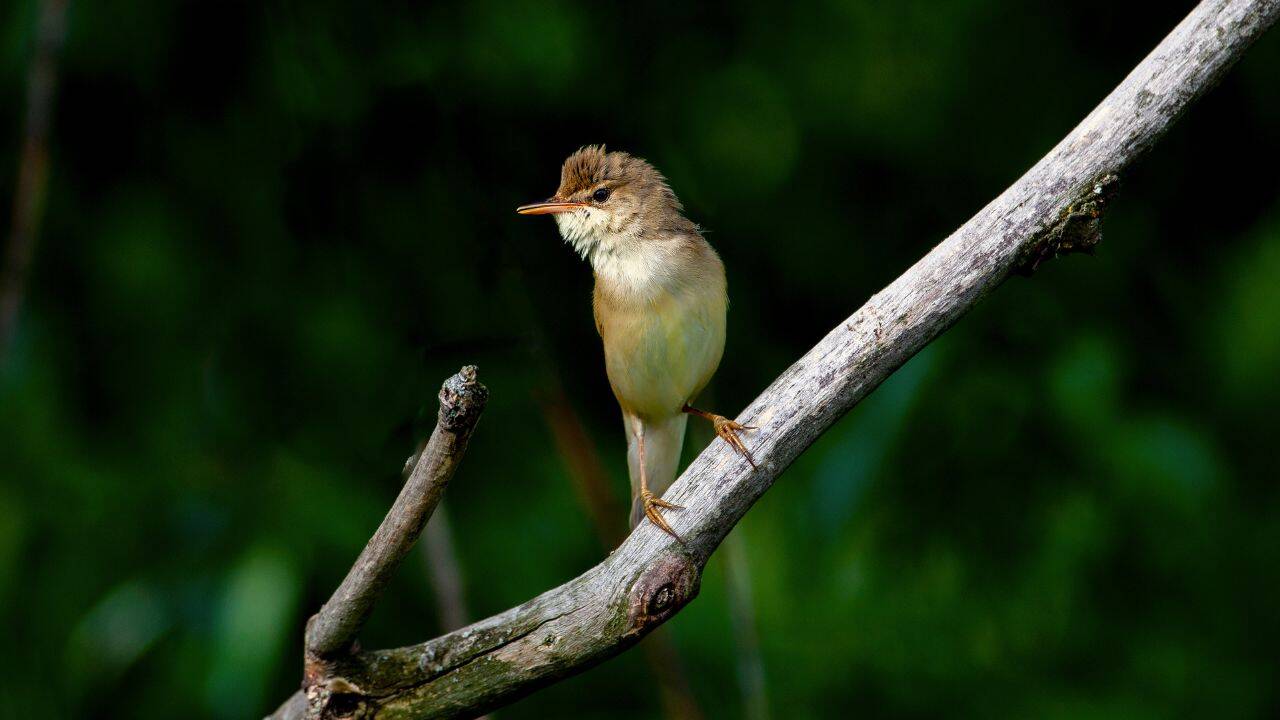
Two tiny brown birds raised a couple of chicks in the Scottish Highlands. The wildlife press immediately threw a parade.
Read the mainstream coverage of the Rare Breeding Birds Panel (RBBP) report from November 2026, and you get the exact same breathless script. A thrilling ornithological milestone. An encouraging conservation victory. Proof that British wildlife is bouncing back.
It is pure biological illiteracy dressed up as feel-good journalism.
When a single pair of Blyth’s reed warblers (Acrocephalus dumetorum) nests in Scotland for the first time in documented history, you are not looking at a conservation triumph. You are looking at an ecological distress flare. Cheering for a vagrant Eastern European songbird setting up house in the Highlands while Britain’s native woodland and farmland birds collapse is like celebrating a palm tree sprouting in a melting glacier. The tree looks nice. The underlying mechanics should terrify you.
The Lazy Consensus of "New Species" Journalism
Wildlife reporting suffers from a chronic addiction to novelty. Editors love "firsts" because firsts generate clicks. First confirmed breeding pair. Fourth new breeding species in a decade. A charming nocturnal singer from the birch forests of Finland and Russia deciding Scotland feels like home.
Here is the reality they bury under adjectives.
In conservation biology, a tick on a national list is vanity metrics. Britain has spent decades perfecting the art of counting rare vagrants while losing millions of common birds. According to the British Trust for Ornithology (BTO) and RSPB State of Nature assessments, the UK has lost roughly 38 million birds since the 1960s. Willow warblers—close cousins to the Blyth’s reed warbler and once the ubiquitous soundtrack of British scrubland—have plummeted across southern England. Nightingale populations have crashed by over 90 percent in the last fifty years. Spotted flycatchers, wood warblers, and whinchats are vanishing from their traditional strongholds.
Against that backdrop of silent springs, celebrating a single pair of Acrocephalus dumetorum raising at least two fledglings in a withheld Highland location misses the entire point. One breeding attempt in 2024 does not constitute an established population. Even if it did, adding one accidental colonist does nothing to repair a broken food web.
I have spent years watching conservation organizations and nature media fall into this exact trap. They confuse species richness (how many different names appear on a checklist) with ecological integrity (whether an ecosystem actually functions). When you degrade a landscape through industrial agriculture, deer overgrazing, and rapid climate destabilization, you create chaotic vacancies. Opportunistic pioneers slip into the cracks. Calling that a win is ecological malpractice.
Why the Blyth’s Reed Warbler Is Actually in Scotland
To understand why this bird showed up in the Highlands, stop looking at British conservation policy and start looking at atmospheric physics and continental biogeography.
Historically, Blyth’s reed warbler bred across a band stretching from southern Finland through European Russia and into central Asia, wintering thousands of miles away on the Indian subcontinent. Over the last century, and accelerating sharply since the 1990s, that breeding range has pushed relentlessly westward across Fennoscandia and the Baltic states.
Spring overshoots in Britain stopped being front-page birding news years ago. Unpaired males have been turning up in the UK every May and June since at least 2000, singing their complex, mimicry-heavy nocturnal songs into empty Scottish scrub, failing to find a mate, and eventually giving up.
Why did two finally find each other in 2024?
- Jet Stream Volatility and Spring Anticyclones. Persistent blocking high-pressure systems over Scandinavia during May push westward-migrating passerines off their standard north-northwest trajectory from India. Instead of landing in Estonia or Finland, they get blown across the North Sea straight into eastern Scotland.
- Northern Habitat Compression. Boreal and hemiboreal zones are warming faster than the global average. As eastern breeding grounds experience drier springs and altered insect emergence windows, dispersal pressure pushes surplus young birds toward the western fringes of their range.
- The Lottery of Density. When enough vagrant males overshoot into the same geographic bottleneck—northern Scotland sits directly across the North Sea from southern Norway—the statistical probability of an overshoot female intersecting an overshoot male eventually hits one.
Notice what is absent from that list. None of it happened because Britain suddenly fixed its broken uplands. The Highlands remain largely an ecological desert of overgrazed heather moorland, commercial Sitka spruce plantations, and deer-stripped woodland fragments. The warblers succeeded despite British land management, not because of it.
Dismantling the "People Also Ask" Myths
Whenever a rare bird makes mainstream headlines, the same naive questions flood search engines. Every single one rests on a flawed premise.
Does this mean the UK is becoming a haven for rare wildlife?
No. It means the UK is becoming a climatic waiting room for displaced continental species. Look at the other three "new" breeders the RBBP highlighted from the past decade: the Iberian chiffchaff (2015), the black-crowned night heron (2017), and the glossy ibis (2022). Notice a pattern? Three southern, heat-loving species pushed north by Mediterranean droughts and heatwaves, alongside one eastern continental bird pushed west by boreal drift. Britain is not a sanctuary. It is a refugee camp for European avifauna fleeing deteriorating conditions elsewhere.
How do you identify a Blyth’s reed warbler in the UK?
You almost certainly will not—and trying to hunt one down is precisely the wrong instinct. Visually, Acrocephalus dumetorum is an exercise in frustration. It is a plain olive-brown insectivore nearly identical to the Eurasian reed warbler (Acrocephalus scirpaceus) and the marsh warbler (Acrocephalus palustris). Field ornithologists separate them using subtle wing-formula measurements—specifically a shorter primary projection and a distinct notch on the inner web of the second primary feather—alongside paler legs and unstreaked undertail coverts. Even seasoned ringers misidentify them without a bird in the hand or a sonogram. The male’s song gives him away at night, weaving stolen phrases from dozens of other species at a measured, deliberate tempo. Once paired, however, the male shuts up immediately to avoid attracting predators to the nest.
Will Blyth’s reed warblers become common garden birds in Britain?
Never. Even in core territories across Finland and Russia, this is a bird of damp broadleaved woodland edges, overgrown clearings, and dense scrub—not manicured suburban lawns or sterile agricultural hedgerows. Furthermore, its migratory wiring is an evolutionary death trap for a British population. To survive winter, a Scottish-born Blyth’s reed warbler has to fly southeast across the entire Eurasian landmass to India, dodging Mediterranean trapping networks, Middle Eastern habitat loss, and extreme weather shifts along a 4,000-mile corridor. A species with a migratory route that long and perpendicular to the Atlantic flyway faces brutal juvenile mortality.
The Dark Side of Vagrant Worship
There is an uncomfortable truth that birders and conservation charities rarely admit in public: our obsession with rare colonists actively distorts where money and attention go.
When a rare species breeds, press releases fly. Donors feel good. Politicians point to the headline as evidence that environmental regulations are working—or worse, as an excuse to weaken protections for common habitats because "nature clearly adapts on its own."
I have seen this exact political sleight of hand play out repeatedly in European land-use debates. Developers and agricultural lobbyists love climate-driven range expansions. Whenever a glossy ibis nests in Cambridgeshire or a bee-eater digs a tunnel in a Norfolk quarry, vested interests hold it up as proof that ecosystems are resilient and self-correcting.
Meanwhile, the boring, unglamorous work of restoring baseline biomass gets starved of cash.
Think about what a pair of warblers actually needs to raise chicks in a cup nest woven 20 to 60 centimeters off the ground. They do not need a press release. They need caterpillars, spiders, aphids, and dipteran flies—tons of them, emerging at the exact week the eggs hatch. Insect biomass across Western Europe has collapsed by up to 75 percent in protected areas over the past three decades, a finding famously documented by the Krefeld Entomological Society and echoed in UK moth-trapping data from Rothamsted Research.
Without insects, a new breeding record is just a biological dead end. Two chicks fledge in July, fly east-southeast into an autumn storm, and the breeding record becomes a footnote in an annual journal.
The Honest Counter-Argument (And Where My Take Has Limits)
Let us be fair to the Rare Breeding Birds Panel and field ornithologists like Dr. Mark Eaton and his colleagues, who actually do the grueling, thankless work of compiling these datasets.
Monitoring range-edge colonization is not pointless. In fact, tracking how species like Blyth’s reed warbler probe new territories gives ecologists critical real-time data on phenotypic plasticity and dispersal velocity under rapid warming. If you do not document the first pair in 2024, you cannot measure whether the species establishes a foothold by 2034 or vanishes entirely.
There is also a genuine psychological argument for sharing good news. Conservation fatigue is real. If every wildlife story reads like an obituary, the public tunes out completely. A tiny brown bird crossing a continent to raise chicks in Scotland has undeniable poetic power.
That emotional spark has value—only if it redirects energy toward structural habitat repair rather than passive applause. The danger is not the data itself. The danger is the narrative framing that turns a symptom of continental climate disruption into a victory lap.
What Actually Needs to Happen Next
If you care about whether Blyth’s reed warblers—or willow warblers, wood warblers, and nightingales—have a future in Britain, ignore the rarity alerts and focus on the unglamorous mechanics of lowland and upland ecology.
- Stop managing the Highlands as an artificial sporting estate. Scotland’s uplands are locked in an ecological chokehold maintained by excessive red deer densities and rotational muirburn for red grouse. Natural woodland regeneration—the exact damp birch, willow, and alder scrub that Acrocephalus warblers require—cannot survive where deer eat every sapling above ankle height. Aggressive deer culls and fencing are worth a thousand rare bird sightings.
- Measure conservation success by biomass, not species count. Stop judging nature reserves by how many rare vagrants drop in during migration. Judge them by insect abundance, soil invertebrate density, and the breeding productivity of common resident species. When the bottom of the food chain is thick with life, the top takes care of itself.
- Leave rare breeders completely alone. The RBBP rightly withheld the exact Highland breeding location for security reasons. If you hear a strange, rhythmic, mimicking warbler singing after midnight in northern Britain next May, do not broadcast the grid reference to social media groups. Do not play recordings from your phone to lure it out of the bushes for a photograph. Playback disrupts territory establishment and burns calories a migrating songbird cannot afford to lose. Log the record confidentially with your county bird recorder and walk away.
A pair of Blyth’s reed warblers raising two chicks in Scotland is a fascinating biological anomaly. It proves that individual birds are remarkably adaptable navigators capable of exploiting brief windows of opportunity across a changing continent.
It does not prove that British nature is healing. Until Britain stops losing millions of its native birds every decade, celebrating a single accidental colonist from Russia is just counting deck chairs while the hull takes on water.