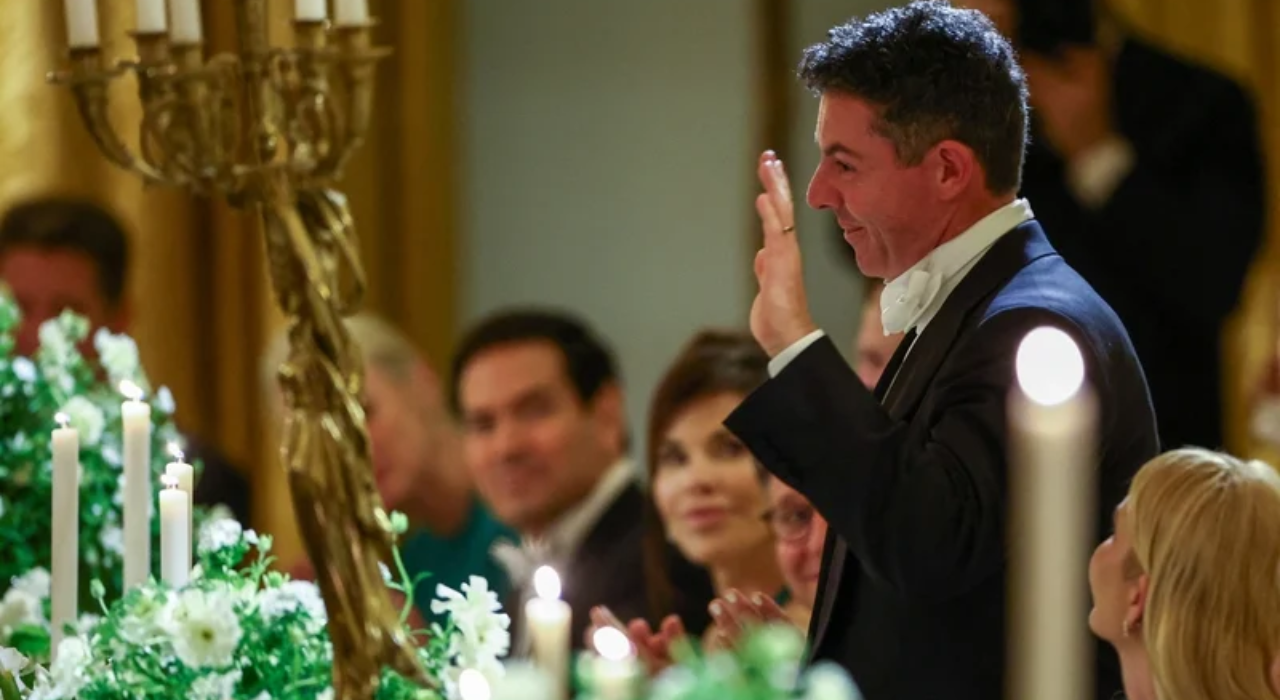
Media outlets are tripping over themselves to label Donald Trump’s recent White House dinner speech "awkward" or "bizarre." They’ve fixated on a brief pause where the President pivoted from geopolitical rhetoric to laud Rory McIlroy’s Masters victory. The consensus suggests a lapse in decorum. The consensus is wrong.
What the "awkwardness" narrative misses is the fundamental mechanics of high-stakes charisma and the strategic use of the non-sequitur. In a room full of stiff diplomats and scripted politicians, a sudden shift to sports isn't a glitch; it’s a power move. It breaks the tension. It humanizes the podium. Most importantly, it forces the audience to reset their attention span.
The Myth of the Linear Speech
Traditional speechwriting is dead, yet journalists still grade politicians like they’re reciting 18th-century poetry. They want a beginning, a middle, and a coherent end. That’s not how modern influence works. We live in a fragmented attention economy.
When Trump stops to talk about McIlroy’s swing or his triumph at Augusta, he isn't losing his place. He is performing a pattern interrupt. I’ve watched executives at Fortune 50 companies try to mimic this. Most fail because they lack the ego to pull off a total tonal shift. Trump does it because he treats every room—even a White House state dinner—like a high-end locker room.
McIlroy winning the Masters is a massive cultural data point. By injecting it into a formal dinner, Trump isn't being "clumsy." He is signaling that he is tuned into the same frequency as the general public, rather than the isolated bubble of the Washington elite.
Rory McIlroy and the Optics of Winning
Let’s look at the subject of the praise. Rory McIlroy is a symbol of professional resilience. After years of "close but no cigar" finishes at the Masters, his green jacket win is a narrative of redemption.
Politicians love winners. They crave the proximity to excellence. When Trump pauses to acknowledge McIlroy, he is performing a classic association tactic.
- The Winner Effect: By publicly praising a champion, the speaker absorbs a fraction of that perceived success.
- The Common Ground: Golf is the universal language of the billionaire class and the aspirational middle class.
- The Disruption: It forces the press to report on something other than policy, effectively hijacking the news cycle with a positive sports story.
The "awkwardness" the media describes is actually the discomfort of a room being forced to transition from a scripted reality to a spontaneous one. Most people are terrified of spontaneity. They see a pause and project their own anxiety onto it. Trump, however, inhabits that silence.
Why the Press Gets It Wrong Every Time
The media views these moments through the lens of "The West Wing." They want Aaron Sorkin dialogue. They want gravitas. They want the president to stay in character as a stoic philosopher-king.
They fail to realize that the philosopher-king is a boring brand.
In reality, the most effective communicators are the ones who can oscillate between the profound and the trivial without blinking. This is "High-Low" communication. You talk about trade deficits one second and a 400-yard drive the next. It makes the trade deficit talk feel more grounded and the golf talk feel more significant.
I’ve spent years analyzing the cadence of public figures who actually move the needle. The ones who stick to the teleprompter are forgotten by the time the valet brings the car around. The ones who "halt" the speech to talk about a golfer are the ones who dominate the headlines for forty-eight hours.
The Logic of the Tangent
Imagine a scenario where a CEO is delivering a quarterly earnings report. The numbers are mediocre. The vibe is tense. Suddenly, the CEO stops, looks at a junior analyst in the front row, and congratulates them on their recent marathon time.
The analysts from Goldman Sachs would call it "unprofessional." The employees would call it "the only part of the meeting they actually liked."
Trump’s Rory McIlroy detour operates on this same frequency. It’s a calculated pivot to a topic where everyone in the room has a neutral or positive opinion. No one hates a Masters winner. It’s the ultimate "safe" high-ground.
The Cost of Professionalism
The downside of my contrarian view is obvious: it rewards a lack of discipline. If every politician started rambling about their favorite athletes in the middle of legislative debates, we’d have total incoherence.
But there is a difference between rambling and a targeted shout-out. Trump knows his audience. The people at that White House dinner—donors, athletes, industry titans—they play golf. They care about the Masters. The journalists writing the "awkward" headlines? They’re the ones who feel out of place, not the guests.
Stop Reading the Transcript
If you read the transcript of a Trump speech, it looks like a disaster. If you watch the room, it looks like a revival.
The media’s mistake is treating a performance like a document. You don’t read a concert; you experience the energy. When the President stops to talk about McIlroy, he is checking the temperature of the room. He is looking for the nods, the smiles, the moment of shared recognition.
That isn't a failure of rhetoric. It’s the highest form of it.
The next time you see a headline about an "awkward moment," ask yourself who is actually uncomfortable. Usually, it’s just the person holding the pen, unable to cope with a reality that doesn't follow their boring, linear script.
Rory McIlroy won the Masters. Trump won the room. The media won nothing but a few cheap clicks for a narrative that hasn't worked in a decade.