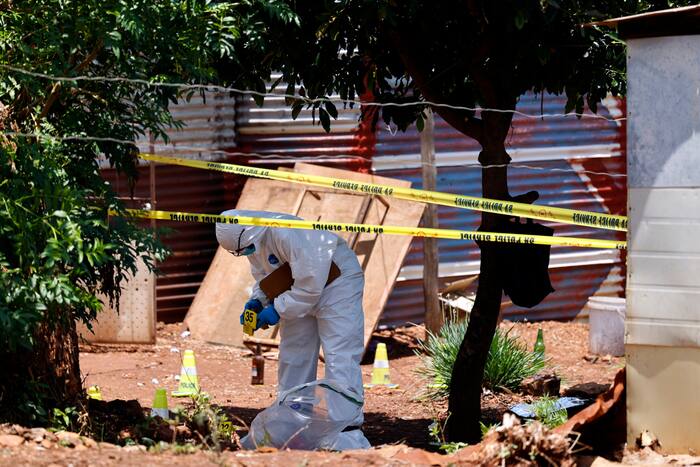
Seventeen dead in a single day across two separate shootings in South Africa. When headlines like this drop, the international press immediately reaches for its favorite lazy template. They treat the bloodshed like an American-style lone-wolf tragedy, frame it as random street crime, and call for stricter gun laws.
That narrative is dangerously wrong.
If you look at the mechanics of what actually happens on the ground in provinces like Gauteng, KwaZulu-Natal, and the Eastern Cape, these events are rarely spontaneous outbursts of madness. They are calculated executions, turf wars, and failures of state intelligence masquerading as random violence. By lumping every multi-casualty shooting under the generic umbrella of "gun violence," commentators obscure the real drivers of the carnage: organized syndicates, illicit state-sourced weaponry, and an economic vacuum that turns informal settlements into war zones.
The Myth of the Gun Control Fix
Whenever a mass shooting makes global news, the predictable reflex is to blame firearm availability. In South Africa, this argument falls apart upon basic inspection of the legal framework.
South Africa already enforces the Firearms Control Act of 2000, one of the strictest civilian gun ownership regimes on the planet. To legally purchase a handgun, a citizen must undergo competency training, pass a background check, submit to character interviews with family members and neighbors, prove the need for self-defense, and wait months—sometimes years—for the Central Firearms Registry to process the application.
The shooters firing automatic rifles into taverns in Soweto or ambushing families in Lusikisiki did not wait eighteen months for a competency certificate.
I have spent years analyzing security risk assessments and supply chain vulnerabilities across Southern Africa, and the data points to a completely different reality. The weapons driving these mass casualties are overwhelmingly illegal, and a disturbing percentage originate from the state itself. Between 2010 and 2020, official audits and parliamentary inquiries revealed that thousands of firearms were lost or stolen from the South African Police Service (SAPS) and the South African National Defence Force (SANDF). High-profile cases, such as the conviction of former police colonel Christiaan Prinsloo—who admitted to stealing over 2,000 firearms from police evidence stores and selling them directly to Cape Flats gangs—prove that the state is often the primary wholesaler for the underworld.
Passing another law restricting legal gun owners does nothing to stop a corrupt official from walking out of an armory with a crate of R5 assault rifles. Focusing on civilian gun laws is a distraction that lets the actual culprits off the hook.
Why Taverns and Homesteads Are Targeted
To understand why 17 people can be killed in two separate incidents on the same day, you have to understand the specific anatomy of South African mass shootings. They generally fall into two distinct operational categories, neither of which resembles the random public massacres seen in the West.
1. The Tavern Massacre as Economic Warfare
In South African townships, the local tavern or shebeen is more than a place to drink. It is an economic hub, a social anchor, and prime territory for extortion syndicates.
When gunmen kick open the doors of a tavern and spray the room with 9mm and rifle rounds, mainstream reports describe it as a "senseless attack." In reality, it is often a brutal enforcement tactic. Protection rackets—locally known as the "construction mafia" or extortion gangs—demand weekly payouts from small business owners. If a tavern owner refuses to pay, or if a rival syndicate wants to demonstrate that the current protectors cannot keep the venue safe, they execute the patrons. Killing the customers destroys the business overnight and sends a clear message to every other entrepreneur on the block: pay up, or close down.
2. The Rural Homestead Execution
The second pattern involves targeted hits on specific families or individuals in rural areas, particularly in the Eastern Cape and KwaZulu-Natal. These attacks are frequently tied to taxi industry disputes, stock theft syndicates, or traditional leadership rivalries.
In the minibus taxi industry—an unregulated, multi-billion-rand sector that moves the majority of South Africa’s workforce—routes are worth millions. Disputes over who controls a lucrative commuter corridor are routinely settled by hiring izinkabi (professional hitmen). These assassins do not care about collateral damage. If their target is inside a house with twelve family members, they will eliminate everyone inside to ensure no witnesses survive to testify in a court system that already struggles to protect informants.
The Intelligence Vacuum
Why do these attacks happen with such impunity? Because South Africa’s crime intelligence apparatus was systematically hollowed out over a decade of political capture, and it has never recovered.
Policing mass shootings after the fact is a losing game. By the time forensic teams are placing yellow evidence markers around shell casings, the syndicate has already achieved its objective. Preventing multi-casualty hits requires proactive intelligence: infiltrating syndicates, tracking illicit ammunition flows, and turning low-level operatives before they pull the trigger.
Instead, SAPS Crime Intelligence has been plagued by leadership purges, slush fund scandals, and infighting. Without actionable intelligence, police are reduced to reactive patrols. They drive through high-crime precincts with blue lights flashing, forcing criminals to simply wait twenty minutes until the patrol car turns the corner.
Consider a basic operational scenario: A local extortion gang decides to hit a tavern on a Friday night because the owner missed a payment. In a functioning intelligence environment, an informant within the gang or the illicit arms network flags the movement of high-caliber weapons into the area days in advance. Tactical units intercept the vehicle before it reaches the venue. In the current environment, the police only find out about the operation when the mortuary vans are called at 2:00 AM.
Dismantling the "Poverty Causes Crime" Excuse
Another pillar of the lazy consensus is the idea that extreme poverty and a 30%+ unemployment rate automatically produce mass murderers.
This is an insult to the millions of impoverished South Africans who wake up every day, navigate broken public transit, and work tirelessly to support their families without ever picking up an illegal firearm. Poverty creates desperation, and desperation fuels opportunistic crimes like petty theft, shoplifting, and muggings.
Poverty does not organize a coordinated, multi-shooter ambush using military-grade hardware.
Mass shootings require logistics. Someone has to procure the weapons, source the ammunition, pay the shooters, arrange the getaway vehicles, and bribe the right people to ensure the dockets go missing if anyone gets arrested. That is not the work of a starving individual; it is the work of a criminal enterprise operating in a low-risk, high-reward environment. When the conviction rate for murder hovers in the low teens, murder becomes a rational business expense for organized crime.
What Actually Stops the Bloodshed
If banning legal guns won't work and waiting for macroeconomic miracles will take decades, what actually stops multi-casualty shootings? Security experts and criminologists who study organized crime—like the researchers at the Institute for Security Studies (ISS) and the Global Initiative Against Transnational Organized Crime—have been pointing to the exact same solutions for years. Politicians ignore them because they require hard administrative work rather than flashy press conferences.
- Audit and Secure State Armories Immediately: Implement biometric access controls and independent, third-party audits for every single SAPS and SANDF weapons depot. Track ammunition batches chemically and serially so that when a casing is found at a crime scene, investigators know within hours which specific police station or military base lost it.
- Dismantle the Witness Intimidation Pipeline: You cannot prosecute hitmen if witnesses are murdered before the trial begins. South Africa needs a heavily funded, independent witness protection program completely divorced from regular police stations, where corrupt officers frequently leak witness locations to syndicates.
- Target the Financial Arteries of Extortion: Stop treating tavern shootings as isolated homicides and start prosecuting them under anti-racketeering laws. Follow the money. Seize the assets of the syndicate bosses who collect the extortion fees, rather than just arresting the disposable teenagers they hire to pull the triggers.
- Restore Crime Intelligence: Strip political appointees out of Crime Intelligence and rebuild informant networks from the ground up, focusing specifically on the taxi industry, illicit mining (zama zamas), and illegal firearms trafficking.
The Hard Truth About This Approach
There is a catch to this strategy, and it explains why it rarely gets implemented: it requires the state to investigate itself.
Auditing police armories will implicate senior officers. Cracking down on taxi violence and construction mafias will expose politicians and municipal officials who take kickbacks from those exact same syndicates. Rebuilding witness protection means admitting that the current justice system cannot keep citizens safe.
It is much easier for officials to stand in front of television cameras after seventeen people are dead, blame "gun culture," promise more police patrols, and wait for the news cycle to move on.
Until the public stops accepting the narrative of random violence and demands accountability for the state-enabled criminal networks behind these executions, the body count will keep climbing. Stop asking how to get guns off the streets, and start asking who is handing them out from behind a badge.


