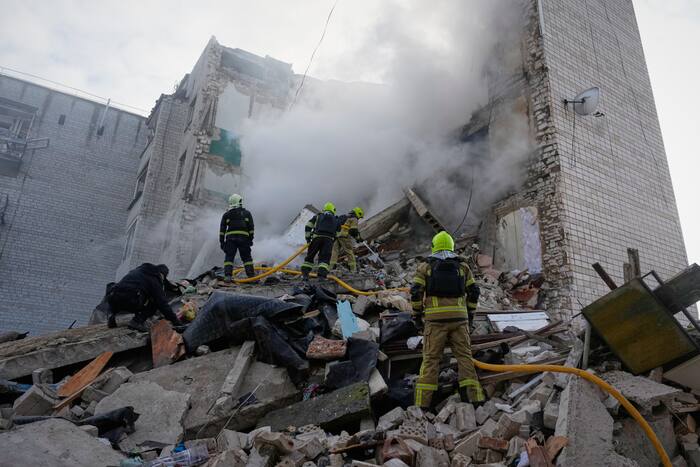
Two dead. Four wounded. Another shattered concrete facade on the outskirts of Ukraine’s capital.
If you read the standard wire copy covering this morning’s strike near Kyiv, you already know the script. Journalists rush to the scene, photograph the blown-out windows, quote a grieving neighbor, and frame the event as another bout of senseless, erratic Russian brutality. They treat an apartment building getting hit as either an act of pure spite or the result of cheap, malfunctioning guidance chips salvaged from washing machines.
That framing is comforting. It allows Western readers to shake their heads at barbarism and move on. It is also dangerously wrong.
Having spent over a decade analyzing air defense economics, munitions procurement, and urban targeting doctrines from Eastern Europe to the Levant, I can tell you that modern long-range strike campaigns rarely waste expensive airframes on random apartment blocks just to make the evening news. When a residential structure outside Kyiv takes a direct hit, you are not looking at a failure of Russian targeting. You are looking at the brutal mathematics of
The Lazy Consensus of "Senseless Brutality"
Legacy media outlets cover these strikes like local crime blotters. They tally the casualties, note the arrival of emergency crews, and imply that Moscow’s strategic goal is simply to scare civilians into surrendering.
Anyone who has actually studied the history of strategic bombing—from the London Blitz to the air campaigns over Vietnam—knows that bombing apartment buildings does not break civilian morale. In fact, it achieves the exact opposite. Every respected military theorist since Giulio Douhet’s theories were debunked in World War II agrees that strikes on residential areas harden public resolve and increase political cohesion. Russian general staff officers read the exact same military history textbooks as officers at Fort Leavenworth. They know killing two civilians in a Kyiv suburb will not force Volodymyr Zelenskyy to sign a capitulation treaty.
So why does it keep happening?
Because the apartment building is rarely the intended aimpoint, yet its destruction is a mathematically guaranteed byproduct of the actual mission.
When a Russian Tu-95MS bomber launches a Kh-101 cruise missile, or when a launch crew fires a Shahed-136 one-way attack drone toward the Kyiv oblast, the primary objective is almost always logistical, industrial, or defensive. They are hunting transformer substations, dispersed drone assembly workshops, Patriot battery radars, or rail junctions.
However, Kyiv is arguably the most densely defended airspace on the planet. To penetrate that shield, attackers rely on complex flight profiles. Missiles hug the terrain at altitudes under fifty meters to stay below radar horizons. Drones weave through residential suburbs specifically because planners know air defense commanders face agonizing rules of engagement over populated areas.
The Physics of a Fallen Interceptor
Here is the uncomfortable reality most correspondents omit because it complicates a clean moral narrative: a massive percentage of residential damage in and around Kyiv is caused by the defensive battle itself, not an uncontested Russian aimpoint.
Consider the physics of an air defense engagement over a sprawling metropolis.
- Electronic Spoofing: Ukraine deploys sophisticated
The use of the electromagnetic spectrum to sense, protect, and communicate while denying the enemy the ability to do the same. systems that jam and spoof GLONASS satellite navigation signals. When a guided munition loses its satellite lock mid-flight, its inertial navigation system drifts. Over a flight path of a thousand kilometers, a drift of a fraction of a degree translates into hundreds of meters of error at the terminal phase. A missile aimed at a military repair depot easily ends up slamming into a nine-story residential block half a kilometer away. - Mid-Air Interceptions: When a Patriot PAC-3 interceptor or an IRIS-T missile strikes an incoming warhead at Mach 4, the target does not vaporize into harmless dust. Momentum is conserved. Hundreds of kilograms of burning fuselage, unspent rocket fuel, and high-explosive fragments follow a ballistic trajectory straight down into whatever sits beneath the engagement zone.
- Interceptor Malfunctions: Surface-to-air missiles are high-stress machines operating at extreme tolerances. When a booster fails or a proximity fuse triggers prematurely over a suburb, the interceptor itself becomes an unguided bomb.
Does this absolve Moscow of responsibility? Not at all. Under international humanitarian law, the aggressor launching dual-use or indiscriminate salvos into populated airspace bears total legal and moral culpability for the resulting civilian deaths.
Yet, when newsrooms flatten this complex kinetic reality into "Russia bombs apartments for no reason," they blind the public to the actual tactical crisis unfolding over Ukraine.
The Economics of Interceptor Depletion
To understand why residential buildings are still burning years into this conflict, stop looking at the rubble and start looking at a spreadsheet.
War at this scale is an accounting exercise written in blood and tungsten. Every time an air raid siren wails in Kyiv, an asymmetrical financial transaction occurs in the sky.
| Munition Type | Estimated Unit Cost | Primary Role | Strategic Implication |
|---|---|---|---|
| Shahed-136 Drone | $20,000 – $50,000 | Decoy / Saturation | Forces defenders to burn expensive air defense ammo |
| Kh-101 Cruise Missile | $1.2 Million – $1.5 Million | Precision Strike | Threatens hardened infrastructure; demands top-tier interceptors |
| Patriot PAC-3 MSE | $4 Million+ | Ballistic/Cruise Defense | Irreplaceable in the short term; bottlenecks Western supply chains |
| Gepard 35mm Burst | ~$3,000 per burst | Low-Altitude Counter-UAS | Cost-effective, but limited to short-range point defense |
Look at those numbers. That table is the entire war in miniature.
When Russia launches a mixed package of cheap drones alongside a handful of ballistic or cruise missiles, the primary goal isn't necessarily to hit a specific building. The goal is to force Ukraine to expend a $4 million interceptor to stop a $30,000 drone, or to exhaust the magazines of localized air defense batteries so that subsequent waves fly through unopposed.
Imagine a scenario where a regional air defense commander has four interceptors left in a launcher and six incoming targets on the radar screen. Two targets are heading toward a critical power plant; four are tracking toward a dense residential district. Which ones do you shoot down? If you protect the power plant, the apartments get hit. If you protect the apartments, the grid collapses, freezing tens of thousands of people in the dark.
That is the trap Moscow sets with every single launch. By routing flight paths directly over civilian housing estates, Russian planners force Ukrainian defenders into a lose-lose calculus. Either Ukraine burns through finite Western interceptor stocks at an unsustainable rate, or civilian infrastructure absorbs the kinetic fallout of degraded defense coverage.
Why "Better Air Defense" Is a Flawed Answer
Whenever a strike kills civilians near Kyiv, the predictable chorus of pundits demands that Western allies simply "send more air defenses."
It sounds decisive. It makes for a great soundbite on cable news. It is also completely disconnected from industrial reality.
You cannot conjur Patriot batteries out of thin air. Raytheon and Lockheed Martin face rigid bottlenecks in solid rocket motor production, seeker heads, and specialized microelectronics. Even with accelerated global production lines, annual output for top-tier interceptors sits in the hundreds, while Russia manufactures thousands of long-range drones and hundreds of missiles annually.
I have watched defense procurement officials in Washington and Brussels tie themselves in knots trying to solve an offensive volume problem with defensive luxury goods. It never works. In any missile exchange, the offense holds the structural cost advantage. A defender must be right 100% of the time across a massive geographic perimeter; the attacker only needs to get lucky once, or simply outspend the defender's magazine depth.
Relying purely on static ground-based air defense around Kyiv is like trying to stop a flood with buckets instead of fixing the broken dam upriver.
The Uncomfortable Truth About Escalation
If journalists actually wanted to answer the implicit question behind every article about a bombed Kyiv apartment—How do we make this stop?—they would have to confront the taboo subject of deep-strike reciprocity.
Air defense is a shield, and shields eventually crack under sustained hammer blows. The only historically proven method for stopping a strategic bombing campaign is to destroy the archer, not the arrows.
For years, Western policy artificially restricted Ukraine from striking the airfields, missile storage depots, and drone manufacturing plants deep inside Russian territory using supplied long-range systems. The fear of escalation paralyzed decision-makers in Washington and Berlin. Meanwhile, Russian bombers took off from bases like Engels-2 in complete safety, fired their payloads from within Russian airspace, and landed in time for dinner.
Even as those restrictions have eroded and Ukraine has developed its own domestic long-range strike capabilities, the fundamental asymmetry remains. Until the cost of launching a strike package exceeds the political and military value Moscow extracts from depleting Ukrainian air defenses, the strikes on Kyiv’s suburbs will continue.
What You Should Actually Watch For
The next time you see a breaking news alert about an apartment building hit near Ukraine’s capital, ignore the emotional hand-wringing and look for the diagnostic clues buried in the reporting:
- The Munition Mix: Was it a solo drone, or part of a coordinated multi-vector salvo? Isolated hits suggest electronic warfare deflection or mechanical failure. Multi-vector salvos indicate a deliberate attempt to map and exhaust air defense radars.
- Proximity to Infrastructure: Pull up a map of the affected district. You will almost always find a railway hub, a high-voltage substation, an industrial park, or a known military logistics node within a two-kilometer radius.
- Time of Impact: Strikes occurring around 3:00 AM to 5:00 AM are timed to exploit human fatigue in mobile air defense fire teams and maximize the psychological shock of waking a city up to explosions.
- Interception Claims vs. Ground Damage: Compare the Ukrainian Air Force’s morning shoot-down report with the location of the debris. High interception rates paired with widespread roof and window damage confirm heavy mid-air kinetic engagements directly over populated zones.
The Limits of the Cold View
There is an obvious danger in analyzing war strictly through targeting math and procurement spreadsheets. When you reduce a strike to cost-exchange ratios and inertial drift, you risk sanitizing human tragedy. Two people died in that apartment building. Their families do not care about the unit cost of a PAC-3 interceptor or the mechanics of GPS spoofing. To them, the violence is absolute, personal, and unforgivable.
We should never lose sight of the human cost, nor should we ever normalize the reality of ballistic missiles falling on European suburbs.
Yet, empathy is not a strategy. Outrage does not intercept cruise missiles.
When media outlets frame every civilian casualty near Kyiv as an inexplicable spasm of random evil, they do their readers a profound disservice. They obscure the cold, calculating military doctrine driving the campaign. Russia is not wasting precision weapons to blow up random living rooms. Russia is executing a methodical campaign of resource exhaustion, using civilian populations as human shields to force impossible air defense trade-offs, and weaponizing the physics of falling debris.
Stop reading these headlines as isolated tragedies. Read them as progress reports on a slow-motion siege designed to bankrupt Western air defense stockpiles—and decide whether the West is actually willing to break the siege at its source.