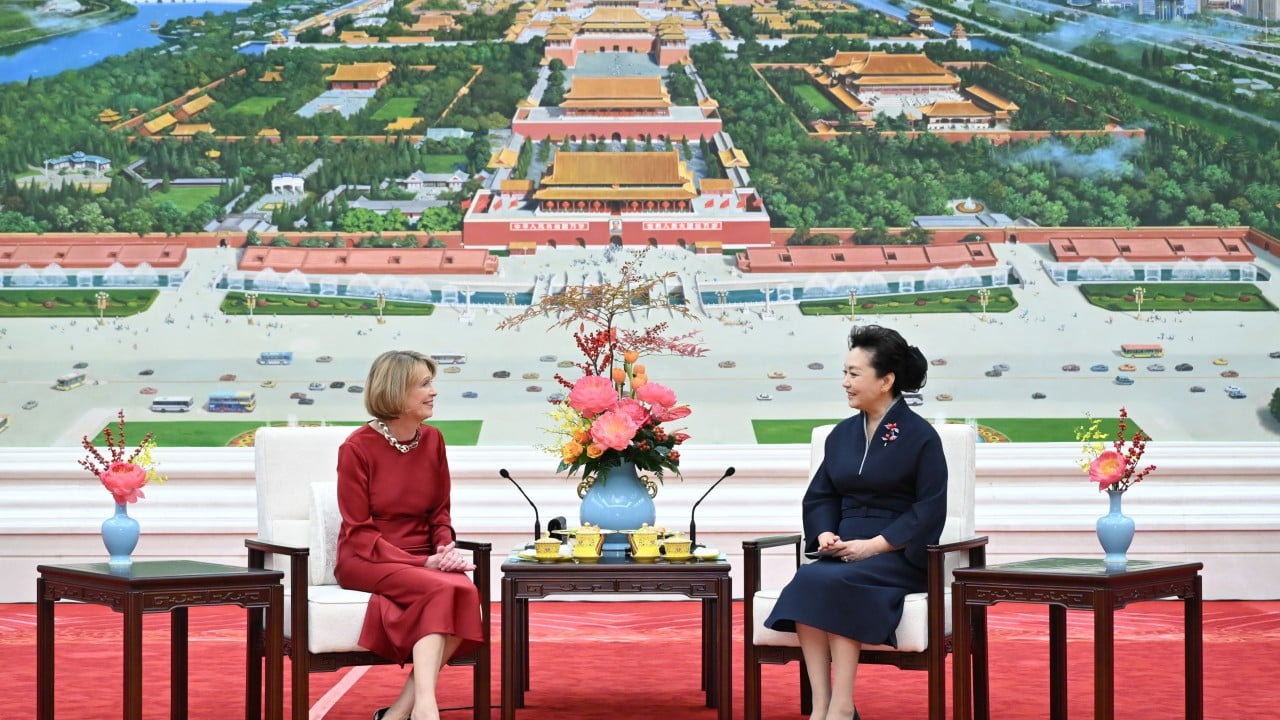
Western foreign policy commentators love a lazy narrative. Put two political spouses in a room with fine porcelain, silk embroidery, and a string quartet, and the headlines write themselves.
"Soft power on display."
It is predictable. It is neat. And it is fundamentally wrong.
When China’s first lady Peng Liyuan hosts a German counterpart—whether it is Elke Büdenbender or any visiting dignitary from Berlin—the mainstream press rushes to frame the afternoon tea as a masterclass in charm diplomacy. They gush over the bespoke tailoring. They analyze the choice of traditional Chinese opera pieces. They treat aesthetic curation as a geopolitical weapon capable of softening Berlin’s stance on trade tariffs, industrial subsidies, or supply chain de-risking.
Let’s cut through the diplomatic theater. That is not soft power. That is state-sponsored interior design masquerading as strategy.
If you have spent any real time watching how bilateral deals between Beijing and Berlin actually get hammered out behind closed doors, you know that a pleasant afternoon at the Diaoyutai State Guesthouse does not move a single decimal point on an automotive tariff sheet. Treating spousal diplomacy as a serious lever of international influence confuses cultural pageantry with actual attraction.
Joseph Nye, the political scientist who coined the term "soft power" in the late 1980s, defined it with surgical precision. Soft power is the ability to get what you want through attraction rather than coercion or payments. It arises from the attractiveness of a country’s culture, political ideals, and policies. Notice the critical requirement in Nye’s framework: the target audience has to actually be attracted to the underlying values, not just impressed by the catering.
The Illusion of the Silk Glove
The standard media coverage of Peng Liyuan’s diplomatic outings falls into a classic analytical trap. Journalists see high-context cultural signaling and assume it translates into political capital.
Consider the mechanics of a typical Sino-German state visit. While the Chancellor and the President are locked in tense negotiations over overcapacity in green tech, electric vehicle duties, and Germany’s "China Plus One" diversification strategy, the spouses are whisked away to a museum, a conservatory, or a tea pavilion. Peng Liyuan, a former celebrated soprano with genuine stage presence and impeccable poise, executes her role flawlessly. She bridges the language barrier with music and art. She projects warmth, stability, and refinement.
Then, the press release drops. The photos hit the wires. Commentators immediately declare that Beijing is successfully deploying its "secret weapon" to charm European skeptics.
Here is the problem with that thesis: charm does not survive contact with a balance sheet.
German foreign policy toward China is driven by cold, hard industrial survival. Executives from Volkswagen, BASF, and Siemens are not sitting in boardrooms in Wolfsburg or Munich thinking, “Well, the trade deficit is crushing our manufacturing base, and intellectual property protections remain shaky, but did you see the guzheng performance Peng Liyuan arranged for the First Lady?”
It sounds absurd when you state it plainly, yet that is the exact subtext of every breathless "soft power" write-up.
I have watched corporate and diplomatic delegations prep for Beijing for years. Millions of euros are spent on cultural briefings, gift protocols, and etiquette coaching. Yet, the moment the delegation lands back in Frankfurt, the only metrics that matter to the Chancellery and the Bundestag are market access, regulatory reciprocity, and geopolitical alignment. The tea party is forgotten before the plane clears Chinese airspace.
Why Aesthetic Diplomacy Fails the Soft Power Test
To understand why these high-profile spousal meetings fail as soft power, you have to look at who is actually watching and how influence operates in modern democracies.
Soft power works bottom-up or laterally. Hollywood movies, Japanese anime, South Korean pop music, and American tech platforms generate soft power because millions of ordinary citizens voluntarily consume them, admire the lifestyle they represent, and subsequently view the country of origin more favorably. That grassroots affinity then constrains or nudges their elected leaders.
Spousal diplomacy operates in a vacuum. It is an elite-to-elite closed loop.
- Zero Grassroots Penetration: The average voter in Hamburg or Munich does not watch state broadcaster footage of two first ladies admiring cloisonné vases. Even if they see a passing photo in the morning paper, it registers as routine protocol, not a compelling reason to rethink their skepticism of Beijing’s foreign policy.
- The Authenticity Deficit: Modern audiences—especially in Western Europe—have hypersensitive radar for state-curated propaganda. When cultural heritage is deployed explicitly as a backdrop for a diplomatic summit, it loses its organic appeal. It feels choreographed, transactional, and sterile.
- Policy Contradictions: As Nye himself has repeatedly pointed out in his critiques of Beijing’s charm offensives, soft power cannot be bought or staged when hard policies actively alienate the target public. You cannot host a charming tea ceremony on Tuesday while engaging in aggressive maritime posturing or harsh trade retaliation on Wednesday and expect the tea ceremony to win the week.
What Is Actually Happening in That Room
If it isn’t soft power, why does Beijing invest so much energy into Peng Liyuan’s diplomatic profile? And why does Berlin happily play along?
The answer is far more pragmatic, and far less romantic, than the media suggests. It comes down to two things: domestic political theater and diplomatic friction reduction.
First, look at the domestic audience inside China. State media coverage of Peng Liyuan hosting European dignitaries is not primarily aimed at Germans. It is aimed at Chinese citizens. Seeing the First Lady command the international stage with grace, dressing in elevated traditional Chinese aesthetics (Guochao style), and receiving respectful deference from Western counterparts reinforces national pride and domestic legitimacy. It signals that China has arrived as a peer superpower that sets the cultural standard, rather than mimicking Western norms. In that sense, it is an inward-facing morale tool, not an outward-facing persuasion tool.
Second, look at the mechanics of bilateral protocol. High-level diplomacy is grueling, adversarial, and prone to ego clashes. The spousal program serves as a pressure release valve. It keeps the bilateral relationship visually cordial while the principals fight over substance in the next room. It provides safe, non-controversial B-roll for the evening news in both countries, signaling to markets and the public that the two nations are still talking, even if they are deadlocked on every major policy issue.
Berlin understands this game completely. When the German First Lady accepts the invitation, smiles for the cameras, and praises the hospitality, she is not falling under a spell of Chinese soft power. She is doing her job: maintaining diplomatic decorum so that German diplomats have the breathing room to negotiate hard commercial interests without triggering an unnecessary diplomatic freeze.
Answering the Wrong Questions
When readers search for news about these diplomatic encounters, they are usually fed a diet of superficial trivia. Let’s dismantle the standard questions surrounding this topic and replace them with reality.
Does cultural diplomacy actually change foreign policy?
No. Cultural exchanges build baseline familiarity and keep communication channels open during crises, which has value. During the Cold War, American jazz musicians toured the Soviet Union, and Soviet ballet companies toured the West. Those tours humanized the "other side," which helped prevent catastrophic miscalculations. However, the ballet did not end the arms race, and jazz did not tear down the Berlin Wall. Economic collapse, deterrence, and hard political negotiations did. Expecting a state dinner or an afternoon concert to alter Berlin’s national security strategy is naive.
Why does Peng Liyuan get so much more media attention than previous Chinese first ladies?
For decades after the founding of the People’s Republic, Chinese leaders' spouses kept an intentionally low profile, largely adhering to traditional norms of political modesty. Peng Liyuan broke that mold because she was already a household name in China—a famous folk singer and military performer—long before Xi Jinping took office. Beijing realized they had a charismatic communicator who could humanize the top leadership for both domestic and foreign audiences. Her visibility is a modernization of Chinese statecraft, bringing it closer to the Western "First Lady" model, rather than a sudden invention of a new geopolitical superpower.
Is Germany softening its stance on China because of these high-level visits?
Look at the data, not the photo ops. Germany officially adopted its first-ever comprehensive China strategy in 2023, explicitly labeling China simultaneously as a "partner, competitor, and systemic rival." Since then, Berlin has tightened investment screening, pushed for supply chain diversification, and backed European Union investigations into Chinese state subsidies. The smiles at the Diaoyutai State Guesthouse have not reversed a single structural shift in German policy.
The Counter-Intuitive Risk of Overplaying the Charm Card
There is an inherent downside to relying heavily on polished, high-status spousal diplomacy, and strategic communicators rarely admit it: it creates a jarring dissonance when real-world friction hits.
When a government spends years cultivating an image of serene harmony, ancient wisdom, and gracious hospitality through its cultural figureheads, any subsequent hardball tactic—whether it is an export control on critical minerals or a sharp diplomatic rebuke—looks twice as aggressive by comparison. Instead of softening the blow, the contrast sharpens the sense of distrust among foreign observers.
Imagine a scenario where a European trade delegation is treated to an opulent, deeply personal cultural tour in Beijing, complete with bespoke gifts and warm rhetoric about shared heritage, only to have their core market-access proposals flatly rejected the following morning without compromise. The hospitality does not make the rejection easier to swallow; it makes the delegation feel played. In high-stakes diplomacy, excessive polish without substantive concession breeds cynicism, not attraction.
How to Actually Read a State Visit
If you want to understand what is truly happening the next time Peng Liyuan hosts a foreign counterpart, stop reading the fashion breakdowns and the soft-power think pieces. Apply a three-step filter to separate the signal from the noise:
- Ignore the venue; track the deliverables. Watch what gets signed in the plenary hall, not what gets served in the tea room. If a visit produces joint declarations on climate standards, new agricultural import quotas, or aviation orders, the trip mattered. If the biggest headline out of a two-day summit is the First Lady’s dress or a museum visit, it means the substantive negotiations stalled and the PR teams had to scramble for cover.
- Look at the delegation roster. Follow the CEOs. When the German Chancellor travels to Beijing, look at which industrial titans are on the plane. Their presence—or conspicuous absence—tells you everything about the real state of bilateral leverage.
- Watch the follow-through at 90 days. Diplomatic warmth has a half-life of about three months. Check the trade data, tariff rulings, and parliamentary votes a quarter after the visit. That is where real power lives.
Diplomacy is an unsentimental business conducted by professionals who measure success in basis points, security guarantees, and regulatory concessions. Pageantry has its place—it oils the gears of protocol and gives the cameras something pretty to look at while the real work happens out of sight.
Stop mistaking the theater lobby for the stage.