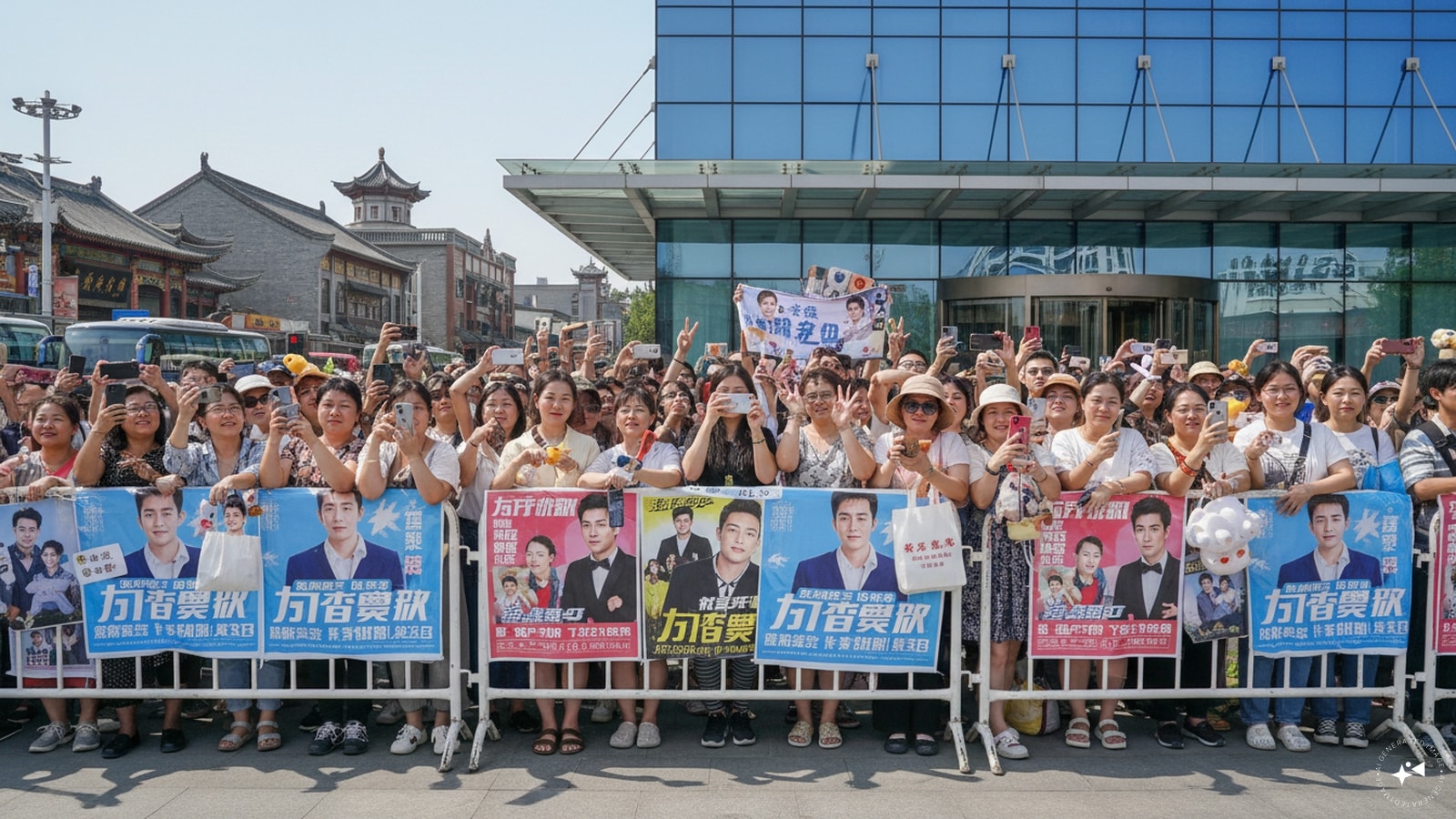
Mainstream entertainment journalists love a cute human-interest story. A bunch of starry-eyed fans hop on a flight from Seoul, Bangkok, or Kuala Lumpur, land in Zhejiang province, and camp outside a dusty backlot in Hengdian World Studios just to catch a three-second glimpse of a guy in a synthetic wig walking from a trailer to a soundstage. Cute, right? Wrong. You are looking at the exhaust fumes and calling it the engine.
The lazy consensus tells you that China's massive film towns are booming because C-dramas have finally conquered Asian pop culture, turning remote county-level cities into the next Hollywood. That narrative misses the financial and structural mechanics entirely. International fans flying into Hengdian are not a sign of an organic cultural renaissance. They are the byproduct of a hyper-industrialized, deeply precarious content factory that has figured out how to monetize parasocial desperation while hiding a massive structural contraction in actual film and television profitability. Also making waves in this space: What Most People Get Wrong About Close-Up Photographer of the Year.
If you want to understand why thousands of people are standing in the freezing rain in Dongyang, stop looking at the actors. Look at the balance sheets of the platforms, the collapse of traditional box office margins, and the ruthless supply-chain economics of the daipai (proxy photography) cartel.
The Myth of the Organic Cultural Boom
Every PR-friendly article about Hengdian treats the influx of international tourists as proof that Chinese historical dramas—xianxia and wuxia epics—are naturally winning hearts and minds across borders. This confuses manufactured distribution with genuine cultural demand. More information regarding the matter are explored by Vanity Fair.
Over the past several years, China's big three streaming giants—Tencent Video, iQIYI, and Youku—hit a domestic subscriber ceiling. Growth stalled. Ad revenue flattened. When you cannot squeeze another yuan out of domestic tier-one cities, you dump your catalog onto international apps like WeTV, iQIYI International, and Viki, aggressively subsidizing localization in Thai, Vietnamese, Bahasa Indonesia, and Korean.
The international fans showing up at Hengdian's gates are not discovering a hidden gem. They are the end-result of an aggressive customer acquisition funnel designed to offset domestic stagnation. And here is the part the travel pieces leave out: the studios do not actually want those fans there, yet they cannot survive without the hype those fans generate.
I have watched production executives lose their minds over set leaks while simultaneously instructing their marketing teams to leak the exact call sheets to fan-club administrators. It is a calculated hypocrisy. If an actor walks from their hotel to the set without fifty telephoto lenses pointed at them, the project is dead on arrival. Investors and platform buyers measure a drama's viability months before it airs by one metric alone: reidu (heat index) on social media, which is artificially inflated by the volume of unauthorized set photos circulating online.
Inside the Hengdian Supply Chain
To call Hengdian a "film town" is an insult to actual filmmaking. It is a manufacturing plant. Spanning roughly 30 square kilometers, it is the largest outdoor film studio in the world, built not for artistic prestige, but for ruthless cost-per-minute efficiency.
When a crew books Hengdian, they are tapping into a vertically integrated assembly line:
- Zero-friction set recycling: The exact same Ming Dynasty palace courtyard used for a tragic historical epic on Tuesday will be redressed with cheap foam rocks and dry ice for a fantasy romance on Thursday.
- Compressed shooting schedules: A 40-episode drama that would take two years to shoot in the West is churned out in 110 days. Actors work 16-hour shifts, often filming two different scenes with two different B-units simultaneously.
- The gray-market paparazzi economy: Surrounding the official production crew is an entire shadow workforce of professional stalkers, drone operators, and ladder-renters who sell raw footage directly to fan clubs.
Think about the absurdity of this setup. In Los Angeles or London, a leaked photo of a lead actor in costume is a security breach that gets people fired. In Hengdian, it is the primary marketing campaign.
Imagine a scenario where a mid-tier streaming drama has a modest budget of 150 million RMB. The producers know they cannot afford a nationwide billboard campaign when the show drops next year. Instead, they spend a fraction of that budget styling the lead actors in absurdly intricate, photogenic costumes specifically designed to look good through a 600mm lens from fifty yards away. They let the daipai photographers capture the actors' daily commute. Those photos get uploaded to Weibo, translated into Thai and English on X (formerly Twitter) within twenty minutes, and suddenly an international fanbase is funding LED billboards in Bangkok for a show that has not even finished editing.
The tourists flying across Asia are not spectators. They are unpaid labor in a global viral marketing loop.
Why Fans Are Paying to Watch Paint Dry
If you ask a travel blogger whether visiting Hengdian is worth the money, they will give you a sanitized itinerary: visit the Qin Palace, catch a stunt show at Dream Valley, and maybe spot a celebrity if you are lucky.
Here is the brutal truth: as a traditional tourist destination, Hengdian is terrible.
Dongyang is a county-level city with no airport of its own. You fly into Hangzhou or Yiwu, take a long bus or private car, and arrive in a town where the entire local economy is built around price-gouging crews and desperate fans. The theme park attractions are dated, the faux-historical architecture looks like painted fiberglass up close, and the food is mediocre unless you know which back-alley spot the stunt coordinators eat at after midnight.
Furthermore, if you show up expecting to casually bump into your favorite actor at a coffee shop, you will leave empty-handed and broke. Top-tier stars—the liuliang (traffic idols) who actually draw international crowds—do not walk around Hengdian. They stay in heavily guarded five-star hotels, get shuttled in blacked-out vans with curtains drawn, and enter sets through covered tunnels constructed specifically to block sightlines.
To actually see anyone famous, you have to participate in the shengtu (raw photo) economy. That means:
- Waking up at 3:30 AM to claim a spot on a muddy dirt road outside a studio gate.
- Paying local scalpers anywhere from 200 to 1,000 RMB just to stand on a wooden folding ladder for three hours.
- Dealing with aggressive security guards who will shine high-powered lasers directly into your camera sensor to ruin your shots—unless your fan club paid the local "security fee" under the table.
Does this sound like a fun vacation? Of course not. Yet thousands of young women from across Asia drop thousands of dollars on flights, hotels, and scalper fees every month to endure it. Why? Because C-drama fandom operates on a fundamentally different psychological contract than Western celebrity culture.
Western pop culture sells aspiration; you want to be like the star. C-drama idol culture sells yangcheng—the feeling of raising or nurturing the star. Fans believe their physical presence, their screaming at 5:00 AM, and their viral hashtags directly protect their favorite actor from being sidelined by ruthless talent agencies and fickle investors. They are not tourists. They are investors defending their asset.
The Structural Crack Nobody Wants to Admit
While the mainstream media celebrates crowded hotels in Zhejiang, the actual industry insiders in Beijing and Shanghai are terrified. The Hengdian tourism surge masks three massive structural vulnerabilities in the Chinese entertainment sector.
1. The Collapse of Mid-Budget Storytelling
Because platforms only greenlight projects that guarantee immediate social media heat, studios have abandoned grounded, realistic storytelling in favor of formulaic, idol-driven costume dramas. These shows require massive set pieces, which forces everyone into Hengdian, driving up local rental and labor costs while homogenizing the entire industry's output. When every show is shot on the same backlots with the same lighting setups and the same twelve actors rotating partners, audience fatigue is inevitable.
2. Regulatory Whiplash
The Chinese entertainment industry exists at the mercy of the National Radio and Television Administration (NRTA). At any moment, a sudden policy shift—a crackdown on "effeminate" male aesthetics, a cap on actor salaries, a ban on time-travel tropes, or a sudden tax audit—can freeze a 300-million-RMB production overnight. Hengdian has an entire graveyard of unreleased dramas sitting on hard drives because one lead actor got caught in a scandal or a historical trope fell out of political favor. International fans are pouring emotional and financial capital into a volatile market where their favorite show can be erased from the internet with zero warning.
3. The Short-Drama Cannibalization
While everyone is watching the big-budget crews in Hengdian, the real disruption is happening at the bottom of the food chain. Micro-dramas—vertical, one-minute-per-episode soap operas shot in seven days for $50,000—are devouring audience attention spans. Hengdian has pivoted aggressively to accommodate these crews, earning the nickname "Shudian" (Vertical Town). These micro-dramas do not rely on A-list stars or international fan tourism; they rely on algorithmic ad-buying and pure dopamine hooks. As capital floods into fast-turnaround vertical content, the traditional 40-episode Hengdian epic looks increasingly like an overpriced dinosaur.
How to Actually Navigate This Ecosystem
If you are an industry observer, a marketer, or even a die-hard fan planning a trip, stop falling for the glossy travel brochures and PR spin. You need to treat Hengdian for what it actually is: an industrial zone with a ruthless set of unwritten rules.
For marketers and brand strategists:
Stop measuring C-drama success by domestic broadcast ratings or official platform view counts—both are notoriously easy to manipulate. If you want to know if an actor actually has commercial pull across Southeast Asia and East Asia, look at the grassroots logistics around Hengdian. Track the volume of independent fan-funded food trucks (yingyuan) arriving on set, the resale value of their call sheets on gray-market Telegram groups, and the organic engagement on unedited daipai clips. That is where real purchasing power lives.
For travelers and fans who still insist on going:
Drop the naive expectation of a standard sightseeing trip. If you go, understand that you are entering a gray-market economy.
- Skip the official scenic spots unless you genuinely care about architecture; they are overpriced tourist traps designed for domestic bus tours.
- Do not hire random "tour guides" on social media promising VIP set access. Ninety percent of them are scammers who will take your deposit and drop you off at a closed gate where nothing is filming.
- Verify production schedules through legitimate fan-club hubs before booking a flight, and accept that productions move indoors without notice.
I will admit the obvious flaw in my own cynicism: for the fans standing on those muddy ladders at dawn, the transaction feels completely worth it. When an actor rolls down their van window for two seconds to wave, the emotional payoff is real, regardless of how manufactured the surrounding industry might be. You cannot argue with someone's genuine joy, even when you can clearly see the assembly line producing it.
Still, we need to stop pretending this is a fairy tale about the universal power of cinema. Hengdian is not the next Hollywood. It is a hyper-efficient content factory running on sleepless crews, gray-market paparazzi, and the weaponized devotion of fans who fly across a continent just to wave at a tinted car window. Call it a miracle of modern fandom if you want—just do not mistake the factory floor for magic.