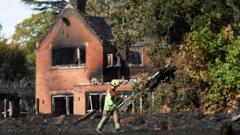
Every news ticker and official briefing is currently reciting the exact same comforting narrative: the West Midlands fires are an unfortunate act of meteorological violence, a tragic byproduct of an amber heat warning and tinder-dry grass.
It is a lazy consensus designed to absolve systemic failure.
Blaming the sun for burning down dozens of homes in Stourbridge, Stoke-on-Trent, and Birmingham ignores the structural reality of how British infrastructure is managed. The weather did not ignite the urban fringe; decades of planning apathy, hollowed-out municipal risk assessment, and obsolete wildfire modeling did.
The Myth of the Unprecedented Heat
We are told that record-shattering summer temperatures make these blazes an anomaly. This is nonsense. I have spent years analyzing municipal emergency response frameworks, and I have seen authorities routinely blow millions on reactive crisis communication while ignoring foundational hazard mitigation.
The UK has surpassed last year's wildfire numbers, yet local planning committees continue to approve high-density residential developments right up against unmanaged scrubland and golf courses without mandatory defensible space buffers.
When a grass fire in Stourbridge can transition seamlessly into a residential catastrophe destroying nearly forty homes, the failure is not meteorological. It is architectural and regulatory.
Why Traditional Emergency Models Fail
The standard playbook for British fire services is built for structural fires in damp environments, not fast-moving interface fires. When multiple blazes erupt simultaneously across Staffordshire, Worcestershire, and the West Midlands, central brigades find themselves stretched past breaking point.
Imagine a scenario where emergency response funding is tied directly to predictive vegetation management rather than post-disaster equipment procurement. The current approach pours money into reactive firefighting fleets after the smoke clears, while basic brush clearance and zoning laws around urban interfaces remain neglected.
Chief fire officers are left performing triage in a system that treats rural-urban interface risks as an afterthought. Treating these incidents as rare weather events ensures they will happen again next summer.
The Uncomfortable Reality of Land Management
We need to talk about fuel loads. Decades of underfunding conservation and land management have turned public green spaces and suburban fringes into literal powder kegs.
When local authorities slash maintenance budgets, dry grass and unchecked scrub accumulate right against back gardens. A single discarded glass bottle or stray spark becomes an apocalyptic event only because millions of kilograms of dry biomass were allowed to build up unchecked.
If we continue to accept climate change as a catch-all excuse for municipal negligence, local councils will never be held accountable for zoning homes next to unmanaged tinderboxes.
Stop waiting for rain. Start redesigning how our towns meet the countryside.