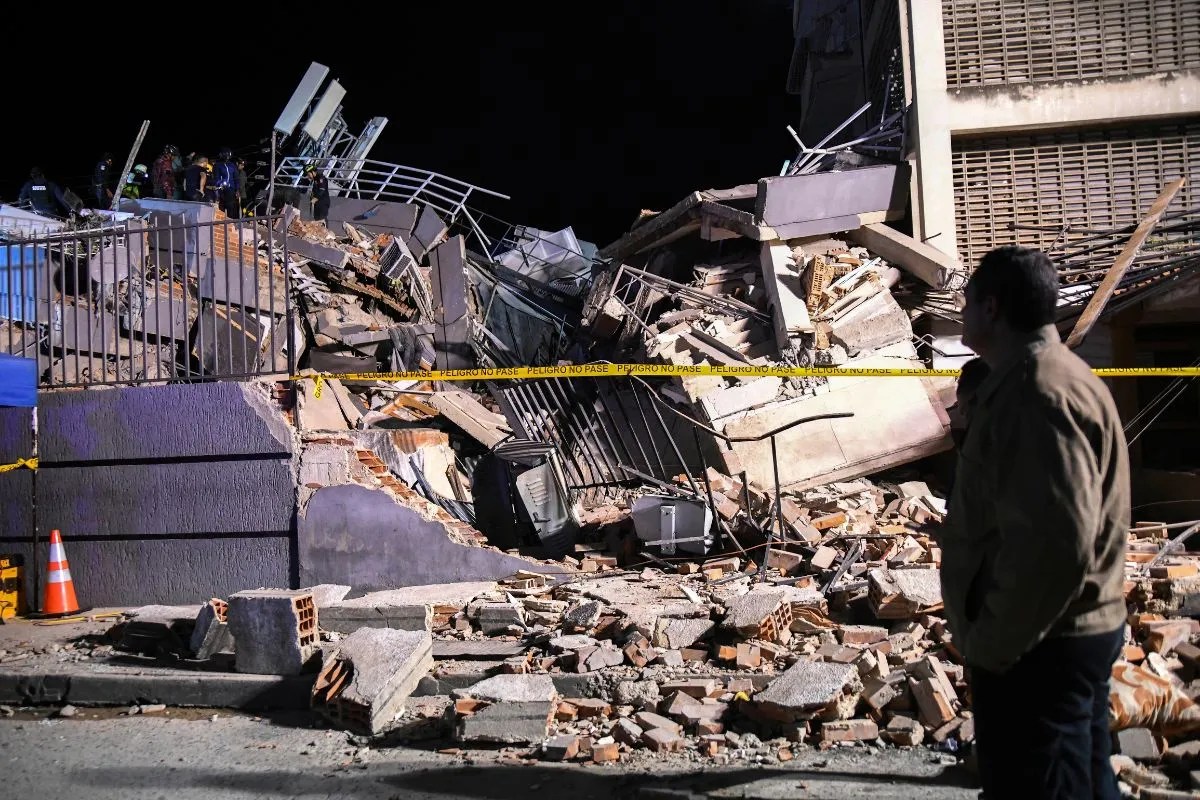
Media outlets love a neat, tragic historical parallel. They tally up the body count, look back through the archives, and hit you with a sensational headline. 164 dead today. 200 dead 59 years ago. They frame it as an unavoidable cycle of nature, a cruel twist of geographic fate where the earth shakes for 35 seconds and human life is wiped out by sheer bad luck.
This is a lie. It is a lazy consensus designed to absolve the real culprits.
Earthquakes do not kill people. Structural violence, weaponized corruption, and engineered infrastructure decay kill people. When a building collapses in Caracas, it is not an act of God. It is a crime scene. Media reporting that obsesses over magnitudes, historical timelines, and weeping survivors completely misses the point, hiding systemic manslaughter behind the facade of a natural disaster.
The narrative that Venezuela is simply a victim of its fault lines needs to be dismantled right now.
The False Equivalence of 1967 and Today
Mainstream reporting frantically draws a straight line between the recent disaster and the infamous 1967 Caracas earthquake. They point out that 59 years ago, a major tremor took 200 lives in less than a minute. The unspoken implication is clear: nothing has changed because nature is overwhelmingly powerful.
That logic is fundamentally broken. Everything should have changed in 59 years.
In 1967, global seismic engineering was in its infancy. We did not fully understand ductile detailing or how concrete behaves under cyclic shear stress. Since then, the international engineering community has developed highly sophisticated structural dynamics. We learned how to build structures that sway instead of snapping. We learned how to reinforce columns so they do not burst under pressure.
When you compare a mass-casualty event in 1967 to a mass-casualty event today, you are not highlighting a tragic consistency of nature. You are highlighting a profound, criminal failure of development.
Over nearly six decades, nations like Chile and Japan transformed their building sectors. They suffered massive tremors and walked away with single-digit fatalities because their infrastructure evolved. Venezuela did not evolve. It regressed. Drawing a romanticized historical parallel to 1967 treats architectural stagnation as an inevitability rather than what it actually is: a deliberate political failure.
The Chemistry of Corruption in Concrete
To understand why people die when the ground shakes in Latin America, you have to look at the concrete. I have spent years reviewing structural failures in developing urban centers. Concrete looks uniform from the outside, but its internal chemistry tells the entire story of a nation’s economy.
Safe building requires a precise mix of clean aggregate, specific grades of Portland cement, and high-tensile steel rebar. More importantly, it requires strict enforcement of building codes.
In a hyper-inflationary, corrupt environment, every single step of that process is compromised.
- The Sand Problem: High-quality river sand is expensive. Corrupt contractors routinely substitute it with unwashed beach sand or high-clay soil. Beach sand contains chlorides that corrode internal steel rebar from the inside out over decades. The building is already hollowed out before the earth even moves.
- The Steel Shortage: When state monopolies control steel production and foreign currency vanishes, standard seismic-grade rebar becomes a black-market luxury. Substandard, brittle steel is substituted, or worse, the spacing between stirrups in concrete columns is widened to save money.
- The Inspection Racket: Building inspectors do not inspect; they collect bribes to sign off on faulty blueprints. An extra floor is added to a building that was never engineered to hold the weight because someone paid off a local official.
When the earthquake strikes, the media blames the Richter scale. The engineering reality is that the building was already a weapon waiting for a trigger.
The collapse does not happen because the ground shook too hard. It happens because the concrete lacked the tensile strength to withstand even a moderate lateral load. The failure occurs at the beam-column joints, pancaking floors on top of each other and leaving zero survival voids for the residents inside.
The Chile Contrast
If you still believe that the Venezuelan body count is an unavoidable consequence of geography, look at Chile.
In 2010, Chile was hit by an 8.8-magnitude earthquake. That is a massive release of energy, exponentially stronger than the moderate tremors that routinely devastate less-prepared nations. Yet, the death toll from structural collapses in Chile was remarkably low relative to the size of the event. Why? Because Chile enforces its building codes. If a building collapses in Santiago, the structural engineer faces immediate criminal liability and prison time. The accountability is baked into the law.
In Venezuela, accountability does not exist. The regulatory bodies tasked with overseeing municipal safety have been hollowed out by decades of political cronyism. Engineers who point out structural deficiencies are silenced or forced to flee the country.
The result is an urban landscape built out of unreinforced masonry and bootleg concrete. Suggesting that a 164-person death toll is just "bad luck" insults every civil engineer who has spent their life proving that seismic resilience is entirely achievable through policy and discipline.
Dismantling the Prevalent Mythologies
Let us address the questions that always populate the public forum after a disaster like this. The public is conditioned to ask the wrong things because the media feeds them bad framing.
Can we predict earthquakes to save lives?
This is a useless question. It assumes that the only way to survive an earthquake is to run away from buildings before they fall. We cannot predict earthquakes with precise minutes-and-hours accuracy, and we do not need to. We already know exactly where the fault lines are. We know the hazard maps.
The focus on prediction is an escape mechanism for incompetent governments. It allows them to say, "If only we had a better warning system, we could have saved them." No. You save lives by making sure the roof does not fall on their heads when they are asleep. A well-built city does not need to be evacuated for a moderate tremor.
Why do old buildings survive while new ones collapse?
People look at historical colonial structures standing tall while modern apartment blocks crumble and assume modern engineering is a scam.
The truth is simpler. Colonial structures were often over-engineered with massive, thick load-bearing adobe or stone walls that rely on sheer mass. Modern concrete frames rely on precise structural calculations. If you build a concrete frame but skimp on the steel or the cement quality, the building has zero structural redundancy. It lacks both the mass of the old world and the flexibility of the new world. It is a death trap by design.
The Logistics of Aftermath Murder
The tragedy does not end when the ground stops moving. The body count climbs in the days following the event because of an entirely different structural failure: the collapse of logistics.
When an earthquake hits a functional nation, heavy rescue machinery, urban search-and-rescue teams, and medical triage units deploy within hours. In an economy that has been thoroughly systematically dismantled, the response is a farce.
Imagine trying to rescue survivors when the local fire trucks have no diesel because of fuel shortages. Imagine attempting emergency surgeries in hospitals that lack running water, sterile gauze, or functional backup generators. Victims who survive the initial collapse die of crush syndrome or simple infections because the state cannot provide basic medical stability.
This is not a natural disaster. It is an administrative execution.
The True Cost of Cheap Optimism
The most dangerous response to this crisis is the calls for international aid that focus entirely on blankets, tents, and temporary food supplies. This band-aid approach satisfies the global urge for charity while leaving the underlying rot untouched.
If the international community pours money into rebuilding Venezuela using the same corrupt networks, the same unregulated contractors, and the same substandard materials, they are simply financing the next disaster. They are setting the timer for another headline 50 years from now that will lament yet another "unavoidable tragedy."
We have to stop treating these events as sudden interruptions to normal life. For millions of people living in poorly constructed urban informal settlements, the disaster is already happening every single day. The earthquake merely accelerates the timeline.
True resilience requires an aggressive, uncomfortable overhaul of municipal governance. It requires stripping corrupt officials of their licensing power. It requires independent, third-party structural audits of every multi-story residential building in high-risk zones. It requires accepting the brutal truth that hundreds of buildings currently occupied by families are completely unsalvageable and must be condemned.
Until we change the vocabulary around these events, nothing changes. Stop writing about the tragedy of the 35 seconds that shook the earth. Start writing about the decades of greed, negligence, and incompetence that turned those 35 seconds into a massacre.