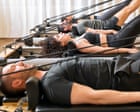
The pearl-clutching has reached a fever pitch. If you believe the headlines, the neighborhood Pilates studio has become a high-stakes gambling den where your L4-L5 vertebrae are the ante. The narrative is predictably lazy: a "wild west" of unregulated instructors and over-engineered sliding carriages is supposedly fueling a national injury crisis.
It’s a convenient lie. It shifts the blame from the individual to the apparatus. It treats grown adults like fragile porcelain dolls.
The reality is far more uncomfortable. The rise in Pilates-related injuries isn't a failure of regulation; it is a direct result of a sedentary population trying to outsource their physical literacy to a machine they don't understand. We aren't seeing a "reformer crisis." We are seeing a "frailty crisis" colliding with a piece of equipment that demands more respect than a mindless treadmill.
The Regulation Myth
Critics demand "stricter oversight" and "standardized certification" as if a piece of paper from a central governing body magically prevents a hamstring strain. This is the same bureaucratic impulse that has turned general fitness into a bland, ineffective soup.
Regulation doesn't create safety. Competence does.
In every other high-performance discipline—weightlifting, gymnastics, rock climbing—the burden of safety sits squarely on the shoulders of the practitioner and the immediate coach. Why is Pilates treated differently? Because it has been marketed as a "gentle" lifestyle choice for the brunch crowd.
When you frame an activity as "safe," people switch their brains off. They walk into a room filled with springs, pulleys, and moving platforms and assume the equipment will do the work for them. That lack of mental engagement is the primary driver of injury. You don't need a government inspector; you need to stop checking your phone between sets of Footwork.
Your Body is the Variable Not the Spring
The media loves to highlight the "danger" of the reformer's resistance. They claim the springs are too heavy or the movements are too complex for the average person.
This is backward logic.
The reformer is a closed-chain environment. It provides more feedback than almost any other piece of gym equipment. If you get hurt on a reformer, it’s rarely because the machine failed you. It’s because your proprioception is shot. You have lost the ability to sense where your limbs are in space.
We are seeing a generation of "desk athletes." These are people who sit for ten hours a day, effectively turning their glutes into decorative cushions and their hip flexors into steel cables. When these individuals jump onto a reformer and attempt a "Long Stretch" or "Short Box" series, they aren't starting from zero. They are starting from a deficit.
The injury isn't "caused" by Pilates. The injury was pre-installed by a lifestyle of physical inactivity. Pilates merely provided the diagnostic environment that brought those structural failures to light.
The Cult of "Feel the Burn"
The fitness industry has a toxic obsession with intensity as a proxy for progress. We’ve seen this play out in high-intensity interval training, and now it has infected the Pilates studio.
The "Wild West" isn't about lack of certification; it's about the shift from Contrology (Joseph Pilates’ original name for his method) to Aerobic Pilates.
Joseph Pilates designed his system to be a precise, almost clinical approach to movement. He didn't care if you sweated. He cared if you could articulate your spine. Today’s boutique studios have stripped away the precision to make room for high-volume, high-heart-rate classes that "torch calories."
When you add speed to a technical movement, form is the first casualty.
- Momentum replaces muscle engagement.
- The core becomes a passenger rather than a pilot.
- Shear force on the joints increases exponentially.
The injury rise is a direct byproduct of trying to turn a precision instrument into a cardio machine. You wouldn't use a scalpel to chop wood, yet we act surprised when people get cut trying to do "Power Pilates" at 120 beats per minute.
Why "Gentle" is Dangerous
There is a pervasive idea that if we just make Pilates easier, people will be safer. This is the most dangerous lie of all.
Safety in movement comes from load tolerance. If you spend your entire life doing "gentle" movements, you are preparing your body for a "gentle" life. The moment you have to lift a heavy suitcase, catch a falling child, or trip on a curb, your body will break because it has no structural integrity.
We shouldn't be making Pilates easier. We should be making it more rigorous.
True injury prevention involves progressive overload. It requires challenging the nervous system. The reformers in these "high-risk" studios aren't the problem—the lack of foundational strength training is. If you can’t perform a basic bodyweight squat with perfect mechanics, you have no business doing standing work on a moving carriage.
Instead of demanding "regulation," we should be demanding prerequisites.
The Anatomy of the Blame Game
Let’s look at the "People Also Ask" logic that dominates this conversation.
"Is Pilates safe for beginners?"
The question itself is flawed. "Safe" isn't a binary state. A beginner with a background in dance is in a different universe than a beginner who hasn't touched their toes since 1998. The focus shouldn't be on the safety of the modality, but on the readiness of the individual.
"How do I avoid injury in Pilates?"
The answer isn't "find a more certified instructor." The answer is: Develop a relationship with your own tension. If you feel a "tweak" and keep going because the instructor told the whole class to do ten more reps, that's not a "Wild West" problem. That’s a "you" problem. We have outsourced our internal safety sensors to 24-year-olds in spandex with microphones. Reclaiming your own physical autonomy is the only way to stay out of the physical therapist’s office.
The Myth of the "Bad" Exercise
There is no such thing as a "bad" exercise. There are only exercises for which you are currently unprepared.
The media loves to vilify specific moves—usually the ones that look the most "scary" on Instagram. They point to the "Teaser" or "Snake and Twist" as the culprits for back pain.
I’ve seen clients spend thousands on "rehabilitative" Pilates only to get injured because they refused to do the hard work of building basic core tension. They wanted the "vibe" of the studio without the discipline of the method.
The reformer is a mirror. If you have a weak kinetic chain, it will show you. If you have a pelvic tilt that you’ve ignored for a decade, it will show you. If you try to bypass your weaknesses using the machine’s springs, the machine will eventually punish you.
The High Cost of Easy Access
The "boom" is the problem, but not for the reasons people think.
The democratization of fitness always leads to a dilution of quality. When a workout becomes a trend, it becomes a commodity. When it becomes a commodity, the goal shifts from "improving the human" to "filling the room."
The "Wild West" reformers are the ones in studios that prioritize aesthetics over mechanics.
- The Lighting: Dim, purple, "club" vibes that make it impossible for an instructor to actually see a client’s spine.
- The Music: Loud enough to drown out the sound of a popping tendon.
- The Pacing: Designed to ensure no one feels "left behind," which means the person with the herniated disc is doing the same move as the former gymnast.
If you want to talk about "experts warning" of anything, warn people about the danger of the "Atmosphere-First" studio. If your instructor spends more time on their playlist than on your alignment, you aren't in a Pilates class. You're in a choreographed accident waiting to happen.
Stop Asking for a Safety Net
The demand for more regulation is just a demand for a thicker safety net so we can continue to be reckless. It is an extension of the modern desire to live a life without friction or risk.
Fitness is inherently risky. Moving your body through space involves forces that can, and will, break you if you are careless. The reformer isn't a medical device; it’s a tool for physical transformation. Transformation requires stress.
The rise in injuries isn't a sign that the industry is broken. It’s a sign that the population is physically bankrupt and trying to pay their debts with a currency they don't have.
Stop looking for the "safe" studio. Stop waiting for a governing body to tell you that an instructor is "qualified" because they passed a multiple-choice test.
Look in the mirror. Assess your own mobility. Own your own mechanics. If you get hurt on a reformer, don't blame the "Wild West." Blame the person who stepped onto the carriage without checking their ego at the door.
Pick up a weight. Learn to hinge. Respect the machine, but respect your own physiology more. The reformer is an honest teacher; if you’re getting hurt, it’s because you’re failing the class.