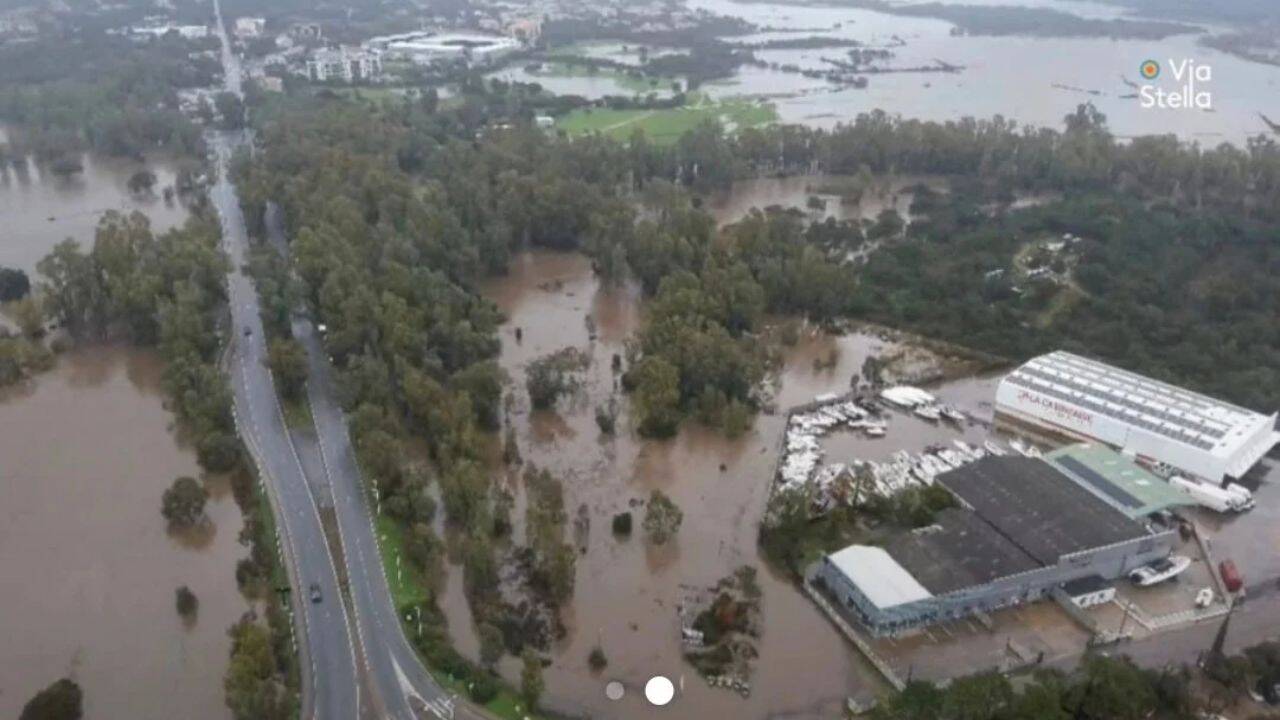
Two people are dead in Corsica, a vehicle sits mangled at the bottom of a swollen river, and a firefighter is nursing injuries after a desperate rescue attempt. Read the standard breaking news coverage of this tragedy, and you will walk away with the exact same comforting, useless takeaway that local officials want you to believe: The weather was unprecedented. The rain was too heavy. Nature won.
That narrative is a lie.
Every time a Mediterranean storm hits an island like Corsica and claims lives, the media defaults to the lazy consensus of meteorological fatalism. Reporters quote rainfall totals in millimeters. Politicians offer thoughts and prayers while staring grimly at mudslides. Everyone treats a submerged car like an unavoidable act of God, akin to a meteorite falling out of the sky.
It wasn't the rain that killed those two people. It was a predictable collision of terrible Mediterranean urban planning, driver overconfidence engineered by modern automotive marketing, and a broken emergency alert system that relies on people checking their phones while navigating hairpin mountain turns.
If you want to understand why people keep dying in European flash floods, you have to stop looking at the clouds and start looking at the concrete.
The Myth of the "Freak" Mediterranean Storm
Let’s dismantle the meteorological excuse first. Heavy rain in Corsica is not a black swan event. It is a recurring seasonal feature of the western Mediterranean basin, known to meteorologists as a Genoa low or, in French forecasting circles, an épisode méditerranéen.
Here is the basic physics that every regional planner knows and routinely ignores:
- Warm, moisture-laden air sits over the Mediterranean Sea well into the autumn and winter months.
- Cold air masses sweep down from northern Europe, slamming into that warm marine layer.
- Corsica, essentially a jagged granite mountain range rising straight out of the sea, acts as a massive wall.
When that wet air hits Corsica’s peaks—which soar above 2,700 meters just kilometers from the coast—orographic lift forces the air upward rapidly. It cools, condenses, and dumps staggering volumes of water onto steep, non-porous granite slopes. Because the island's topography is a series of vertical chutes, that water doesn't soak into the ground. It turns into high-velocity battering rams within minutes.
Calling this "unexpected" is like calling winter cold. Météo-France issues orange and red vigilance alerts for this exact phenomenon every single year. I have spent years analyzing post-disaster infrastructure failures across southern Europe, and the pattern is monotonous. The meteorology is understood down to the decimal point. The failure happens on the ground.
Why Modern Cars Are Death Traps in Moving Water
Look closely at the headline detail that everyone glosses over: Vehicle swept away in floods.
Why was that car in the water in the first place? Because modern automotive design has tricked drivers into believing they are piloting amphibious tanks.
Over the last fifteen years, the European car market has been swallowed whole by crossovers and SUVs. Drivers sit higher off the asphalt. They have all-wheel drive, traction control, terrain-management dials, and heavy curb weights. That elevated seating position creates a lethal psychological illusion. When a driver looks down at a flooded road from the cabin of a two-ton SUV, six inches of rushing brown water looks like a puddle.
Here is the brutal reality of fluid dynamics that no car commercial will ever show you: water does not care about your all-wheel drive.
According to well-established hydrological safety standards verified by the U.S. National Weather Service and European civil protection agencies, the math of vehicle buoyancy is unforgiving:
- Six inches (15 cm) of fast-moving water will reach the bottom of most passenger cars, causing loss of control and possible stalling.
- Twelve inches (30 cm) of water will float many vehicles, completely lifting the tires off the road surface. Once your tires lose contact with the asphalt, your four-wheel drive is spinning uselessly in liquid.
- Eighteen to twenty-four inches (45–60 cm) of rushing water will sweep away almost any vehicle, including heavy SUVs and pickup trucks.
Think about why that happens. A modern car is not a solid block of steel; it is a sealed, air-filled box sitting on four rubber tires filled with air. It is engineered to be buoyant. Simultaneously, water weighs roughly 1,000 kilograms per cubic meter. For every foot the water rises up the side of a vehicle, it displaces thousands of pounds of water, generating massive upward buoyancy while lateral currents push against the broad side of the chassis.
The moment a driver enters a flooded low-water crossing—or a coastal road where runoff has pooled—physics takes the wheel. The vehicle floats, turns sideways to the current, and rolls. By the time the occupants realize the door won't open because of external water pressure, the car is already tumbling downstream.
The Concrete Sponge Problem
If driver arrogance puts the car in the water, decades of reckless coastal development put the water on the road.
Corsica’s coastline has undergone an aggressive, poorly regulated construction boom over the past forty years. Vacation rentals, beachfront access roads, parking lots, and commercial zones have been paved directly over natural floodplains and seasonal riverbeds (known locally as oueds or torrents).
In an untouched watershed, soil, root systems, and natural gravel beds absorb a massive percentage of initial rainfall, slowing down peak runoff times. When you replace absorbent Mediterranean maquis shrubland with asphalt and concrete, you reduce ground permeability to zero. You are effectively building a giant funnel aimed directly at the lowest-lying roadways.
Even worse, local municipalities routinely undersize their drainage infrastructure to save money. Culverts—the tunnels that carry streams underneath roads—are often built to handle a "10-year storm" rather than a "100-year storm." When an intense Mediterranean downpour hits:
- Debris, branches, and rocks wash down the steep mountain gorges.
- That debris jams the narrow mouth of an undersized culvert in seconds.
- The road embankment instantly transforms into an earthen dam.
- Water backs up, overtops the asphalt, and washes out the roadbed entirely.
A driver traveling at night or in blinding rain doesn't see a raging river. They see wet pavement—right up until the moment the road collapses beneath their front axle or a wall of backed-up water broadsides their door.
Stop Relying on "Turn Around, Don't Drown" Slogans
Every time a flood kills motorists, public safety officials trot out the same tired advice: Stay home. Don't drive through flooded roads.
That is terrible advice for real-world human behavior. Telling people not to drive when they are already caught in a storm—trying to pick up their kids from school, commuting home from work, or navigating unfamiliar tourist routes—does nothing.
If we actually want to stop reading headlines about firefighters risking their lives to pull bodies out of submerged cars, we have to abandon passive public service announcements and implement physical, idiot-proof interventions.
1. Physical Barriers, Not Flashing Lights
A yellow flashing sign that says "Flooded Road Ahead" is an invitation for an impatient driver to test their luck. Look at railroad crossings: we don't rely on polite signs to stop cars from driving in front of freight trains; we drop heavy mechanical gates across the lane. High-risk low-water crossings and coastal underpasses in flood-prone zones like Corsica require automated, water-level-triggered drop gates. When water hits six inches, the gate comes down. Physically block the stupidity.
2. Mandate Escape Tools in Every Vehicle
In Europe, drivers are legally required to carry high-visibility vests and warning triangles in their cars. Yet almost nobody carries a spring-loaded window punch and seatbelt cutter within arm's reach of the driver's seat.
When a car enters deep water, electrical systems short-circuit within seconds. Power windows fail. Central locking jams. Because external water pressure presses against the doors with hundreds of pounds of force, you cannot push a door open until the cabin completely fills with water—a terrifying wait that causes most victims to panic and drown. Tempered side windows can be shattered instantly with a ten-dollar tungsten-tip punch, letting occupants escape before the car submerges. It should be standard safety equipment in every glovebox across the EU.
3. Kill the "Hero Rescue" Mentality Without Specialized Swift-Water Gear
Notice the second half of the Corsica headline: firefighter injured in rescue.
First responders are trained to run toward danger, and that instinct gets them hurt or killed in swift-water scenarios. Moving floodwater is arguably the most hazardous environment a rescuer can enter. Unlike structural fires, where heat and smoke give clear sensory warnings, swift water hides submerged rebar, downed power lines, sharp rocks, and lethal hydraulic recirculations ("keepers") that trap bodies underwater indefinitely.
In too many regional jurisdictions, standard municipal firefighters are dispatched to flood rescues without dedicated swift-water technician certification, drysuits, or tethered throw-bag systems. Sending structural firefighters into raging mountain torrents with basic gear isn't bravery; it is an administrative failure that turns one rescue into two victims.
The Uncomfortable Truth About Living on the Coast
There is a massive catch to fixing this, and it is why politicians prefer blaming the weather: real flood resilience destroys property values and inconveniences voters.
If Corsican authorities actually enforced strict zoning laws, they would have to condemn coastal properties built on seasonal floodplains. They would have to tear up profitable beachfront roads to restore natural wetlands and retention basins. They would have to shut down major transit arteries hours before a single drop of rain falls, triggering outrage from businesses, tourists, and commuters whenever a storm track shifts twenty miles out to sea.
Nobody gets re-elected for closing a highway on a sunny afternoon because a weather model looks ugly. Nobody wins local support by telling a developer they can't pave over a dry riverbed.
So, we keep the status quo. We build roads across mountain runoff chutes. We sell heavy SUVs with commercials showing them splashing effortlessly through pristine streams. We wait until the rain starts falling, send out vague text alerts, and hope nobody gets caught in the dark.
And when the inevitable happens—when the culverts clog, the asphalt vanishes, and the water sweeps another car into the dark—we print the exact same headline, blame the heavy rain, and wait for the next storm to prove us wrong all over again.