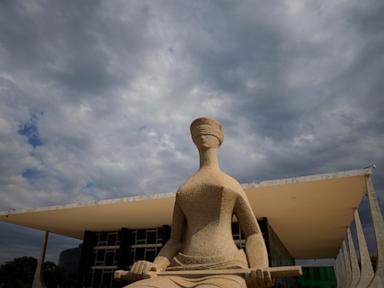
Everybody loves a simple narrative. The lazy consensus dominating global media coverage of Brazil right now goes something like this: Brazil's Supreme Court, the Supremo Tribunal Federal, has overreached into the political arena, turning itself into an authoritarian star chamber run by robe-wearing activists. According to this comfortable fiction, if the justices would just step back, mind their constitutional docket, and let the normal democratic process function, peace and stability would return.
It is a clean story. It is also entirely backwards.
The crisis shaking Brasília is not a judicial power grab. It is a vacancy crisis. The court did not steal power out of sheer arrogance; power was abandoned on the floor by a legislature and executive too fractured, corrupt, or cowardly to govern, and the judiciary picked it up to keep the lights on.
When other institutions fail to perform basic state functions, courts do not get to choose whether they enter the vacuum. They are sucked into it by gravity. Pretending that Brazil’s top court is the villain of its own story ignores the structural rot underneath.
The Myth of the Neutral Referee
Let us dispense with the fairy tale of the neutral constitutional arbiter. In mature democracies with hyper-stable legislative majorities, supreme courts can afford to play the role of the quiet referee, occasionally blowing a whistle on an overzealous parliament. Brazil has never had that luxury.
When you have dozens of political parties splintered across a fragmented Congress, consensus is impossible. Corruption scandals do not break coalitions; they paralyze them. Under those conditions, politics stops being an arena for policy and turns into an endless exercise in transactional survival.
Into that void stepped the STF. When threats to democratic stability emerged, from botched governance to outright challenges to electoral integrity, the court acted. Critics scream about judicial activism, but they conveniently forget what the alternative was: total institutional collapse.
You cannot run a country of over 200 million people on legislative gridlock while extremist factions test the boundaries of the state. The justices did not invent polarization. They were handed the garbage fire and told to put it out with a glass of water.
Why Targeting the Court Is a Dangerous Distraction
Right now, political operators on both sides find it exceptionally convenient to make the Supreme Court the primary enemy. For the populist right, attacking individual justices like Alexandre de Moraes is an effective mobilizing tool. It turns legal accountability for coup plots and digital disinformation campaigns into a free speech crusade. For opportunistic actors elsewhere in the spectrum, blaming the court provides a handy excuse for policy failures and economic stagnation.
This strategy relies on a fundamental misdiagnosis. If you abolish judicial oversight or impeach half the bench tomorrow, the underlying legislative dysfunction does not vanish. The vacuum remains.
Imagine a scenario where the court retreats entirely, stripping away its own investigative tools and deferring completely to a paralyzed political class. Within six months, you would not see a renaissance of deliberative democracy. You would see a free-for-all of institutional capture, where impunity reigns unchecked and local strongmen dictate terms to a toothless state. The court is not the disease; it is the scar tissue over a chronic infection.
The Real Cost of Hero Worship
The danger is not merely that the court is too strong. The deeper hazard is how the court has been forced to position itself.
Constitutional courts should be boring. Their members should be obscure technocrats whose names are unknown outside of law schools. When a supreme court's docket becomes daily tabloid fodder and its individual justices are treated like political warlords or saviors, the institution is already in mortal peril.
The STF allowed itself to become a permanent substitute for politics. That is its true error. By stepping in to manage emergency after emergency, it created a moral hazard for the rest of the political system. Why should a congressman compromise or build a sustainable coalition when they know the court will either bail them out or take the blame for the fallout?
Stop Treating Symptoms
If you want to fix the crisis in Brazil, stop obsessing over the personnel on the bench. Reform the electoral rules that fragment Congress into fifty unmanageable factions. Fix the campaign finance models that reward demagogues. Force the executive branch to build real legislative majorities instead of relying on backroom judicial interventions to clear the path.
Until the political class takes back its responsibilities, the Supreme Court will remain trapped in the spotlight, cursed for acting and condemned if it doesn't. Stop blaming the referee for playing the game when everyone else walked off the pitch.