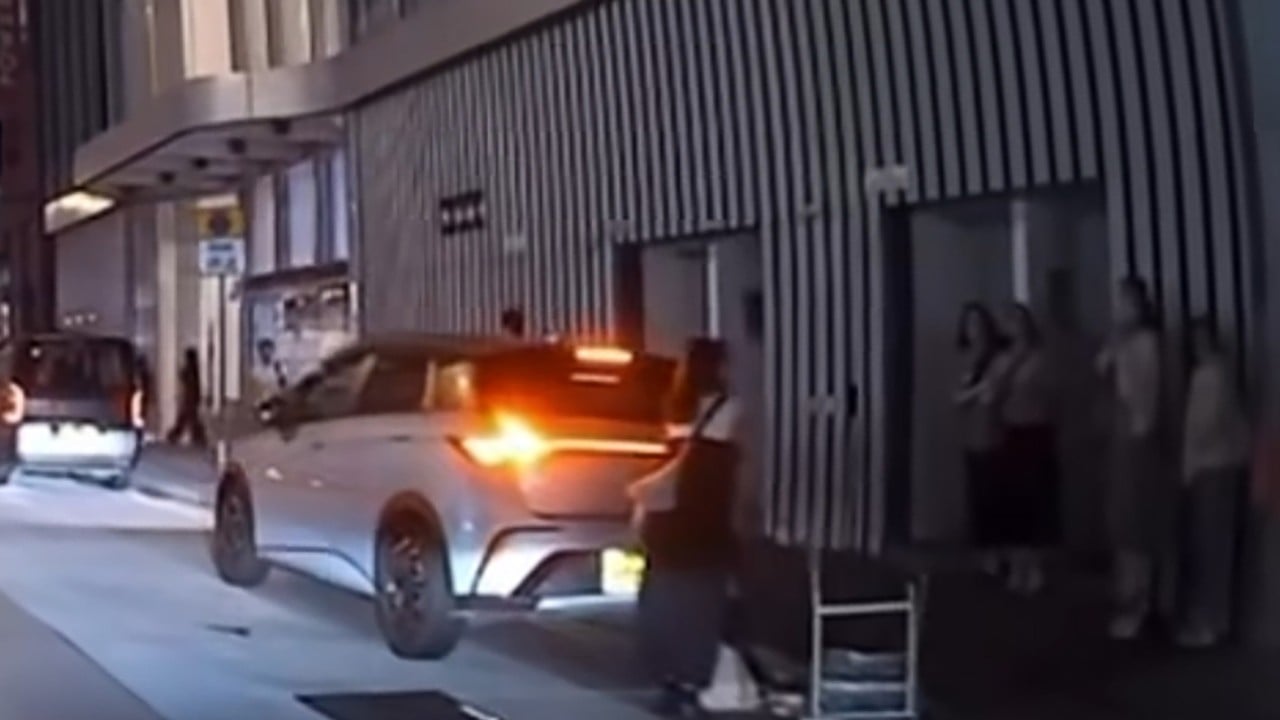
A folding table plummeted from a residential tower in Hong Kong and missed a pedestrian by inches. The local press ran the exact same script they always run. Gasps. Shock. "Miracle escape." A vague, hand-wringing finger wag at careless residents, followed by a brief reminder that throwing objects from heights is illegal.
That narrative is lazy, dangerous, and misses the actual culprit by forty stories.
When a piece of furniture falls out of a high-rise window in one of the densest cities on earth, the incident is not a freak accident caused by individual clumsiness. It is the predictable output of a vertical real estate market that treats basic spatial ergonomics as an afterthought, paired with an enforcement architecture stuck in the twentieth century. Blaming the tenant who leaned a folding table against a balcony railing is like blaming a commuter for getting crushed in a subway stampede when the transit authority removed half the trains.
I have spent over a decade consulting on urban risk management and high-density property operations across East Asia. I have watched property management conglomerates spend millions on marble lobby renovations while ignoring the structural realities of 300-square-foot apartments. Until we stop treating falling objects as isolated criminal anomalies and start treating them as systemic design failures, someone is going to die on the pavement next week.
The Myth of the Careless Resident
The prevailing media consensus relies on a comforting fiction: bad things happen because irresponsible people break rules. Under Hong Kong’s Summary Offences Ordinance, dropping an object from a building carries a maximum fine of HK$10,000 and six months in prison. When a folding table, a pane of aluminum-framed glass, or a drying rack crashes onto a sidewalk in Mong Kok or Sham Shui Po, authorities immediately frame it as a policing issue. Catch the culprit. Fine them. Move on.
This framing collapses under basic scrutiny.
Consider the physics and the floor plan. In Hong Kong, the average living space per person hovers around 160 square feet. For tens of thousands of families living in subdivided flats or aging private housing estates, storage is non-existent. Everything is collapsible. Beds fold into walls. Tables fold flat. Chairs stack.
Where do you put a folded table when your entire living room is six feet wide? You put it on the tiny utility balcony, or you wedge it next to an outward-opening casement window.
Now add aerodynamics to that cramped floor plan. High-rise buildings create violent, localized wind tunnels—a phenomenon fluid dynamicists call the Venturi effect. Wind accelerates as it squeezes between closely packed towers, creating sudden negative pressure zones right outside open windows. A lightweight, flat-surfaced object like a folding table acts as an airfoil. A single gust of cross-wind doesn't need someone to push that table out the window; the pressure differential will literally suck it off a narrow ledge and launch it into freefall.
Calling that "human negligence" ignores basic fluid mechanics. You cannot pack seven million people into vertical concrete tubes with zero storage capacity, give them outward-swinging windows, and act surprised when household items become projectiles.
The Enforcement Illusion
If the root cause is architectural and spatial, the response from property managers and municipal regulators is pure theater.
Walk through any older residential district in Kowloon and look up. You will see thousands of aging, corroded window hinges, unauthorized metal cages bolted into decaying concrete, and balconies crammed to the ceiling with loose domestic goods. Under the Mandatory Window Inspection Scheme (MWIS), building owners are legally required to inspect and repair windows every five years once a building hits ten years old.
On paper, the regulation looks strict. In practice, compliance is a bureaucratic shell game.
I have audited maintenance logs for residential towers where property management companies checked every compliance box while doing zero preventative risk mitigation. Why? Because the liability structure incentivizes reactive blame-shifting over proactive design. If a window frame snaps or a piece of furniture drops from a private unit, the building management corporation immediately distances itself, pointing to the deed of mutual covenant that places sole liability on the individual flat owner.
Meanwhile, enforcement relies heavily on closed-circuit television cameras pointed upward at building facades—colloquially known as "sky eyes."
Think about the absurdity of this strategy. A camera pointed at a 40-story facade captures a blur falling at 9.8 meters per second squared. Unless the object leaves a clear trail back to a specific open window—and unless someone happens to be standing right there—identifying the exact unit out of 320 identical flats is nearly impossible. Even when police do trace the flat, proving intent or culpable negligence versus an accidental wind gust ties up months of investigative resources for a misdemeanor fine.
Deterrence only works when the probability of getting caught is high and the behavior is intentional. You cannot deter physics with a CCTV camera.
What the Property Sector Refuses to Fix
If you want to understand why folding tables keep falling from the sky, follow the capital expenditure budgets of major property developers and management firms.
In high-density vertical cities, building facades are treated as static barriers rather than dynamic risk zones. Modern commercial skyscrapers use sealed curtain walls for a reason: they eliminate the risk of falling objects and manage wind loads safely. Residential towers, however, continue to rely on operable windows and open balconies to save on central HVAC costs and satisfy outdated ventilation codes.
Here is what the industry refuses to admit: open-air balconies and outward-swinging casement windows are fundamentally incompatible with ultra-high-density residential living.
Let's look at the engineering trade-offs:
- Casement vs. Sliding or Tilt-and-Turn Windows: Outward-opening casement windows rely on friction stays and rivets that degrade rapidly in humid, salt-heavy coastal air. When a rivet shears, the entire window sash drops. Tilt-and-turn windows, standard across dense European cities, open inward, eliminating both the risk of falling sashes and the vacuum effect that pulls loose objects outside.
- Balcony Parapet Design: Standard building codes mandate a minimum parapet height of 1.1 meters. That height is calculated to stop an adult human from accidentally tipping over the edge. It does nothing to stop a four-foot folding table leaned vertically against the railing from catching an updraft and flipping over the top.
- Micro-Storage Infrastructure: Developers routinely shave inches off interior hallways and utility areas to maximize sellable square footage. By refusing to build recessed storage into micro-apartments, developers externalize their spatial efficiency onto the balcony—turning outdoor ledges into open-air closets.
Admitting these design flaws would require developers to rethink floor plans and force building owners to fund expensive facade retrofits. It is much cheaper to issue a press release reminding tenants to "keep balconies tidy."
The Real Cost of "Near Misses"
Every time a pedestrian walks away unharmed from a falling object, news outlets frame it as a stroke of good luck. In risk engineering, a near miss is not luck; it is a leading indicator of a catastrophic failure.
Heinrich’s Law—a foundational principle in industrial safety—states that for every major injury accident, there are 29 minor injuries and 300 near misses. While the exact ratios vary across industries, the underlying mathematical reality is absolute: you cannot reduce fatal outcomes without systematically eliminating the near misses at the base of the pyramid.
A standard plastic-and-steel folding table weighs roughly 10 to 15 kilograms. Dropped from the 20th floor—roughly 60 meters—it reaches an impact velocity of over 34 meters per second (more than 120 kilometers per hour) before accounting for air resistance. That is roughly equivalent to being struck by a mid-sized motorcycle traveling at highway speed.
The woman who walked past that Hong Kong building did not survive because the system worked. She survived because of a three-inch variance in her walking pace. Relying on pedestrian timing as a primary safety buffer is not urban planning; it is Russian roulette.
Why Conventional Safety Advice Fails
When these incidents go viral, the standard public service advice is predictable: Walk under covered walkways. Stay away from building edges. Don't put things near windows.
This advice is completely detached from reality.
First, Hong Kong’s pedestrian infrastructure forces people onto narrow sidewalks directly beneath overhanging structures, scaffolding, and cantilevered balconies. You cannot "stay away from building edges" when the sidewalk is four feet wide and bordered by four lanes of bus traffic.
Second, telling residents in 250-square-foot apartments not to store items near windows ignores how human beings actually inhabit space. People will always optimize for immediate daily utility over low-probability tail risks. If the only place to put a folding table when guests come over is next to the balcony door, that is where the table will go. Good design accounts for human behavior; bad design scolds humans for behaving predictably.
To be clear, shifting the focus to structural and regulatory reform has real downsides. Retrofitting older buildings with inward-opening windows, installing high-tensile safety mesh across balcony perimeters, and enforcing strict spatial storage minimums will drive up management fees and construction costs. In a housing market already plagued by the world's worst affordability crisis, adding compliance costs will squeeze middle- and low-income homeowners. Those financial burdens cannot simply be hand-waved away.
Yet the alternative—continuing to subsidize cheap facade design with the physical safety of pedestrians on the street below—is indefensible.
How to Actually Stop Objects From Falling
If municipal authorities and property managers want to eliminate falling object fatalities rather than just prosecuting the aftermath, they need to abandon passive surveillance and mandate physical containment.
- Mandate High-Tensile Invisible Grilles on All Residential Balconies: Building codes must move beyond the 1.1-meter railing standard. Marine-grade stainless steel cable grilles—spaced no more than two inches apart—prevent any household item larger than a coffee mug from exiting a balcony, without blocking light, airflow, or emergency fire escape access.
- Ban Outward-Opening Casement Windows in High-Rises: Any new residential construction or major facade renovation above five stories should require inward-opening tilt-and-turn windows or restricted-opening sliding tracks. If a window cannot physically open wide enough to pass a piece of furniture, wind suction becomes irrelevant.
- Shift Liability to Building Management Corporations: Stop treating falling objects solely as individual tenant crimes. When an object falls from a building, fine the management corporation alongside the resident unless the building can prove it conducted quarterly exterior visual audits and maintained proper perimeter containment. When management companies share financial liability, enforcement happens overnight.
- Deploy Overhead Catch-Netting on High-Footfall Corridors: In dense commercial-residential zones like Mong Kok, Wan Chai, and Causeway Bay, cantilevered polycarbonate canopies or heavy-duty debris netting at the second-floor podium level should be mandatory, not optional.
A folding table falling from the sky is not a bizarre freak accident, and surviving it is not a miracle. It is a predictable mechanical failure engineered by cramped floor plans, outdated window hardware, and negligent property governance. Stop praising the luck of the pedestrian who survived, and start holding the people who built and manage the towers accountable before the next falling object hits its target.