The grass at Kew Gardens is never truly silent, but today it carries a weight that wasn't there last week. You feel it before you see it. A shift in the air pressure. A sense that something ancient and immovable has decided to take a seat among the rare orchids and the Victorian glasshouses.
Henry Moore spent his life trying to make mountains out of pebbles. Now, in the largest outdoor exhibition of his work ever staged, those mountains have arrived in Southwest London.
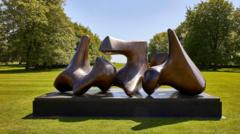
There is a specific kind of silence that follows a heavy bronze sculpture. It isn't the absence of sound. It is a presence. As you walk toward the Great Broad Walk, a massive, undulating shape rises from the horizon. It looks like a hip bone. Or a wave. Or perhaps a mother leaning over a child. It is all of these things, and yet it is stubbornly, defiantly a piece of metal.
The Weight of Being Human
Moore didn't care for the polished, dainty aesthetics of the galleries of his youth. He grew up the son of a coal miner in Yorkshire. He knew what it meant to pull something hard and cold out of the earth. He understood that the human body is not a static thing; it is a landscape of ridges, valleys, and caves.
Walking through Kew right now feels like navigating a map of the human psyche. You stumble upon a "Reclining Figure" and realize you aren't looking at a statue. You are looking at the way a person feels when they are tired. The bronze dips where the spirit sags. It arches where the will persists.
Consider the logistical nightmare of this beauty.
To place these twenty-eight massive works across 300 acres of botanical perfection is an act of engineering masochism. You cannot simply drop a six-ton bronze onto a lawn. The ground has to be surveyed. The roots of ancient oaks—some of which have seen empires rise and fall—must be protected with the devotion of a religious relic. Cranes hovered over the temperate house like skeletal birds, lowering these giants into place with millimeter precision.
Why go through the trouble? Because Moore believed that art needs to breathe.
Put a Moore in a white-walled room and it looks like a captive. Put it under the shifting grey sky of a London afternoon, surrounded by the fractal complexity of cedar branches, and it begins to pulse. The shadows change every hour. The rain streaks the green patina, making the bronze look like it’s weeping or sweating. It becomes part of the ecology.
The Invisible Stakes of a Public Park
We live in a digital slipstream. Most of what we consume is weightless. Pixels on a screen, voices in a cloud, data that vanishes the moment the power cuts out. There is a profound, almost frightening relief in standing next to something that will outlast your grandchildren.
Moore’s work is a physical anchor.
Visitors often do a strange thing when they approach these sculptures. They stop talking. They reach out—even though the signs usually discourage it—to feel the temperature of the bronze. They want to know if it’s warm from the sun. They are checking for a pulse.
This exhibition isn't just a collection of hits; it’s a dialogue between two different kinds of growth. On one side, you have the botanical world of Kew, where life is fast, green, and seasonal. On the other, you have Moore’s world, where life is slow, heavy, and geological.
One woman stood for twenty minutes yesterday in front of "Mother and Child." She didn't take a photo. She didn't check her phone. She just traced the outline of the sculpture with her eyes, her own shoulders slowly dropping from her ears as she matched the rhythm of the stone. She looked like she was remembering something she had forgotten years ago.
That is the hidden utility of this exhibition. It forces a deceleration. You cannot rush a Henry Moore. If you try to power-walk past these pieces, they simply look like lumps of dark material. You have to wait. You have to let your eyes adjust to the scale.
The Yorkshire Ghost in the Garden
Moore once said that "the hole can itself have as much shape-meaning as a solid mass."
This is the central mystery of his work. He carved holes through the torsos of his figures. He let the light through. He let the wind whistle through the stomach of a titan. It was his way of saying that what is missing from us is just as important as what is there.
In the context of a world that has spent the last few years feeling hollowed out, these sculptures feel like old friends who understand the void. They don't try to fill the hole; they make it beautiful. They turn a vacuum into a vista.
The technical mastery required to balance these forms is staggering. Look at the "Double Oval." It stands like a gateway to another dimension near the pond. Two massive rings of bronze, pitted and scarred, framing the water and the sky. It looks like it grew there, but it is the result of years of sketches, tiny plaster maquettes, and the brutal heat of a foundry.
Moore worked until his hands were gnarled. He stayed in his studio in Much Hadham, surrounded by bones and flint stones he found in the fields. He saw the architecture of the universe in a sheep's vertebrae.
Now, his ghosts are wandering Kew.
A Journey Through the Green
If you start at the Victoria Gate and work your way toward the Pagoda, the narrative changes. The pieces near the entrances are welcoming, almost tactile. But as you get deeper into the woods, into the quieter corners of the arboretum, the sculptures become more abstract, more challenging.
They start to look less like people and more like the forces of nature that shape people.
You find yourself asking: Is that a shoulder, or is it a cliff face? Is that a knee, or is it a weathered root?
The answer is always "yes."
There is no "right" way to see this. There are no plaques that tell you exactly what to feel. There is only the wind, the scent of damp earth, and the massive, silent company of these bronze observers.
As the sun begins to dip behind the Hive—that shimmering aluminum lattice that hums with the sound of bees—the Moore sculptures take on a darker hue. They turn into silhouettes. For a moment, the distinction between the man-made and the earth-born vanishes.
The trees reach down. The bronze reaches up.
You walk out of the gates and back toward the Richmond station, the pavement feeling strangely thin and flimsy beneath your feet. The roar of the overhead planes and the chime of the District Line seem frantic and small. You carry the weight of the bronze with you, a heavy, comforting secret held in the center of your chest.
The giants are still there, back in the dark, watching the leaves grow in the moonlight.