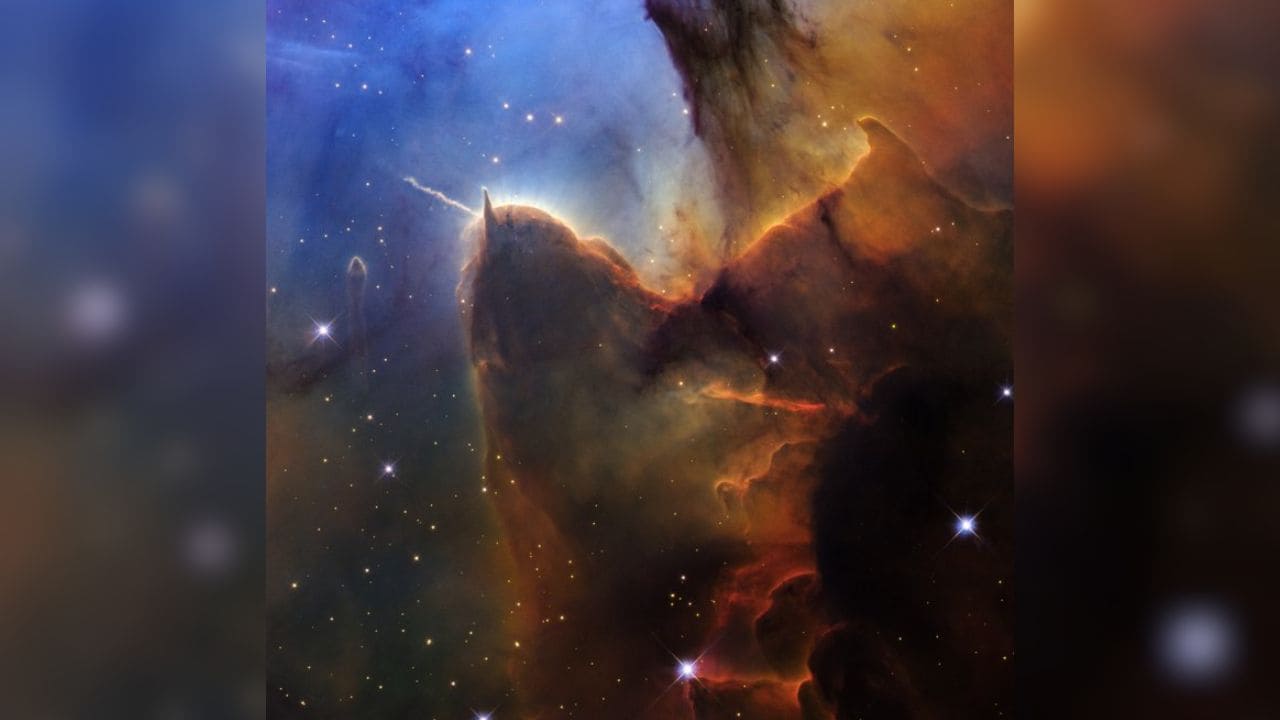
Deep within the Sagittarius constellation, roughly 5,000 light-years from Earth, a chaotic factory is churning out suns. NASA’s recent imaging of the Trifid Nebula, also known as M20, isn't just another pretty picture for a desktop background. It is a raw look at the violent, messy process of stellar birth that defies the serene "nursery" label often given to these regions by pop-science writers. The Trifid is unique because it represents a rare triple-threat of astronomical phenomena—an emission nebula, a reflection nebula, and a dark nebula all colliding in a single localized coordinate. This isn't just space dust floating in a vacuum. It is a high-pressure environment where radiation from massive, newborn stars is actively carving out the very gas clouds that gave them life.
The core of the Trifid Nebula is dominated by a massive star cluster. These aren't the yellow dwarfs like our sun; these are behemoths, specifically O-type stars that burn hot and fast. Their ultraviolet radiation ionizes the surrounding hydrogen gas, causing it to glow a visceral crimson. This is the emission portion of the complex. Meanwhile, the blue fringes of the nebula are created by light scattering off dust—the same physical principle that makes our sky blue on Earth. But the real story lies in the dark, cold "fingers" of gas seen poking into the glowing red center. These are Evaporating Gaseous Globules (EGGs). Inside these dense knots, gravity is winning its eternal war against pressure, collapsing gas into the next generation of stars even as the radiation from existing stars threatens to blow the material away before they can finish forming.
The Brutal Physics of Star Formation
We often talk about stars "forming," as if it were a peaceful accumulation of matter. The reality is a thermal battleground. To get a star, you need cold gas. Cold gas is dense and prone to gravitational collapse. However, the moment a massive star ignites nearby, it begins to heat the surrounding environment to millions of degrees.
This creates a race against time. If the heat from the "parents" arrives too quickly, the "infant" star is starved of its material. The dark lanes that give the Trifid its name—the three-lobed appearance—are actually thick clouds of dust and gas that are currently shielding nascent stars from the blistering radiation of the central cluster. These dust lanes act as a thermal buffer. Without them, the Trifid would have burned itself out long ago, leaving behind a hollow shell of ionized gas rather than a functioning star factory.
Why the Trifid Matters to Human Technology
While looking 5,000 light-years away seems like pure abstraction, the data harvested from M20 drives the development of the sensors we use on Earth every day. The infrared capabilities required to pierce through the Trifid’s dark dust lanes are the direct ancestors of modern thermal imaging and advanced telecommunications.
Infrared Penetration and Dust
Visible light cannot see inside the Trifid’s dark lobes. The dust grains are just the right size to block those wavelengths. To see the "protostars" hidden within, astronomers use the Mid-Infrared Instrument (MIRI) and other long-wavelength sensors.
- Wavelength Shift: By moving from visible light (
500 nm) to mid-infrared (10,000 nm), the "solid" dust clouds become transparent. - Heat Signatures: We aren't looking for light; we are looking for the heat of friction as gravity crushes gas into a sphere.
- Silicon Benchmarks: The mirrors and detectors developed to capture these faint signals are currently being adapted for high-speed laser communication in orbital satellite arrays.
The Longevity Paradox
There is a grim irony in the Trifid Nebula. The most spectacular stars it produces—the ones that make it glow so brightly—are the ones that will kill it. A star twenty times the mass of our sun might only live for a few million years. In cosmic terms, that is a weekend. When these massive stars inevitably go supernova, the resulting shockwaves will do one of two things: they will either compress more gas to trigger a final, frantic burst of star formation, or they will shred the nebula entirely, scattering the raw materials into the graveyard of interstellar space.
Current models suggest the Trifid is in its prime, roughly 300,000 years old. It is a fleeting moment in the life of a galaxy. We are catching a glimpse of a process that is as destructive as it is creative. Every new star seen in these images is a thief, stealing mass from the nebula to fuel a nuclear furnace that will eventually blow its surroundings to pieces.
The Chemistry of the Void
The Trifid isn't just hydrogen and dust. Spectroscopic analysis reveals a complex chemistry involving Polycyclic Aromatic Hydrocarbons (PAHs). These are organic molecules—carbon chains that, on Earth, we associate with soot and exhaust. In the nebula, they act as catalysts for cooling.
By radiating energy away, these molecules allow the gas to stay cold enough to collapse. Without this chemical cooling, the heat from the central stars would keep the gas too "bouncy" to ever form a solid body. We are effectively watching the organic chemistry of the universe act as a refrigerator for the fires of creation. This intersection of biology-adjacent chemistry and high-energy physics is where the most interesting questions remain unanswered. How many of these stars will end up with planetary systems? How much of that organic soot ends up on the surface of those planets?
NASA’s deeper look into M20 proves that the universe doesn't do "steady state." Everything is a flow of energy from one form to another. The Trifid is a localized spike in that flow, a place where the entropy of the universe is momentarily held at bay by the sheer force of gravity and the specific chemistry of carbon and hydrogen.
Investors and tech firms aren't funding these missions just for the posters. They are looking for the limits of what matter can do under extreme conditions. The Trifid is the ultimate stress test for our understanding of fluid dynamics, radiation pressure, and molecular cooling. We study the far away to understand the fundamental laws that govern the hardware in our hands. The next time you see a "new star" in a headline, look past the light. Look for the dust that survived the heat, because that is where the real physics is happening.
Grab the data before the radiation clears the field.