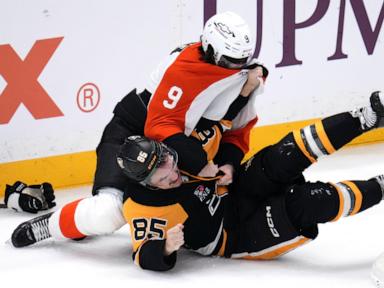
The standard playoff preview is a lazy exercise in confirmation bias. You’ve read them all. They talk about "veteran leadership," "hot goaltending," and "playing the right way." It is a collection of hockey platitudes designed to make people feel safe about picking the higher seed.
Here is the reality: the NHL playoffs are a high-variance math problem that most analysts are failing to solve. They look at the standings and see a hierarchy. I look at the standings and see a series of coin flips where the coins are weighted by luck, shooting percentages, and a refereeing standard that changes the moment the puck drops in Game 1. If you liked this piece, you might want to look at: this related article.
If you are betting on the favorites because they had a "historic" regular season, you haven't been paying attention for the last decade. The regular season is a speed-skating competition; the playoffs are a legalised mugging.
The Goalie Narrative Is a Lie
Every year, we hear that you need an elite, Vezina-caliber goaltender to win. This is the most enduring myth in the sport. What you actually need is a league-average goalie who happens to have a heater for sixteen games. For another perspective on this development, refer to the recent update from NBC Sports.
Look at the data. For every Andrei Vasilevskiy who carries a team, there is a Jordan Binnington or an Antti Niemi—goalies who were journeymen or rookies that simply didn't blink at the right time. When analysts tell you "Team X has the edge because their goalie has a .920 save percentage," they are ignoring the concept of regression to the mean.
In a seven-game series, the sample size is too small for "talent" to override "variance." A goalie can be technically perfect and still lose because three pucks deflected off his own defenseman's skate. Stop drafting your bracket based on the name on the back of the mask. Draft it based on which team suppresses high-danger chances, because that is the only thing a team can actually control.
The Power Play Trap
The "special teams win championships" mantra is another piece of conventional wisdom that needs to die. Yes, a good power play is a weapon. But in the first round, officiating undergoes a psychological shift. The "let them play" mentality means the number of power plays per game historically drops as the series gets deeper and the stakes get higher.
If a team relies on their power play for 30% or more of their offensive production, they are a paper tiger. When the whistles go into the pockets in the third period of Game 7, that "elite" unit becomes irrelevant. You should be looking at 5-on-5 Expected Goals For (xGF). If a team can't generate chances at even strength, they are a dead team walking.
The Boston Bruins of 2023 were the "best regular season team ever." They had the special teams. They had the goalie. They lost in the first round to a Florida Panthers team that simply lived in the dirty areas of the ice at 5-on-5. The Panthers didn't "out-talent" them; they out-grinded the math.
Why Home Ice Advantage Is Overrated
"They worked all year to get Game 7 at home."
Who cares? Since 2015, home teams in the NHL playoffs win at a rate barely above 50%. In some years, road teams have actually performed better. The pressure of playing at home—the "tight sticks" phenomenon—is real. When a home favorite gives up an early goal, the energy in the building doesn't "fuel" them; it turns into a toxic cloud of anxiety that the players can feel.
I have sat in those locker rooms. I have seen $9 million-a-year players looking at the rafters because they can hear the fans starting to moan. The road team, meanwhile, has a "us against the world" simplicity that is much easier to execute under pressure. If your logic for picking a series winner starts with "They have home ice," throw your bracket in the shredder.
The Fallacy of the "Trade Deadline Winner"
We see it every February. A team trades three first-round picks and their top prospect for a "missing piece" veteran who has "won it before." The media declares them the winner of the deadline.
Chemistry is not an e-commerce transaction. You cannot plug a player into a complex defensive system and expect $synergy$ (to use a word the suits love) in three weeks. Often, these trades disrupt the hierarchy of the locker room and the flow of the lines.
The teams that win are the teams that spent the last six months building a coherent identity, not the ones that tried to buy one in the eleventh hour. Look for the "quiet" teams. The teams that made one depth move for a penalty killer you've never heard of. Those are the teams that understand their gaps.
The "Experience" Myth
If experience mattered as much as the "insiders" say it does, the same three teams would win every year until their players retired.
"They haven't been there before" is a line used by commentators who have nothing else to say. In reality, young, fast teams that don't know any better are often the most dangerous. They don't have the mental scar tissue of previous Game 7 losses. They haven't been told they can't win yet.
Speed is the only physical attribute that doesn't slump. You can have a "bad night" shooting. You can't have a "bad night" being 5% faster than the guy chasing you. The league has shifted. The heavy, "experienced" teams are getting burned by 22-year-olds who can skate for 20 minutes a night without sucking wind.
The Matchup You’re Getting Wrong
Everyone is looking at the stars. McDavid vs. MacKinnon. Matthews vs. Kucherov.
Those players will cancel each other out. They will be shadowed, hacked, and neutralised by the league's best defensive specialists. The first round isn't decided by the first line; it’s decided by the third line.
I want the team whose third-line center can chip in two goals over the course of a week while playing 12 minutes of shutdown defense. That is where the margin of victory lives. When the stars are neutralized, the "nobodies" become the protagonists. If you can’t name the fourth-line wingers on the team you’re picking to win the Cup, you don’t actually know that team.
Stop Thinking Like a Fan
The NHL playoffs are a chaotic, violent, and deeply unfair tournament. The "best" team rarely wins. The team that survives is the one that manages their puck luck and maintains their 5-on-5 structure while the world around them is screaming.
Ignore the points totals. Ignore the "star power." Look at the 5-on-5 shot suppression, the depth scoring, and the health of the defensive core.
Or just flip a coin. It’ll probably be more accurate than the "expert" analysis you’re reading on the major networks.
Place your bets accordingly. Or don't. The math doesn't care about your feelings.