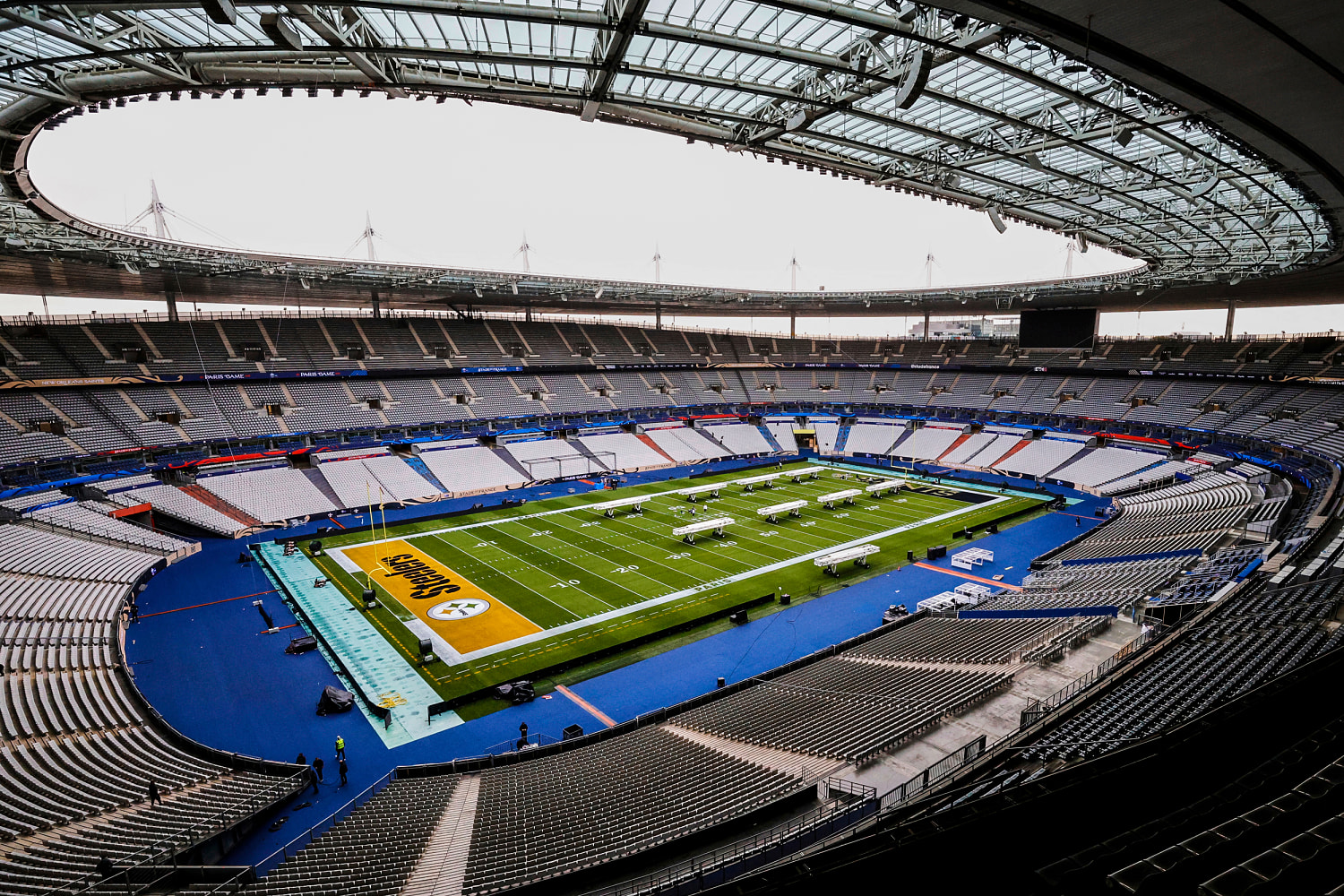
When the National Football League moved forward with its inaugural regular-season game in Paris between the Pittsburgh Steelers and New Orleans Saints at Stade de France amid nationwide French protests, standard news coverage treated the event as a binary standoff between stubborn league executives and street chaos. That framing misses the operational architecture behind the decision. Staging a high-value sports broadcast inside a city experiencing large-scale demonstrations is an exercise in spatial separation, cost isolation, and sunk-cost management rather than a gamble on calm streets.
To understand how the league absorbed security friction while protecting its global expansion strategy, this analysis maps the underlying logic of standard event reporting and replaces vague commentary with four structured frameworks: The Spatial Decoupling Matrix, The Event Cost Function, The Institutional Risk Allocation Model, and The Operational Contingency Sequence.
Deconstructing Standard Coverage
Conventional reporting on international games disrupted by local unrest follows a predictable sequence of claims. First, it treats "security concerns" as a single uniform threat across an entire metropolitan area. Second, it equates canceled downtown fan activations or postponed community events with a threat to the core broadcast product. Third, it frames the league's refusal to postpone as proof of insensitivity to local conditions or fan anxiety.
That logic breaks down under operational scrutiny. A major sporting event consists of distinct physical nodes—team hotels, training pitches, transit corridors, downtown fan zones, and the primary stadium bowl. Protests rarely exert uniform pressure across every node simultaneously. During the October 2026 unrest in France—where demonstrations over living costs and education funding drew hundreds of thousands of people nationwide and triggered clashes and arrests—the operational reality was asymmetric. Inner-city demonstration routes and retail districts faced high friction and accessibility bottlenecks, while the stadium corridor in Saint-Denis sat roughly ten kilometers north of central protest zones such as Bastille.
Treating a central-district closure as a stadium-wide failure conflates peripheral brand activation with core broadcast execution. Both matter commercially, but they carry different risk profiles, staffing requirements, and contractual obligations.
The Spatial Decoupling Matrix
A rigorous security assessment separates civil unrest from live sports operations by mapping two variables: geographic distance from protest focal points and control over perimeter access.
- High-Exposure Peripheral Nodes: Pop-up retail shops, city-center fan hubs, and bar meetups located in dense urban corridors or along protest routes carry high exposure. Crowds move unpredictably, public transit lines face closures or rerouting, and street-level clashes can disrupt foot traffic on short notice. Closing or postponing these touchpoints during the October 2026 Paris weekend—such as shuttering NFL House and city-center retail spaces on Saturday while keeping Sunday's game on track—was a textbook containment move.
- Controlled Fortress Nodes: A national stadium such as Stade de France operates with layered access control, credentialed entry, dedicated perimeter policing, and pre-planned transit lanes. When national authorities deploy tens of thousands of officers nationwide and route permitted marches along defined corridors away from the stadium district, spatial separation reduces spillover risk.
- Mobile Transit Vectors: Moving two NFL rosters, coaching staffs, equipment, and tens of thousands of spectators between hotels, practice sites, and the venue represents the highest dynamic vulnerability. Even if the stadium bowl is secure, blocked arteries or delayed convoys can degrade operations.
Known fact vs. educated hypothesis: It is a documented operational fact that downtown fan activations and meetups were closed or adjusted ahead of the Paris game while the match itself proceeded at Stade de France with heightened security. It is an educated hypothesis—grounded in standard major-event security doctrine—that league and local planners prioritized insulating fixed stadium operations and team movement over defending open urban fan spaces.
The Event Cost Function
Why does a commercial sports league absorb severe reputational and logistical friction rather than reschedule an international fixture? Every international game carries a steep Cost Function that penalizes last-minute cancellation far more heavily than tactical adjustments.
In plain terms, total event cost rises sharply when a league cancels or postpones a cross-border fixture late in the cycle:
- Sunk and Mobilized Costs: International games require months of advance coordination covering charter flights, customs clearances, freight logistics, stadium rigging, hospitality commitments, and local broadcast production. Once teams fly overseas and stadium operations are mobilized, those outlays are largely spent or locked in.
- Schedule Rigidity: A regular-season NFL schedule operates on a tight weekly cadence with fixed bye weeks, prime-time windows, and domestic television commitments. Postponing a game mid-season creates cascading fixture conflicts across multiple clubs and media partners.
- Strategic Market Signaling: International games are instruments of long-term market entry across territories like Europe, Latin America, and Australia. Canceling a debut match because of recurring domestic protest cycles signals fragility to international partners, municipal hosts, and commercial sponsors.
By contrast, trimming peripheral fan events has a low marginal cost relative to canceling the broadcast. Shutting down a pop-up shop or postponing a fan house sacrifices secondary engagement and local goodwill on the margin, while preserving the primary television asset, ticketed stadium gate, and international expansion narrative.
The Institutional Risk Allocation Model
A common error in security commentary is assuming one organization bears all risk alone. In reality, risk on an international event is split across three institutions with different incentives and capacities:
- The Host State (National and Municipal Authorities): Holds monopoly authority over public order, crowd control, intelligence sharing, and national policing deployment. During widespread French demonstrations, state security forces must balance protest containment across multiple cities and public infrastructure against protection for major events.
- The League and Participating Clubs: Control internal operations, travel protocols, credentialing, player and staff communications, and discretionary fan programming. League leadership relies on host authorities and diplomatic advisories to evaluate macro-level public safety while managing internal morale and travel logistics.
- Traveling and Local Attendees: Absorb personal travel risk, transit delays, and changing event schedules. Official government advisories—such as U.S. State Department security alerts issued ahead of unrest—shift informational awareness onto travelers even when the sporting venue itself remains open.
Cause-and-Effect Chains Standard Coverage Misses
When protests escalate days before kickoff, three second-order effects typically emerge that surface-level reports overlook:
- Resource Competition: Heavy protest policing across a capital city stretches municipal law enforcement and transit police. Even if stadium security is ring-fenced, surrounding rail stations and highway approaches can experience congestion or sudden closures.
- Reputational Asymmetry: A calm, sold-out game inside a stadium does not erase headlines showing burning barricades, clashes, or closed fan zones elsewhere in the city. Inside the venue, the atmosphere can feel festive and controlled; on global feeds, the broader protest narrative still frames the weekend.
- Communication Friction: Rapid schedule changes—canceling a practice window, shifting a fan meetup, or restricting entry slots—create immediate confusion for fans and media traveling across time zones. Operational caution without crisp communications converts a smart safety adjustment into a customer-experience complaint.
The Operational Contingency Sequence
For executives, event operators, or risk analysts evaluating a major event in a city experiencing civil unrest, decisions should follow a disciplined sequence rather than reactive improvisation:
- Audit Node Proximity and Transit Dependency: Map every team hotel, training facility, fan venue, and stadium gate against protest routes and public transit lines. Identify any single-point transit chokepoints.
- Verify State Force Allocation: Confirm directly with host security officials whether protest policing will divert perimeter or traffic resources away from venue corridors.
- Tier Event Assets by Exposure: Separate non-essential public gatherings and open-street activations from controlled stadium operations and required team logistics. Cut high-exposure peripheral activations first when street volatility rises.
- Establish Hard Go/No-Go Thresholds: Define objective triggers in advance—such as transit shutdowns along stadium corridors, direct threats to team movement, or official state directives—rather than debating cancellation on emotion hour by hour.
- Centralize Traveler and Staff Advisories: Issue clear, timestamped routing guidance, alert updates, and schedule changes so players, staff, and traveling supporters do not rely on rumor.
Limitations of This Playbook
No containment framework eliminates risk completely. Civil unrest in a major capital is dynamic: march routes can shift unexpectedly, localized clashes can spill onto secondary roads, and severe weather can compound transit disruptions simultaneously. Furthermore, prioritizing stadium continuity over public fan activations protects the broadcast and gate, but it cannot prevent external unrest from dominating pre-game media coverage.
Strategic Recommendation
For international sports leagues expanding into markets with active protest cultures, the winning play is not pretending civil unrest does not affect operations. It is building modular event footprints from day one. Leagues should design international host weekends around self-contained, easily throttled secondary activations and pre-cleared stadium transit corridors—allowing non-essential urban touchpoints to pause cleanly without putting the core game, player movement, or long-term market strategy at risk.