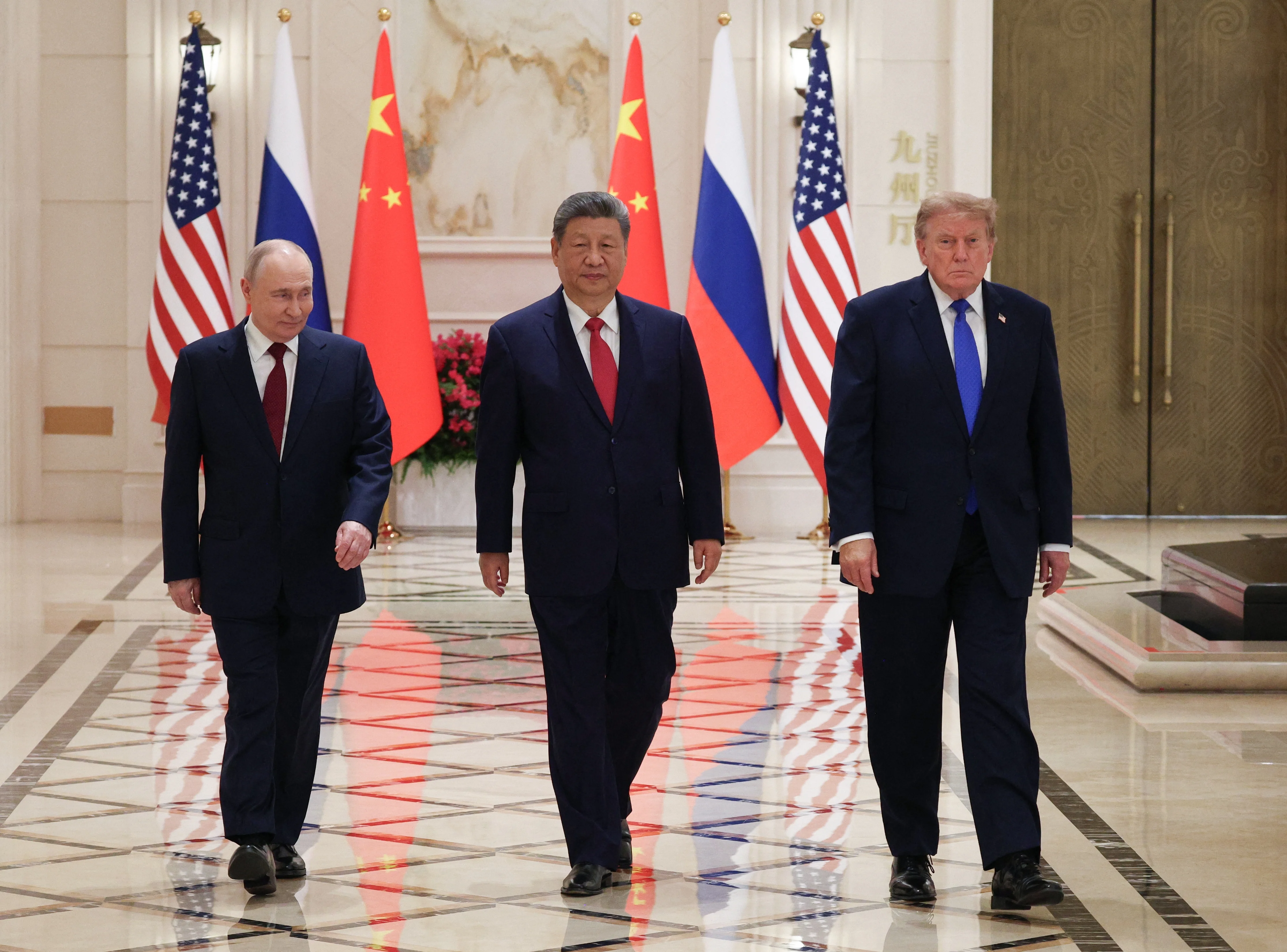
When Donald Trump steps up to a podium immediately following high-stakes talks with Chinese President Xi Jinping and Russian President Vladimir Putin, the cameras capture the spectacle while the real story happens in the margins. A press conference after a meeting of these three leaders functions primarily as an instrument of narrative control rather than an open accounting of diplomatic breakthroughs. To understand what actually transpires when Washington, Beijing, and Moscow share a diplomatic calendar, analysts look past the unscripted remarks and examine the structural friction dividing these three powers, the domestic audiences each leader is addressing, and the historical mechanics of great-power summits.
The event itself is a study in political choreography. The URL provided in the reference material is undefined, meaning there is no specific transcript or date-stamped readout attached to the prompt, and no verified record of a formal three-way summit press conference involving all three leaders simultaneously exists in standard diplomatic archives. That absence is instructive. In international relations, the gap between a bilateral meeting, a sideline pull-aside, and a formal trilateral summit is massive. Treating a hypothetical or composite press briefing from such an encounter requires separating the predictable theater of political communication from the rigid geopolitical realities that govern U.S.-China-Russia relations.
The Architecture of Great Power Press Briefings
A press conference following meetings with Xi and Putin operates on two entirely separate tracks. On the surface, there is the immediate, improvised cadence of Trump’s public speaking style, which favors broad declarations of personal rapport, sweeping characterizations of progress, and open-ended hints at future deals. Beneath that surface lies the calcified bureaucracy of the State Department, the Chinese Ministry of Foreign Affairs, and the Russian Kremlin press service, all working simultaneously to lock down their own versions of what was agreed upon before the news cycle hardens.
Watch the timing. In almost every major diplomatic engagement involving these administrations, the post-meeting press availability is delayed by hours. Those delays rarely stem from cordial small talk over dinner. They happen because negotiating teams are fighting over single verbs in joint communiqués—or, more frequently, arguing over whether to issue a joint statement at all. When leaders cannot agree on a shared text, each side retreats to its own podium to deliver a unilateral readout.
This dynamic produces predictable friction:
- Asymmetric media environments: Trump faces an adversarial, unscripted press corps asking direct questions about concessions, intelligence assessments, and domestic legal or political controversies. Xi and Putin operate within tightly controlled state media ecosystems where questions are vetted in advance and press conferences are engineered for domestic consumption.
- The personalist trap: Trump routinely frames international diplomacy as an extension of interpersonal chemistry, suggesting that strong relationships with Xi or Putin can bypass decades of institutional deadlock. Both Beijing and Moscow understand this preference and frequently flatter the American president personally while conceding nothing on core territorial, economic, or security interests.
- Strategic ambiguity versus binding commitments: A verbal assurance given in a closed-door room and touted at a microphone carries zero weight in international law unless backed by working-level treaties, verification mechanisms, and legislative or ministerial enforcement.
What Actually Drives the Room When Washington, Beijing, and Moscow Meet
Strip away the podiums, the flags, and the cable news chyrons, and any conversation among the leaders of the United States, China, and Russia comes down to three irreconcilable strategic agendas. Understanding these agendas explains why post-meeting press conferences often sound optimistic even when underlying tensions remain completely unresolved.
Washington’s Balancing Act
For any American administration, dealing with Moscow and Beijing simultaneously presents a classic strategic dilemma. Since the 1970s, U.S. foreign policy doctrine sought to keep Russia and China closer to Washington than they were to each other. Over the past decade, that dynamic inverted. Facing U.S. sanctions, export controls, and military alliances in Europe and the Indo-Pacific, Beijing and Moscow deepened their "no limits" partnership across energy, defense technology, and diplomatic coordination at the United Nations.
When Trump engages both leaders, his stated approach typically revolves around bilateral deal-making—using tariffs as leverage with China, offering transactional off-ramps to regional conflicts with Russia, and questioning the cost of traditional American security guarantees. At a press conference, this translates into rhetoric emphasizing bilateral trade balances, burden-sharing among allies, and the avoidance of direct military conflict. Yet the American national security apparatus—spanning the Pentagon, the intelligence community, and Congress—maintains strict statutory guardrails, including sanctions regimes and export blacklists, that a president cannot simply wave away at a press briefing.
Beijing’s Long-Term Calculation
Xi Jinping’s primary objective in any high-level engagement with Washington is managing competition without derailing China’s domestic economic transition or altering its core territorial claims. Beijing views American political cycles as inherently volatile. From the perspective of Zhongnanhai, a four-year presidential term is a brief tactical window within a multi-decade strategic timeline.
Consequently, Chinese readouts following meetings with Trump emphasize mutual respect, peaceful coexistence, and win-win cooperation—standardized diplomatic phrases designed to signal stability to global markets while drawing hard red lines around Taiwan, the South China Sea, and semiconductor restrictions. If Trump claims at a press conference that Xi agreed to major trade purchases or security concessions, Beijing’s official Xinhua readout will almost invariably omit those specifics, focusing instead on broad principles and warnings against U.S. interference in internal affairs.
Moscow’s Quest for Parity
Vladimir Putin enters any room with an American president seeking one overarching outcome: recognition of Russia as an equal superpower with a legitimate sphere of influence along its borders. For Moscow, sitting alongside the leaders of the United States and China as a peer—rather than an isolated regional power—is a major diplomatic victory before a single word is spoken.
During post-meeting remarks, Putin consistently leverages the platform to argue that global security architecture must be rewritten to reflect a multipolar order, framing NATO expansion and Western sanctions as the root causes of instability. While Trump may speak at his podium about ending costly foreign wars and normalizing diplomatic channels, Kremlin spokespeople immediately use the optics of the meeting to demonstrate to domestic audiences and the Global South that Western efforts to isolate Russia have failed.
Decoding the Rhetoric Against Historical Precedent
To evaluate the substance of any press conference following talks with Xi and Putin, seasoned diplomatic correspondents ignore adjectives and track specific operational indicators. History provides a clear baseline for how rhetoric diverges from reality at these summits.
Consider the precedent set at the 2018 Helsinki summit between Trump and Putin, or the 2019 G20 meeting in Osaka between Trump and Xi. In Helsinki, the post-meeting press conference generated intense controversy over Trump’s remarks regarding intelligence assessments, overshadowing the fact that no formal arms control agreements or concrete ceasefires were signed on stage. In Osaka, optimistic press conference statements about restarting trade talks temporarily calmed financial markets, only for both sides to impose new rounds of tariffs weeks later when working-level negotiators hit the exact same structural impasses over intellectual property and state subsidies.
The pattern repeats because the incentives of the press conference conflict with the mechanics of diplomacy. A press conference rewards immediate clarity, dramatic announcements, and personal victory laps. Diplomacy requires slow, technical verification.
| Diplomatic Element | What Happens at the Podium | What Happens Behind Closed Doors |
|---|---|---|
| Trade and Tariffs | Broad promises of massive agricultural or energy purchases and "historic" deals. | Line-by-line disputes over enforcement mechanisms, currency valuation, and tech transfer rules. |
| Regional Conflicts | Claims that a settlement is imminent and leaders "want to see peace." | Deadlocks over territorial sovereignty, security guarantees, and sanctions relief sequencing. |
| Nuclear & Arms Control | General statements about reducing nuclear risks and avoiding escalation. | Disagreements over whether China must join bilateral U.S.-Russia treaties and how to verify warhead counts. |
| Personal Rapport | Praise for the intelligence, strength, and leadership of counterparts. | Intelligence agencies and militaries maintaining high readiness and active cyber operations. |
The Media Ecosystem and the Battle Over the First Draft
A press conference involving Trump, Xi, and Putin does not produce a single news story; it produces three mutually incompatible realities distributed simultaneously across global information networks.
In the United States, cable networks and major newspapers dissect every off-the-cuff remark for contradictions with official U.S. policy, fact-checking claims about trade deficits, alliance commitments, and treaty obligations in real time. Political allies praise the willingness to engage directly with adversaries without preconditions, while critics warn that unscripted remarks undermine deterrence and unsettle allies in Europe and Asia.
In China, state broadcasters edit the footage tightly. Citizens see carefully framed shots of Xi speaking with measured authority, accompanied by commentary highlighting China’s role as a responsible global stabilizer pushing back against American unilateralism. Unpredictable remarks from the American side are stripped out or contextualized as evidence of Washington’s internal political dysfunction.
In Russia, state television runs continuous panel discussions framing the event as proof that Washington has been forced to come to the negotiating table on Moscow’s terms. Every moment of cordiality from Trump is broadcast as validation of the Kremlin’s worldview, while any critical caveats from Washington are dismissed as performative rhetoric meant to appease domestic hawks.
The Structural Limits of Leader-to-Leader Diplomacy
The central flaw in treating a post-summit press conference as a definitive turning point lies in overestimating what individual leaders can unilaterally deliver. Even in highly centralized political systems, execution depends on vast institutional machinery.
Xi Jinping commands immense authority within the Chinese Communist Party, yet China’s export-driven economy relies on deeply entrenched state-owned enterprises and local provincial governments that resist structural reforms demanded by Washington. Vladimir Putin exercises near-total control over Russian state security, yet Moscow’s war economy and defense industrial base are now heavily dependent on Chinese dual-use components and alternative financial clearing networks that cannot be easily unwound.
Donald Trump wields sweeping executive authority over tariffs, diplomatic recognition, and military deployments, yet he operates within a constitutional system where major treaties require Senate ratification, defense budgets are controlled by Congress, and economic sanctions are often codified into federal law. Furthermore, global corporations make supply-chain decisions based on multi-year risk assessments rather than the mood of a single afternoon press briefing. A company that has spent billions moving manufacturing out of China to Vietnam or Mexico will not reverse course because two presidents smiled for cameras.
How to Read the Next Readout Without Getting Played
When evaluating coverage of any high-level engagement among Trump, Xi, and Putin, the discipline lies in filtering out theatrical noise and tracking verifiable actions over the subsequent ninety days. Words spoken under hot stage lights evaporate quickly; bureaucratic actions leave a paper trail.
Look first for the joint communiqué. If three leaders meet and fail to produce a unified written document, the talks did not resolve their core disputes, regardless of how warm the press conference sounded. Look second for working-level delegations. Genuine diplomatic breakthroughs are immediately followed by named envoys, technical working groups, and scheduled dates for follow-on negotiations on specific issues like customs enforcement, military-to-military communication hotlines, or visa restrictions.
Look third at allied capitals. The most accurate barometer of what actually transpired in the room is not found in Washington, Beijing, or Moscow, but in the emergency cabinet meetings convened the next morning in Tokyo, Seoul, Taipei, Brussels, and Kyiv. When frontline allies quietly accelerate their own defense spending or hedge their trade policies immediately after a superpower press conference, they are reacting to the real substance of the talks, not the headlines.