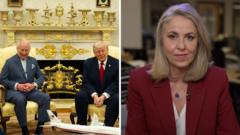
The media circus surrounding the latest royal state visit is a masterclass in nostalgic delusion. Pundits are currently tripping over themselves to calculate the "diplomatic lift" provided by a few days of carriage processions and white-tie dinners. They ask if the "Special Relationship" has been saved.
That is the wrong question.
You cannot save something that has already decomposed into a sentimental ghost.
While the cameras capture the choreographed smiles of heads of state, the actual mechanics of power—trade, defense procurement, and intelligence parity—tell a story of diverging interests and cold-blooded pragmatism. The state visit isn't a bridge to the future; it is a funeral for an era of geopolitical co-dependency that the United States has outgrown and the United Kingdom can no longer afford to pretend exists.
The Soft Power Fallacy
The most persistent myth in British diplomacy is that "soft power"—the pageantry of the Monarchy—translates into "hard influence" at the negotiating table. This is a comfort blanket for a nation that has seen its GDP growth stall and its global relevance shrink.
I have sat in rooms where these "special" ties are discussed by the people actually holding the pens on trade deals. To a US Trade Representative, a royal banquet is a pleasant evening of entertainment. It is not a reason to lower tariffs on British steel or grant financial services passporting rights. The American empire is built on the pursuit of its own national interest, and it views the UK not as a unique partner, but as a medium-sized European power with a useful intelligence outpost.
If soft power actually worked, the UK wouldn't be begging for a free trade agreement that has been stuck in the "maybe later" pile for years. The US doesn't do favors. It does deals.
The Security Illusion
The bedrock of the Special Relationship has always been the Five Eyes and the shared nuclear deterrent. But even here, the rot is visible.
The UK’s obsession with maintaining a "global" military footprint on a shoestring budget has led to a hollowed-out force. When the US looks at its partners today, it isn't looking for a "poodle" to follow it into Middle Eastern quagmires; it is looking for high-tech industrial capacity and regional dominance in the Indo-Pacific.
The UK’s "Tilt to the Indo-Pacific" is a strategic LARP (Live Action Role Play). Sending a single aircraft carrier to the South China Sea every few years isn't a projection of power; it’s an expensive cry for attention. The US is increasingly focused on AUKUS, but don't mistake that for sentimentality. It’s a cold calculation to use British submarine expertise to bolster Australia as a frontline bulwark against China. The UK is the junior subcontractor in that arrangement, not a co-pilot.
The Economic Divorce
Let’s look at the data the "lazy consensus" ignores. The economic gravity of the world has shifted.
- Trade Divergence: US trade policy is moving toward aggressive protectionism and "friend-shoring." The Inflation Reduction Act (IRA) was a direct hit to British green-tech ambitions. There was no "special" exemption for the UK.
- The Tech Gap: The valuation of the "Magnificent Seven" tech giants in the US dwarfs the entire FTSE 100. The UK is a consumer of American innovation, not a peer competitor.
- Foreign Direct Investment (FDI): While the state visit hogged the headlines, capital was quietly voting with its feet. US investors are increasingly wary of the UK’s stagnant productivity and regulatory uncertainty post-Brexit.
The state visit is a distraction from these fundamental structural failures. It creates a temporary "vibes" based rally while the actual foundations of the relationship are being sold for parts.
Stop Asking if the Relationship is Special
When people ask "Is the relationship still special?", they are revealing their own insecurity. Canada doesn't ask if its relationship with the US is special. Neither does Japan. They know where they stand because their value is defined by geography, supply chains, and military reality.
The UK is the only nation that needs a constant verbal reassurance from the White House. This need for validation is a strategic weakness. It prevents the UK from making the hard choices required to build a new, independent identity that doesn't rely on the reflected glory of a fading 20th-century alliance.
The Cost of Sentimentality
Nostalgia is a high-interest loan. By leaning into the "Special Relationship" narrative, the UK avoids the painful reality of its current position:
- It ignores the need to repair ties with its closest neighbors in Europe.
- It overestimates its influence in Washington, leading to diplomatic overreach.
- It wastes political capital on symbolic wins (like state visits) instead of structural reforms.
Imagine a scenario where the UK government stopped using the phrase "Special Relationship" entirely. It would force a more honest assessment of what the UK actually brings to the table. We are an island of world-class universities, a global financial hub, and a leader in high-end aerospace. Those are assets. A dinner with a King is a dinner.
The Brutal Truth About State Visits
State visits are designed for the domestic audience, not the foreign policy elite. They are "bread and circuses" for the 21st century.
For the US President, it's a chance to look "presidential" and "statesmanlike" against a backdrop of ancient tradition—great for campaign ads. For the British Prime Minister, it’s a way to signal to voters that the UK is still a "big player" on the world stage.
Neither side expects the visit to change the price of grain or the deployment of hypersonic missiles.
The UK media’s obsession with who sat next to whom and the "warmth" of the exchange is embarrassing. It’s the diplomatic equivalent of reading tea leaves. The real diplomacy happens in the boring, untelevised meetings between under-secretaries and trade deputies who couldn't care less about the crown jewels.
The Counter-Intuitive Path Forward
If the UK wants to actually matter to the US, it needs to stop being so "special."
The most valuable partners the US has are the ones that are difficult. France is a prime example. France frequently disagrees with the US, pursues its own strategic autonomy, and builds its own industrial champions. Consequently, when France speaks, Washington actually listens—because France has the capacity to act independently.
The UK has become too predictable. We are the "yes" man of the North Atlantic. And in the world of high-stakes geopolitics, the "yes" man is always the first one to be ignored.
The royal state visit didn't save the relationship. It merely confirmed that the relationship is now purely ceremonial. We have transitioned from being a partner in power to being a theme park of heritage that the US visits when it wants to feel sophisticated for a weekend.
If we want a seat at the table that matters, we need to stop polishing the silver and start building the things the world actually needs. Until then, the "Special Relationship" will remain what it currently is: a hollowed-out brand being sold to a public that is too tired to look at the balance sheet.
Burn the script. Stop the begging. Build something that doesn't require a tiara to sell.