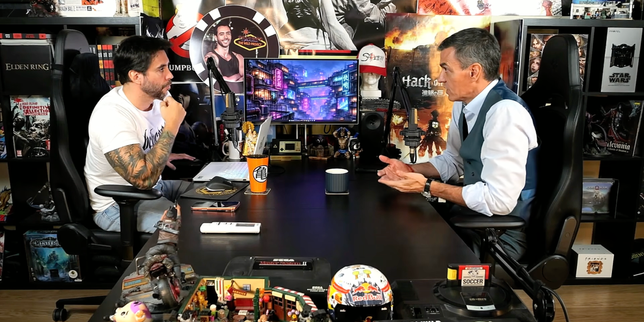
The studio lights in a Madrid bedroom do not look like the fluorescent glare of the Congress of Deputies. They glow purple and cyan, bouncing off acoustic foam panels and a custom-built gaming rig. On the screen, a twenty-something streamer adjusts a pair of oversized headphones, takes a sip from an energy drink, and glances at a chat window scrolling faster than a stock ticker. Sitting across from him, awkwardly perched on an ergonomic racing chair, is a man in a tailored navy suit who wants to run the country.
Pause. Look at the absurdity of that frame.
For decades, the path to the Moncloa Palace—the official residence of the Spanish Prime Minister—ran exclusively through the polished desks of evening news anchors, the front pages of El País or El Mundo, and the thunderous, rehearsed applause of massive bullring rallies. Politicians spoke from podiums. Journalists asked sharp, pre-vetted questions. Voters watched from their living room sofas, separated from power by a thick sheet of broadcast glass.
That glass shattered during Spain’s recent electoral cycles.
When Spanish political candidates began knocking on the doors of YouTubers and Twitch streamers, traditional political commentators scoffed. They saw a cheap stunt, a desperate bid for relevance by aging party machines trying to look hip for the TikTok crowd. They missed the point entirely. This was not a publicity gimmick. It was a surrender—a quiet, seismic admission that the old temples of democratic persuasion had emptied out, and the congregation had moved to the internet.
The Empty Living Room
To understand why a presidential candidate would willingly submit to a two-hour live broadcast hosted by a guy famous for commenting on Minecraft tournaments or viral memes, you first have to step inside a hypothetical Spanish apartment on a Tuesday night.
Meet Mateo. He is twenty-three, holds a degree in graphic design he cannot quite use, and shares a cramped flat in Valencia with two roommates because the rent on a one-bedroom eats seventy percent of an entry-level salary. Mateo does not own a television antenna. He has never bought a physical newspaper. When the evening news comes on at nine o'clock, Mateo is wearing noise-canceling headphones, watching Ibai Llanos—one of Spain’s most influential digital creators—host a charity boxing match or dissect internet drama with millions of concurrent viewers.
If a politician buys a million-euro ad spot during the halftime of a Champions League match, Mateo is scrolling through his phone. If a candidate delivers a fiery speech in the parliament, Mateo only sees it if someone edits the most embarrassing ten seconds into a vertical video with clown music playing underneath.
I remember watching the 2023 Spanish general election unfold from a café in Madrid, struck by the sheer disconnect between the loud, aggressive posters plastered on every bus stop and the absolute silence about politics among the young people sitting at the tables around me. The traditional campaign was shouting into a void. Political strategists looked at their polling data and saw a terrifying cliff: millions of first-time and young voters were completely unreachable through legacy media. They were not necessarily apathetic; they were simply living in a different informational universe.
To reach Mateo, the mountain had to come to the bedroom.
The Architecture of Intimacy
Think of traditional political journalism as a courtroom cross-examination. The journalist acts as a prosecutor on behalf of the public, pressing the candidate for exact figures, catching them in contradictions, and forcing them to defend past failures within strict three-minute segments. It is adversarial by design, built to test a leader’s resilience under pressure.
Now, picture a YouTube podcast or a Twitch stream as a late-night kitchen table conversation after the guests have gone home.
There are no commercial breaks. There is no producer whispering into an earpiece to wrap things up because the weather report is next. The conversation stretches for ninety minutes, two hours, sometimes three. In that expanse of unedited time, the rehearsed talking points—the armor every modern politician wears—begin to feel heavy and artificial. You cannot sustain a stump speech for two hours while sitting across from someone wearing a hoodie who just asked you what you eat for breakfast or how you handle anxiety.
This is the secret weapon of the creator economy, and Spanish politicians realized it faster than almost anyone else in Europe. Creators like Jordi Wild, whose podcast The Wild Project regularly pulls millions of views, or the late-night conversationalists of La Resistencia and Club 113, possess something television networks have spent billions trying to manufacture and failed: parasocial trust.
When a viewer watches a YouTuber for five years, they feel they know the host's moral compass, sense of humor, and bullshit detector. When that host invites a political leader—whether from the progressive left like Yolanda Díaz, the socialist establishment like Pedro Sánchez, or the conservative right like Alberto Núñez Feijóo and Santiago Abascal—into their space, the host’s credibility rubs off on the guest by proxy. The audience thinks, If my favorite creator is willing to sit down and laugh with this person, maybe they aren't the monster the headlines make them out to be.
The Invisible Rules of the New Arena
Stepping into a YouTuber’s studio, however, is not a guaranteed victory lap. It is a high-wire act without a net, governed by unwritten rules that trip up politicians trained in the rigid choreography of parliament.
Consider what happens when a candidate treats a podcast like a press conference. The audience smells the phoniness instantly. In the live chat, thousands of comments erupt in real time, mocking the politician’s stiff posture, their evasive answers, or their sudden, unnatural use of youth slang. On traditional television, a bad performance is quietly forgotten by the next news cycle. On YouTube, a cringeworthy moment is clipped, remixed, and immortalized in the algorithm forever.
During Spain’s municipal and general campaigns, the candidates who survived—and thrived—were those willing to drop the mask of infallibility. When Pedro Sánchez appeared on podcasts like La Pija y la Quinqui, hosted by two sharp, irreverent twenty-somethings, he didn't spend the hour reciting macroeconomic growth charts. He talked about Taylor Swift, his favorite music festivals, and the bizarre reality of living inside a security bubble. Critics on the right accused him of trivializing the presidency. Yet, within hours, clips of the interview were circulating wildly across WhatsApp groups and Instagram stories among voters who had previously viewed him as a distant, cold technocrat.
It was a masterclass in humanization. By answering silly questions seriously and serious questions casually, he bypassed the cynicism that usually greets politicians.
Across the ideological aisle, figures from Vox and the Partido Popular pursued similar strategies, appearing on gaming streams, fitness podcasts, and long-form YouTube interviews to project an image of unfiltered authenticity. They understood a fundamental truth of modern attention: people do not vote for bullet points on a manifesto. They vote for a vibe, a perceived alignment of values, and a sense that a leader actually sees them.
What Gets Lost in the Stream
Yet, as someone who has watched this shift transform public discourse, I cannot shake a lingering unease. Every new medium solves an old problem while quietly inventing a dangerous new one.
When journalism gives way to content creation, accountability becomes collateral damage.
A YouTuber is an entertainer, a conversationalist, and an entrepreneur whose livelihood depends on keeping the audience engaged and maintaining good relationships with high-profile guests. Most creators are not investigative reporters. They do not have a team of fact-checkers verifying a candidate's claims about regional healthcare budgets or youth unemployment statistics in real time. They rarely have the institutional backing—or the professional mandate—to corner a politician on a scandal and refuse to let go until the truth emerges.
Let us return to Mateo in his Valencia apartment. Suppose he watches a two-hour interview with a charismatic candidate on his favorite YouTube channel. The candidate is funny, empathetic, and shares Mateo’s frustration about housing prices. The host nods along, cracks a joke, and moves on to a story about the candidate’s dog. Mateo closes his laptop feeling informed, connected, and ready to cast his ballot.
What Mateo did not hear were the follow-up questions about how that candidate’s party actually voted on rent control six months earlier. He did not see the contradiction between the candidate’s promises and the actual budget deficits. Because the conversation felt so intimate, so free of traditional media bias, Mateo’s critical guard was completely down.
History offers a sobering warning here. In 1960, when John F. Kennedy and Richard Nixon stepped onto a television stage for the first televised presidential debate in the United States, radio listeners thought Nixon won on policy, while television viewers declared Kennedy the victor because he looked calm, tanned, and telegenic. The medium did not just transmit the message; it became the message.
Spain’s migration from television studios to YouTube bedrooms is the twenty-first-century sequel to that night in 1960. We have traded the polished, studio-lit telegenic politician for the relatable, unscripted, podcast-friendly politician.
The New Gatekeepers of Democracy
The old gatekeepers—the newspaper editors, the broadcast directors, the party elders—had plenty of flaws. They were often elitist, slow to adapt, and beholden to corporate or partisan interests. Watching their monopoly crumble carries a certain poetic justice.
Still, power never vanishes; it merely changes hands. The new gatekeepers of Spanish democracy are thirty-year-old men and women sitting behind microphones in suburban home studios, flanked by neon signs and sponsored energy drinks. Their algorithms decide which voices are amplified to millions and which are buried in obscurity. Their personal rapport with a candidate can soften a hardliner's image overnight or rescue a faltering campaign from irrelevance.
Politicians will not stop coming to these rooms. The incentives are far too powerful, and the audience is far too large to ignore. In future elections, a candidate who refuses to sit down with top digital creators will be committing political suicide, much like a candidate in the 1980s refusing to appear on television.
The challenge now falls not on the politicians, nor even on the YouTubers, who are simply doing what they have always done: hitting record and keeping the conversation flowing. The burden rests on the viewer watching through the glow of a laptop screen late at night, forced to distinguish between a genuine leader and someone who simply knows how to wear a pair of headphones well.
The red recording light blinks on in a bedroom in Madrid, the microphone levels settle into the green, and across the desk, a person who wants to write the laws of the land leans forward, smiles, and waits for the stream to go live.


