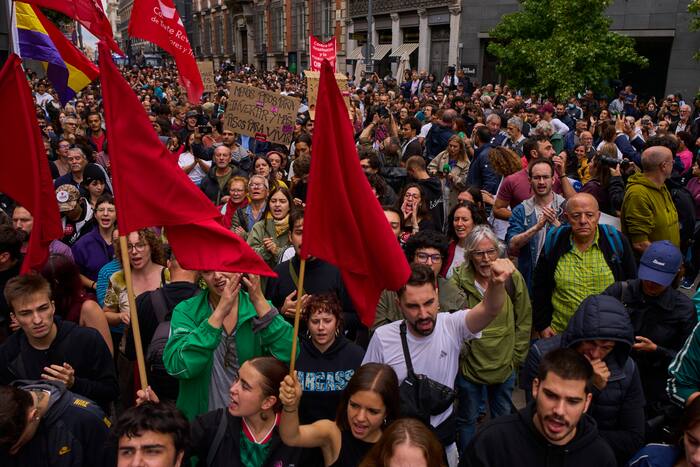
You cannot spend a week walking through Madrid or Barcelona right now without running headfirst into the anger. When an 87-year-old woman named Maricarmen was forced from her home, it didn't just spark local outrage; it lit a match under a powder keg that had been pressurized by a decade of surging costs. Rents across Spain doubled over the last ten years, swallowing nearly every euro a young worker brings home. People are sick of watching their paychecks vanish into the pockets of landlords and speculative funds. They took their fury straight to the steps of Parliament, demanding answers while emergency housing decrees collapsed inside the legislative chamber.
If you want to understand why Spanish streets turned into a sea of protest tents and red flags, you have to look at the raw numbers. In major cities, average monthly rents hit €1,176, consuming roughly 98 percent of an average young person's salary. That is not a housing market; that is an eviction machine. When Prime Minister Pedro Sánchez's minority government scrambled to push through emergency decrees featuring rent caps, short-term rental taxes, and temporary bans on evicting vulnerable tenants, the political opposition blocked them. Conservative parties and regional critics argued that freezing prices and restricting supply would only choke the market further, pitching a massive building spree instead. Also making news in this space: The Marriage of Convenience That Could Break British Politics.
That legislative deadlock shattered the fragile political stability and triggered a snap general election.
Why Emergency Decrees Keep Failing
Politicians love a quick fix, but emergency housing decrees rarely survive a hostile parliament intact. When the government tried to force through sweeping protections—including automatic contract renewals that would penalize landlords heavily for breaking leases—the center-right and regional blocks struck back. Critics claimed that forcing owners to keep tenants indefinitely or face punishing payouts would backfire, causing landlords to pull properties off the market entirely and send prices skyrocketing even higher. Additional details regarding the matter are covered by Reuters.
You cannot legislate affordability into existence without fixing the underlying supply shortage. Real estate investors and vulture funds smelled blood in the water years ago, treating urban apartments like stock portfolios. Meanwhile, everyday citizens are left sleeping in tent cities in Puerta del Sol, wondering how a roof over their heads became a luxury item.
The Political Fallout and What Happens Next
The refusal of parliament to pass these measures didn't just stall a bill; it forced a high-stakes political gamble. Prime Minister Sánchez faced a massive nationwide walkout called by major unions, pushing his administration to tweak and re-table parts of the rejected legislation through narrower caretaker bodies just to salvage some form of rent control and eviction protection. Yet, conservative leader Alberto Núñez Feijóo and the People's Party have made it clear they plan to repeal these interventions entirely if they win power, promising instead to slash red tape and back the construction of one million new homes.
This battle goes beyond a typical partisan brawl. It exposes the brutal reality facing modern European cities where tourism, short-term rentals like Airbnb, and foreign capital have turned urban centers into playgrounds for the wealthy. Until local governments find a way to balance genuine tenant protection with sustainable, long-term construction that ordinary people can actually afford, the protest camps won't disappear. The anger in the streets is real, and the ballot box is only the next battleground in a war over where working people are supposed to live.