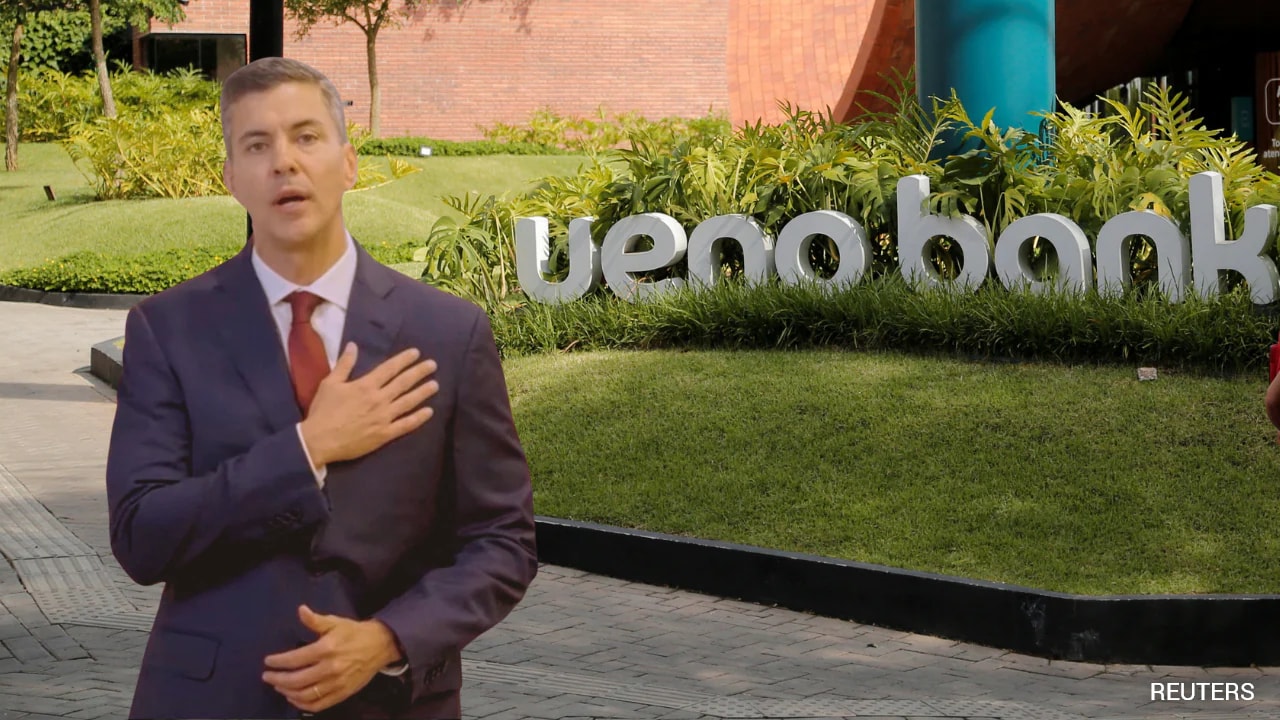
When a sitting head of state holds direct financial equity in a rapidly expanding domestic financial institution, the boundary between sovereign regulatory authority and private capital accumulation collapses. The political crisis surrounding Paraguayan President Santiago Peña and Ueno Bank demonstrates how structural conflicts of interest erode institutional credibility, even in an economy posting strong macroeconomic indicators. Rather than an isolated public relations failure, the episode represents a classic principal-agent breakdown in emerging-market governance, where executive proximity to state-managed liquidity creates asymmetric advantages for a single private entity.
The Structural Architecture of the Conflict
To evaluate the mechanics of the Ueno Bank controversy, one must examine the intersection of executive power, public pension capital, and rapid banking consolidation. Santiago Peña, an economist with prior tenure at the International Monetary Fund and the Central Bank of Paraguay (BCP), entered office in August 2023 on a platform emphasizing institutional modernization and foreign direct investment. Prior to assuming the presidency, Peña held an equity stake in Grupo Vázquez, the holding company controlling Ueno—an entity that transitioned from a finance company into a full-fledged commercial bank in late 2023.
The governance friction stems from three interconnected structural vectors:
- Direct Equity Exposure and Divestment Timing: Upon taking office, Peña’s mandatory asset declarations revealed significant holdings in bonds and shares linked to the financial group. While executive assets may be placed in administrative trusts or divested over time, the initial overlap between Peña’s presidential inauguration and Ueno Bank’s regulatory approval to scale operations created an immediate perception of regulatory capture.
- State Liquidity Allocation: The primary operational accelerant for any commercial bank in a developing market is access to low-cost, long-term deposits. In Paraguay, the Instituto de Previsión Social (IPS)—the state social security and pension fund—represents the single largest pool of institutional liquidity. Investigations and public disclosures revealed substantial transfers of IPS funds into Ueno Bank certificates of deposit and financial instruments shortly after the administration took office.
- Asymmetric Regulatory Enforcement: A sitting president appoints the leadership of the Central Bank of Paraguay and the Superintendency of Banks. When a commercial bank tied to the executive branch absorbs a major competitor—specifically Ueno’s merger with Visión Banco, which created the largest bank in Paraguay by customer count—competing institutions face a market environment where the regulator’s independence is structurally compromised.
The Mechanics of State-Linked Capital Concentration
In standard banking economics, commercial institutions compete for deposits by offering higher interest rates to savers or superior digital infrastructure. When state-controlled entities like the IPS allocate massive liquidity reserves to a specific private bank, that institution bypasses traditional market friction.
The mechanism operates through a straightforward balance-sheet advantage:
- Cost of Funds Compression: Institutional deposits from state pension funds provide predictable, large-scale capital blocks. Securing these funds reduces the bank's reliance on expensive retail deposit acquisition or international debt issuance.
- Accelerated Lending Capacity: Armed with state-backed liquidity, the institution can aggressively expand its loan portfolio, capture market share from legacy competitors, and finance corporate acquisitions.
- Valuation Expansion: Rapid growth in assets under management and customer base inflates the underlying equity valuation of the holding company, directly benefiting its shareholders—including those connected to the political establishment.
Critics and opposition lawmakers framed these capital movements not as standard treasury management by the IPS, but as a directed transfer of public risk to underwrite private equity growth. Defenders of the administration argued that Ueno Bank offered competitive yields and possessed the digital infrastructure required to modernize state payment disbursements, such as social welfare subsidies and public sector payrolls. However, in governance analysis, the commercial viability of the vendor does not neutralize the conflict of interest if the procurement process lacks transparent, arm’s-length competition.
The Political Cost Function for a Technocratic Executive
Santiago Peña’s primary political capital, both domestically and among international credit rating agencies, rested on his reputation as a disciplined technocrat. Unlike traditional populist leaders in Latin America, Peña’s value proposition to global investors was institutional predictability, fiscal restraint, and adherence to orthodox monetary policy.
The Ueno Bank scandal imposed a severe cost function on this technocratic brand through three distinct channels:
1. Erosion of Institutional Credibility
In July 2024, Moody’s Ratings upgraded Paraguay’s sovereign credit rating to Baa3, granting the country investment-grade status for the first time. That upgrade was predicated on sustained economic growth and institutional reforms. However, investment-grade status requires continuous validation of the rule of law and regulatory independence. When domestic media and political opponents documented the overlap between the president’s financial disclosures, state contracts awarded to Ueno for digital payment processing, and IPS liquidity injections, it introduced a governance risk premium. Foreign institutional investors scrutinize whether domestic markets operate on meritocratic competition or crony capitalism.
2. Fracturing of the Ruling Coalition
Paraguay’s political system is dominated by the Colorado Party (ANR), yet internal cohesion depends on the distribution of state patronage and political leverage among competing factions. Peña’s political authority relies heavily on the backing of former President Horacio Cartes, the party’s president, who himself faces severe financial sanctions from the United States government. When Peña became embroiled in a personal financial conflict of interest, his autonomous leverage within the Colorado Party diminished. A weakened executive becomes increasingly dependent on party hardliners in Congress to block impeachment inquiries or investigative committees, forcing policy concessions that dilute his technocratic agenda.
3. Public Trust and Asymmetric Optics
Paraguay faces persistent deficits in public healthcare, education, and infrastructure—sectors directly tied to the solvency and efficiency of the IPS. While pensioners faced medicine shortages and administrative delays at IPS facilities, public reporting highlighted hundreds of millions of dollars in IPS funds flowing into a bank linked to the president. In political risk analysis, the juxtaposition of public service deterioration alongside private financial enrichment creates acute social volatility. Even when financial transactions adhere strictly to existing banking statutes, the failure to anticipate the political optics of state-fund allocation triggers severe reputational damage.
Distinguishing Verified Facts from Analytical Hypotheses
Rigorous assessment requires separating documented public records from broader political hypotheses:
- Verified Facts: President Peña’s sworn asset declarations confirmed prior equity and bond holdings in Grupo Vázquez. The Central Bank of Paraguay authorized Ueno’s transition to a commercial bank and its subsequent merger with Visión Banco. The IPS placed substantial financial deposits in Ueno Bank instruments, and state agencies utilized Ueno’s digital platform for public disbursements. Peña subsequently announced the divestment of his shares in the financial group in response to mounting public pressure.
- Analytical Hypotheses: Whether the executive branch directly instructed IPS administrators to favor Ueno Bank over competing tier-one institutions remains an inference drawn by political opponents and investigative journalists rather than a legally adjudicated fact. Similarly, whether the financial arrangements constitute actionable illicit enrichment under Paraguayan law depends on judicial bodies whose independence is frequently contested in domestic politics.
Limitations of Remedial Divestment
Peña’s decision to liquidate his equity stake in Grupo Vázquez was a necessary tactical response to contain political fallout, yet divestment alone is an incomplete remedy for structural governance failure.
First, retroactive divestment does not unwind existing market advantages. By the time an executive sells shares in a favored enterprise, the entity may have already secured permanent market share, completed transformative mergers, and locked in multi-year state service contracts. The equity sale captures the appreciated value generated during the period of proximity to power.
Second, informal networks persist beyond formal ownership. In concentrated economies with small business elites, financial and political alliances operate through family ties, shared board memberships, and mutual political financing. Removing a name from a shareholder registry does not automatically sever the alignment of incentives between state regulators and dominant market actors.
Third, weak statutory frameworks invite recurrence. Paraguay’s conflict-of-interest legislation—specifically laws governing "revolving doors" and asset declarations—historically lacked rigorous enforcement mechanisms and clear blind-trust mandates prior to inauguration. Without statutory reform, governance standards rely entirely on the voluntary restraint of individual officeholders.
Strategic Framework for Institutional Risk Mitigation
For sovereign policymakers, institutional investors, and corporate boards operating in emerging markets, the Ueno Bank episode establishes clear operational mandates to prevent governance contagion:
- Mandatory Pre-Inauguration Blind Trusts: Public officials entering executive or regulatory roles must transfer all liquid and illiquid financial holdings into independently managed blind trusts prior to assuming office, with full liquidation required for equity in state-regulated sectors such as banking, telecommunications, and energy.
- Algorithmic Allocation of Public Liquidity: State pension funds and sovereign treasuries must replace discretionary deposit placement with transparent, rule-based auction mechanisms. Liquidity allocation should be governed strictly by automated risk-weighted yield thresholds, capital adequacy ratios, and diversification caps that prevent any single commercial bank from holding a disproportionate share of public reserves.
- Cooling-Off Periods for State Contracting: Financial institutions in which a senior public official held a material stake within the preceding five years should face a statutory moratorium on bidding for new state payment-processing contracts or treasury management mandates.
Institutional investors evaluating sovereign debt or direct equity in high-growth frontier markets must weight governance architecture alongside macroeconomic fundamentals. Fiscal discipline and GDP growth cannot insulate an administration when executive financial interests intersect with state capital allocation.