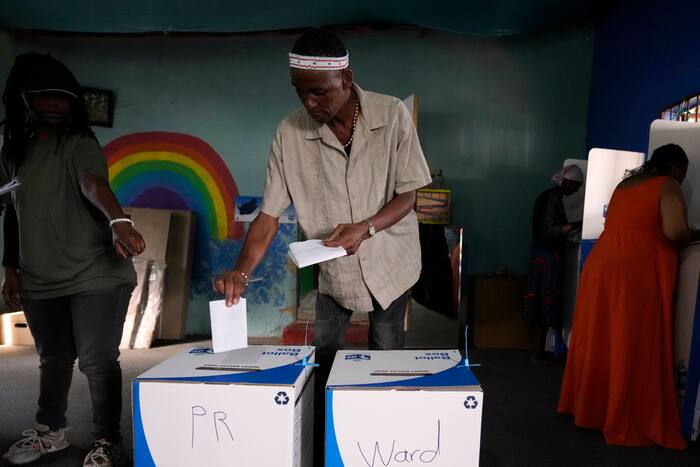
The ground shifted under South African politics, and it isn't moving back.
In the latest municipal elections, the African National Congress (ANC) suffered a historic defeat, pulling in roughly 31% to 32% of the national vote. Compare that to 2021 when they secured 47.5%, or the mid-2000s when they routinely swept over 60% of ballots. Five years ago, the party barely held onto its majority in key metros; now, it doesn't even hold the top spot in several major economic hubs. For a different look, see: this related article.
Most political commentators talk about this crash like it's a sudden, shocking event. They blame recent scandals, internal party infighting, or voter fatigue. But that reading misses the big picture.
This drop wasn't a sudden collapse. It's the logical result of two decades of economic stagnation, collapsing local services, and a fundamental splitting of the electorate. Related coverage on this trend has been provided by TIME.
The Broken Link Between Growth and Votes
If you want to understand why millions of South Africans stopped marking their ballots for the ANC, don't start with political speeches. Start with municipal tap water, rolling blackouts, and unemployment checks.
For the first fifteen years after 1994, the ANC's political dominance rested on a simple, powerful promise: tangible improvement. Between 1994 and 2008, expanding public infrastructure and rising economic growth created real jobs. Millions of households got access to electricity grids, clean water, and social grants for the first time. Voters rewarded the party accordingly.
Then investment stalled.
As infrastructure aged and municipal maintenance fell apart, local governance turned into a daily hassle for working-class families. Sewerage spills in townships became routine. Potholes went unfixed for years. Piped water stopped flowing in rural municipalities across the Eastern Cape and Free State.
Economic research shows a direct line between falling capital investment, slowing job creation, and the sharp decline in ANC support. When people can't count on running water or a steady paycheck, liberation history loses its magic.
The Black Voter Base Is Fragmenting
For decades, the ANC operated as a big-tent movement that absorbed nearly every segment of South Africa's Black electorate. That broad coalition is gone.
Instead of defecting to a single alternative, voters broke off in multiple directions based on age, region, and class:
- uMkhonto weSizwe (MK) Party: Jacob Zuma’s party carved up the ANC’s base across KwaZulu-Natal and parts of Gauteng. In KZN, MK became the largest party in 20 out of 44 municipalities, taking 34% of the provincial ward vote and reducing the ANC to just 20.5%.
- Democratic Alliance (DA): The main opposition party lifted its share to around 23-25% nationally. It gained ground by pitching municipal efficiency, running aggressive voter turn-out campaigns, and picking up urban voters fed up with council mismanagement.
- ActionSA and the Patriotic Alliance: Herman Mashaba's ActionSA tripled its presence in key Gauteng metros like Johannesburg and Tshwane, while the PA consolidated votes in Coloured working-class communities.
- Economic Freedom Fighters (EFF): Though the EFF's vote share dipped slightly to around 6%, it remains a vocal power broker in council chambers.
The result is a fractured electorate where no single party can claim a mandate to govern alone.
Hung Councils Are the New Reality
Back in 2021, 79 municipalities ended up in hung councils without a single-party majority. After this vote, that number jumped to 139 out of 213 councils. Seven of South Africa's eight metropolitan areas now require coalitions to form a local government.
In economic centers like eThekwini (Durban) and Johannesburg, the council seat math is brutally complicated:
In eThekwini, MK leads with 86 seats, followed by the DA with 57, the ANC with 37, and the IFP with 15. To reach the 112 seats needed for a working majority, the ANC has to choose between partnering with Zuma's MK party or forming a multi-party deal alongside the DA and IFP.
In places like Mogale City on the West Rand, major parties couldn't even agree on electing a speaker during their first council sittings, choosing instead to delay meetings to buy time for backroom negotiations.
This dynamic forces bitter political enemies into forced marriages. It makes passing city budgets, appointing city managers, and approving maintenance contracts an ongoing political headache.
What This Means for Businesses and Local Services
If you operate a business, manage property, or invest in South Africa, this election changes how you interact with local government.
When city councils flip between unstable coalitions every few months, administrative continuity vanishes. Procurement decisions get bogged down in political disputes. Municipal managers appointed by an outgoing coalition often face immediate scrutiny or removal when new alliances take power.
To navigate this environment, keep these practical steps in mind:
- Audit Municipal Supply Contracts: Incoming coalition governments routinely audit existing municipal contracts to expose irregularities left by previous administrations. Ensure your compliance documentation, tax clearances, and delivery records are clean.
- Engage Cross-Party Committees: Don't rely on relationships with a single political party or mayor. Build ties across municipal oversight committees and civil service department heads who remain in place when political leadership shifts.
- Plan for Infrastructure Self-Reliance: Given the ongoing gridlock in council chambers, local service delivery improvements will be slow. Businesses should continue investing in private water storage, localized waste management, and off-grid power installations rather than waiting for municipal turnarounds.
The era of a single party dominating South African politics is over. Coalition governance at the municipal level isn't a temporary phase; it's the permanent rules of the game.
South Africa local elections analysis
This video provides concise news coverage summarizing the election results and key coalition dynamics straight from the official election reporting.


